
Lead
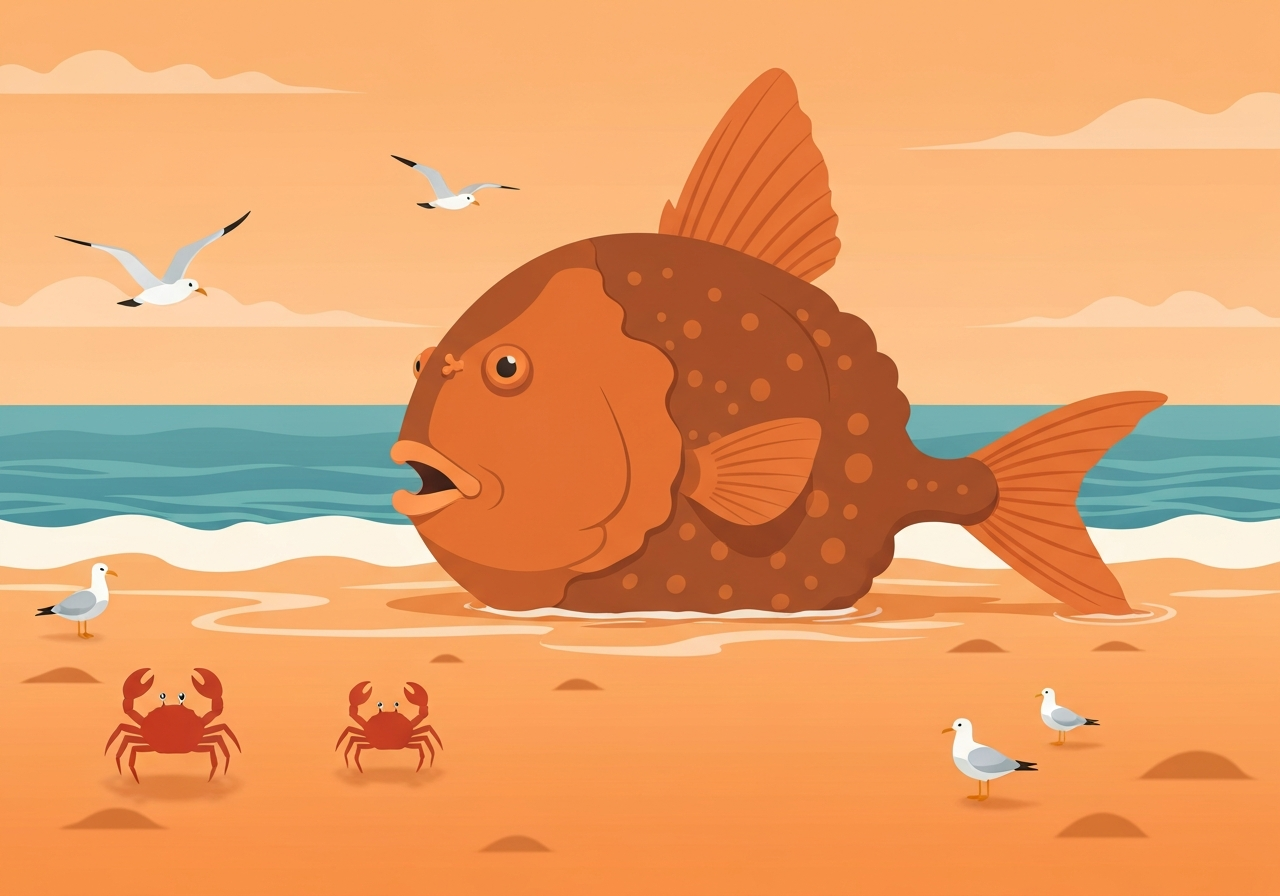
On a wind-brushed Sunday in September at Doran Regional Park, Bodega Bay, Sonoma State University professor Stefan Kiesbye discovered an unusually large, slab-shaped fish during a routine beach cleanup. The animal measured roughly six feet long and three feet across and was later identified by experts as Mola tecta, the rarely seen “hoodwinker” sunfish. The stranding—uncommon for this species in Northern Hemisphere waters—prompted immediate interest from researchers and local responders. The find raises fresh questions about sunfish movements and the limits of known species ranges.
Key Takeaways
- The specimen was found at Doran Regional Park, Bodega Bay, Northern California, on a Sunday in September; discoverer: novelist and Sonoma State professor Stefan Kiesbye.
- Measured about 6 feet (1.8 m) long and 3 feet (0.9 m) across; experts identified it as Mola tecta, described scientifically in 2017.
- Mola tecta (hoodwinker) is considered among the world’s rarest sunfish and was previously documented mainly in Southern Hemisphere currents such as the Humboldt Current.
- Some ocean sunfish relatives can reach enormous masses—up to about two tons—underscoring the ecological significance of pelagic strandings.
- Strandings provide useful data—size, condition, and GPS-tagged location—that feed distribution maps and genetic studies when collected responsibly.
- Possible causes of stranding include shifting currents, storms, injuries, parasites, or vessel strikes, but no definitive cause has been determined for this individual.
- Local responders and beachgoers were urged to record location/time, keep distance, photograph key features, and contact authorities rather than attempt to return the animal to sea.
Background
Sunfishes of the genus Mola are large, laterally compressed pelagic fish found in many of the world’s oceans; however, some species remained undescribed by science until recently. Mola tecta was formally recognized by researchers in 2017, earning the common name “hoodwinker” because it had been overlooked in museum collections and at sea. Historically, records of Mola tecta clustered in cooler Southern Hemisphere waters, particularly those influenced by the Humboldt Current off South America.
Marine strandings have long served as an opportunistic source of data for pelagic species that are otherwise difficult to study. Because large, open-ocean fishes spend much of their lives offshore, strandings—whether caused by environmental stress, disease, injury, or disorientation—give scientists rare direct access to body condition, parasites, and tissue for genetic sampling. Local stewards, citizen scientists, and coordinated stranding networks increasingly act as first observers and communicators for such events.
Main Event
On the morning of the discovery, Kiesbye was conducting a regular shoreline cleanup when he found the unusually shaped carcass near the western edge of Doran Beach. The animal’s slab-like profile and absence of pinniped features quickly suggested it was not a sea lion or seal. Photographs and measurements taken on scene were shared with regional authorities and marine biologists to aid identification.
Specialists reviewing the images and measurements identified the fish as Mola tecta. The hoodwinker differs from the more familiar Mola mola in having a smoother, sleeker silhouette without the pronounced head bumps or chin-like protrusions that adult Mola mola often display. Those morphological distinctions, together with geographic context, guided the preliminary identification.
Responders followed standard protocols: they recorded the exact location and time, documented multiple photo angles, kept a respectful distance, and notified regional stranding contacts. Trained personnel assessed the animal for salvage, tissue sampling, and documentation to contribute to distributional records and any possible necropsy work.
Analysis & Implications
This stranding challenges assumptions about the hoodwinker’s geographic limits. Researchers previously associated Mola tecta primarily with Southern Hemisphere currents such as the Humboldt Current, with records extending north to Peru. Finding one at Bodega Bay implies occasional long-distance movements across ocean basins or episodic northward transport via currents or anomalous oceanographic conditions.
From an ecological perspective, such strandings could indicate changing ocean dynamics. Shifts in current strength, sea surface temperature, or prey distributions can alter the movement patterns of large pelagic species. However, a single stranding is a limited data point; it can signal an important anomaly or an infrequent but natural dispersal event. Interpreting its cause requires combining this observation with longer-term sighting, bycatch, and genetic data.
For conservation and monitoring, the event underscores the value of coordinated citizen-science networks and rapid reporting. Samples and well-documented strandings feed genetic analyses that can reveal population structure, connectivity across basins, and whether northern occurrences represent isolated vagrants or previously under-detected populations. Policy implications include strengthening response capacity and encouraging systematic data collection on beaches.
Comparison & Data
| Feature | Mola tecta (hoodwinker) | Mola mola (ocean sunfish) |
|---|---|---|
| Typical documented range | Primarily Southern Hemisphere records; linked to Humboldt Current to Peru (recent Northern Hemisphere stranding at Bodega Bay) | Widespread in temperate and tropical oceans worldwide |
| Notable identifying traits | Smoother body profile, no pronounced chin or head bumps | Often shows head/chin bumps and a rougher head profile |
| Size (examples) | This specimen ~6 ft × 3 ft; species relatives can be very large | Relatives and adults reported up to about 2 tons in mass |
While the table summarizes broad contrasts, the record at Bodega Bay provides a localized data point: documented length and precise GPS-tagged location contribute to continental-scale distribution models. Researchers will combine these measurements with tissue samples and historical records to refine maps of occurrence and investigate timing relative to oceanographic anomalies.
Reactions & Quotes
Scientists and local stewards expressed both surprise and a cautious scientific curiosity. The find prompted rapid sharing of photographs and measurements to marine biologists tracking sunfish distributions.
“We know that Mola tecta is present in the Humboldt Current off South America, up to Peru in the north, but we didn’t think they crossed the warm equatorial belt, at least not very often.”
Dr. Marianne Nyegaard (sunfish specialist)
Rescue and stranding guidance reiterated safe-public practices and the value of careful documentation for scientific use.
“Record the exact location and time, using your phone’s GPS if possible.”
Stranding-response guidance (regional network)
Unconfirmed
- Whether this individual represents a one-off vagrant or evidence of a recurring, yet undocumented, northward movement by Mola tecta is not established.
- No confirmed cause of death has been released; hypotheses (currents, storms, injury, parasites, vessel strike) remain speculative until necropsy results are available.
Bottom Line
The Bodega Bay stranding of a Mola tecta at Doran Regional Park is a scientifically valuable event that widens the set of observations available for a recently described, rarely recorded species. While a single strand cannot redefine species range by itself, it functions as an important prompt: to re-examine movement models, increase sampling in understudied regions, and maintain robust community-science reporting networks.
For beachgoers and local stewards, the episode is a reminder that shorelines can become frontline observation posts for ocean change. Responsible documentation and quick notification to stranding networks turn surprising finds into data that improve our understanding of ocean life across hemispheres.
Sources
- Iowa Park Leader — local news report on the Bodega Bay sighting (news)
- Mola tecta (hoodwinker) — species summary and references (encyclopedic)
- Doran Regional Park — Sonoma County Regional Parks — park information and location (official agency)
- NOAA — Stranding-response guidance — guidance for documenting and reporting strandings (official agency)