
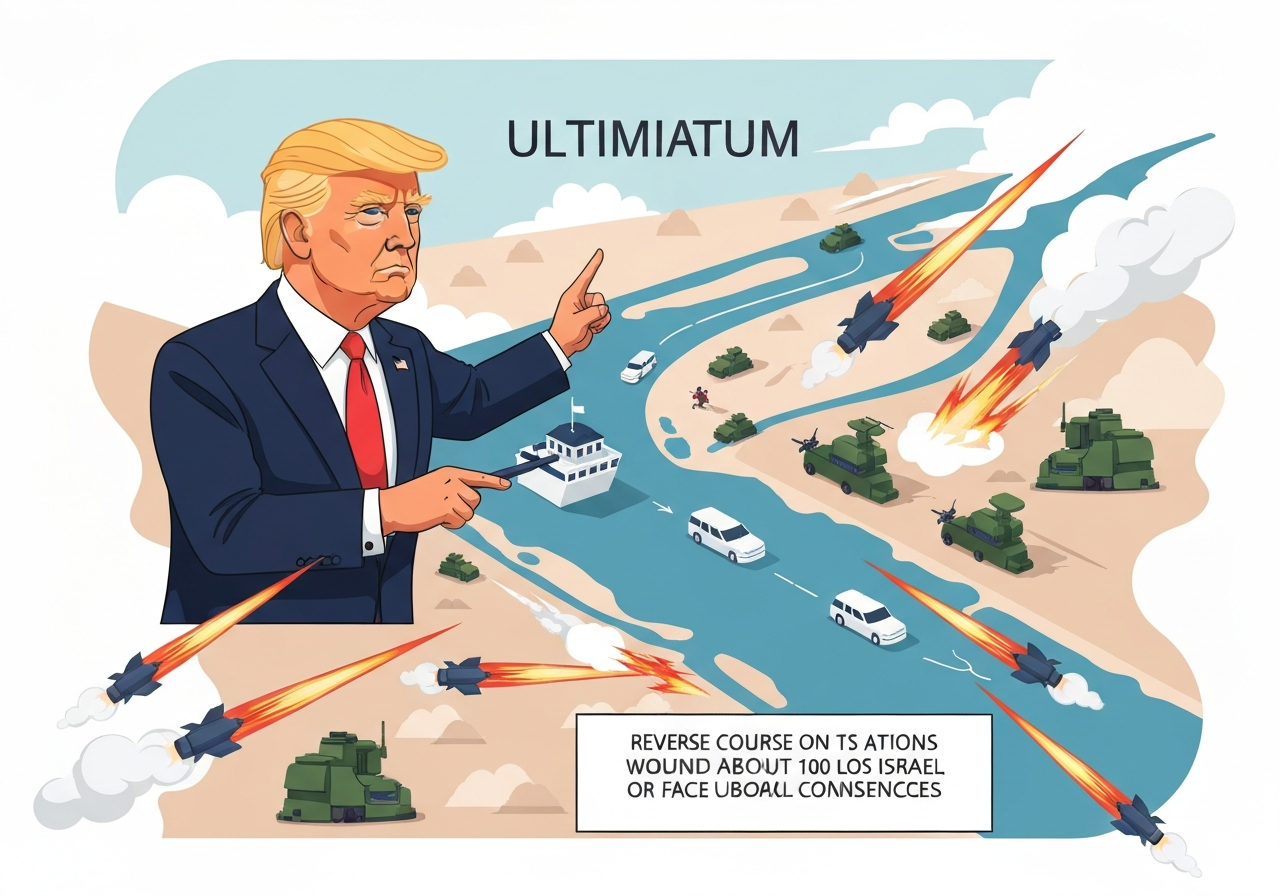
President Donald Trump on Saturday issued a 48-hour ultimatum demanding that Iran fully reopen the Strait of Hormuz, warning the United States would strike Iranian power plants if the waterway is not cleared. The statement came amid renewed exchanges of long‑range missiles and air strikes across the region that have wounded about 100 people in southern Israel and driven new diplomatic alarm. Israel reported Iranian ballistic barrages struck Arad and Dimona after some air‑defence intercepts failed; Israeli forces said they later conducted strikes in Tehran. Global markets and several regional capitals reacted swiftly to the heightened risk, with governments and international agencies urging restraint while preparing contingency measures.
Key takeaways
- President Trump set a 48‑hour deadline for Iran to reopen the Strait of Hormuz and warned the US would target Iranian power plants if the strait remains closed.
- About 100 people were wounded Saturday in southern Israel after Iranian ballistic missiles struck Arad and Dimona; 84 were taken to hospitals in Arad including 10 in serious condition and about 30 were treated in Dimona.
- The death toll from the wider conflict exceeds 1,500 in Iran and more than 1,000 in Lebanon, with at least 15 fatalities in Israel and 13 US military deaths reported by news agencies.
- Iran launched two long‑range ballistic missiles with a reported 4,000 km range toward the US‑UK base at Diego Garcia — the first use of such long‑range missiles since the conflict began on February 28.
- Saudi Arabia detected three missiles aimed at Riyadh; one was intercepted and two reportedly fell in an uninhabited area, while the UAE reported intercepting multiple incoming drones and missiles.
- The effective disruption of the Strait of Hormuz — which handles roughly one‑fifth of seaborne oil and gas — has pushed oil above $100 a barrel and sent European gas prices up as much as 35% in recent trading.
Background
Fighting intensified after US and Israeli strikes on Iran following the killing of Iran’s supreme leader, which escalated a confrontation that began in late February. Tehran has since responded with missile and drone attacks on neighbouring states and military targets linked to the US and UK, closing off normal passage through the Strait of Hormuz in practice by attacking ships and reportedly laying mines. The waterway is a strategic chokepoint for global energy flows; disruption there quickly transmits to international fuel and shipping markets.
Regional actors and some NATO members have pledged to help secure shipping lanes, but have not publicly detailed operational plans for convoying or mine‑clearance. Japan’s foreign minister said Tokyo could consider minesweeping only if a ceasefire is in place, while several countries have ordered emergency preparations for energy disruptions. Humanitarian effects have been severe: millions of people in Iran and Lebanon have been displaced and civil infrastructure has been damaged across multiple states.
Main event
On Saturday night President Trump published a demand that Iran fully reopen the Strait of Hormuz within 48 hours, saying US forces would begin strikes on Iranian energy facilities if Tehran did not comply. Iran’s military command responded that it would target US energy, information technology and desalination infrastructure if Iranian facilities were attacked, raising the prospect of strikes on civilian‑facing systems beyond purely military targets.
Iranian ballistic missiles struck the towns of Arad and Dimona in southern Israel on Saturday; Israeli authorities said multiple projectiles were not intercepted and about 100 people were wounded. First responders found damaged residential buildings, a crater roughly five metres across at the Arad impact site and fires from direct hits on vehicles. Israeli emergency services said 84 wounded were taken to hospitals in Arad, including 10 in serious condition; roughly 30 were reported wounded in Dimona.
In a brief early‑morning statement Israeli forces said they had carried out strikes in Tehran. Saudi Arabia’s ministry of defence reported detecting three missiles launched toward Riyadh, one of which was intercepted and two of which fell in an uninhabited area. The UAE ministry said its systems had intercepted multiple incoming drones and missiles in the eastern region.
The Israeli military also reported that Iran launched two ballistic missiles with a stated range of 4,000 km aimed at the Diego Garcia base in the Indian Ocean — a long‑range strike cited as the first of its kind since February 28. Maritime authorities reported an explosion close to a bulk carrier off the UAE coast, and the UK’s maritime trade operations unit logged continuing incidents around commercial shipping in the Gulf.
Analysis & implications
The ultimatum and the subsequent Iranian response increase the risk of broader regional escalation. If the United States follows through on strikes against energy infrastructure, Iran’s declared retaliation targeting US and regional energy and desalination assets could widen the conflict into attacks on civilian supply chains and essential services. That would compound humanitarian suffering and complicate any diplomatic path to de‑escalation.
Global energy markets are acutely sensitive to these developments. The effective near‑closure of the Strait of Hormuz has already pushed oil prices above $100 a barrel and sent European gas prices sharply higher, triggering policy concerns at major central banks. Traders and analysts warn that continued disruption could feed higher inflation, slow growth, and increase volatility in equity and bond markets.
Maritime insurance costs, rerouting of tankers away from Gulf passages, and cancelled shipments are already producing knock‑on effects: several oil deliveries to Australia were cancelled or deferred, and governments such as Sri Lanka have raised pump prices and altered work schedules in response to fuel shortages. Nations face a difficult choice between limited, risky interventions to reopen shipping lanes and the political and military costs of a larger coalition operation.
| Metric | Latest reported figure |
|---|---|
| Wounded in Arad & Dimona (Israel) | About 100 (84 hospitalised in Arad; ~30 in Dimona) |
| Reported regional death toll | Iran: >1,500; Lebanon: >1,000; Israel: at least 15; US military: 13 |
| Long‑range missiles launched at Diego Garcia | 2 (range reported 4,000 km / 2,500 miles) |
| Strait of Hormuz share of seaborne oil & gas | About 20% |
| European gas price spike (recent) | Up to 35% |
These figures show both the immediate human toll and economic shockwaves. Casualty and damage counts remain fluid as rescue and damage‑assessment operations continue; market indicators respond to news of each new strike or political warning.
Reactions & quotes
US, Iranian and international officials issued stark statements after the ultimatum and subsequent strikes. Below are representative remarks and the context in which they were made.
Before quoting, note the US presidential post was circulated on the president’s social platform and amplified by senior US officials as the public US position for the weekend.
“If Iran does not fully open the Strait of Hormuz within 48 hours, the United States will strike and obliterate Iranian power plants.”
Donald Trump, US President (social media post)
The president’s message marked a sudden hardening of tone after comments the previous day about reducing US military involvement, prompting allies and markets to reassess the likelihood of wider strikes.
“If Iranian fuel and energy infrastructure is violated, all energy, IT and desalination infrastructure belonging to the US and the regional regime will be targeted.”
Khatam Al‑Anbiya, Iranian military operational command (statement via Fars)
Iran’s operational command framed its warning as defensive reciprocity, signalling willingness to broaden targeting to infrastructure that supports civilian life, which heightens the humanitarian and economic stakes.
“The IAEA has not received any indication of damage to the Negev nuclear research centre near Dimona.”
International Atomic Energy Agency (official statement)
The IAEA comment seeks to reassure about nuclear safety even as conventional strikes and missile exchanges continue in the region around Dimona.
Unconfirmed
- Precise cause of the Israeli air‑defence failures that allowed missiles into Arad and Dimona is under investigation and has not been publicly confirmed.
- Attribution of every maritime explosion near the UAE and the exact number of mines laid in the Strait of Hormuz remain unverified by independent inspectors.
- Some casualty totals reported in near‑real time differ across agencies; final confirmed figures may change as hospitals and authorities update counts.
Bottom line
The 48‑hour ultimatum and Iran’s matching warnings have raised the prospect of a dangerous new phase in the conflict, where strikes on energy infrastructure could trigger retaliatory attacks on civilian systems and further destabilise global markets. The human cost is rising, with dozens wounded in Israel and thousands displaced across multiple countries; damage assessments and casualty counts remain incomplete as rescue teams continue work.
Policymakers now face a narrow window to reduce tensions: diplomatic channels, third‑party mediation and clear, verifiable steps to reopen maritime routes would lower market disruption and lessen civilian harm. If the ultimatum is not withdrawn or bridled by back‑channel diplomacy, expect continued volatility in energy markets, higher insurance and shipping costs, and an increased risk of a broader regional conflagration that would be harder to contain.
Sources
- The Guardian (live coverage) — Media: live reporting and aggregated updates
- Associated Press — News agency: casualty and field reports
- International Atomic Energy Agency (IAEA) — International agency: nuclear safety statements
- Reuters — News agency: markets and diplomatic reporting
- UK Ministry of Defence — Official: maritime and defence briefings
- Israel Defence Forces (IDF) — Official military statements