
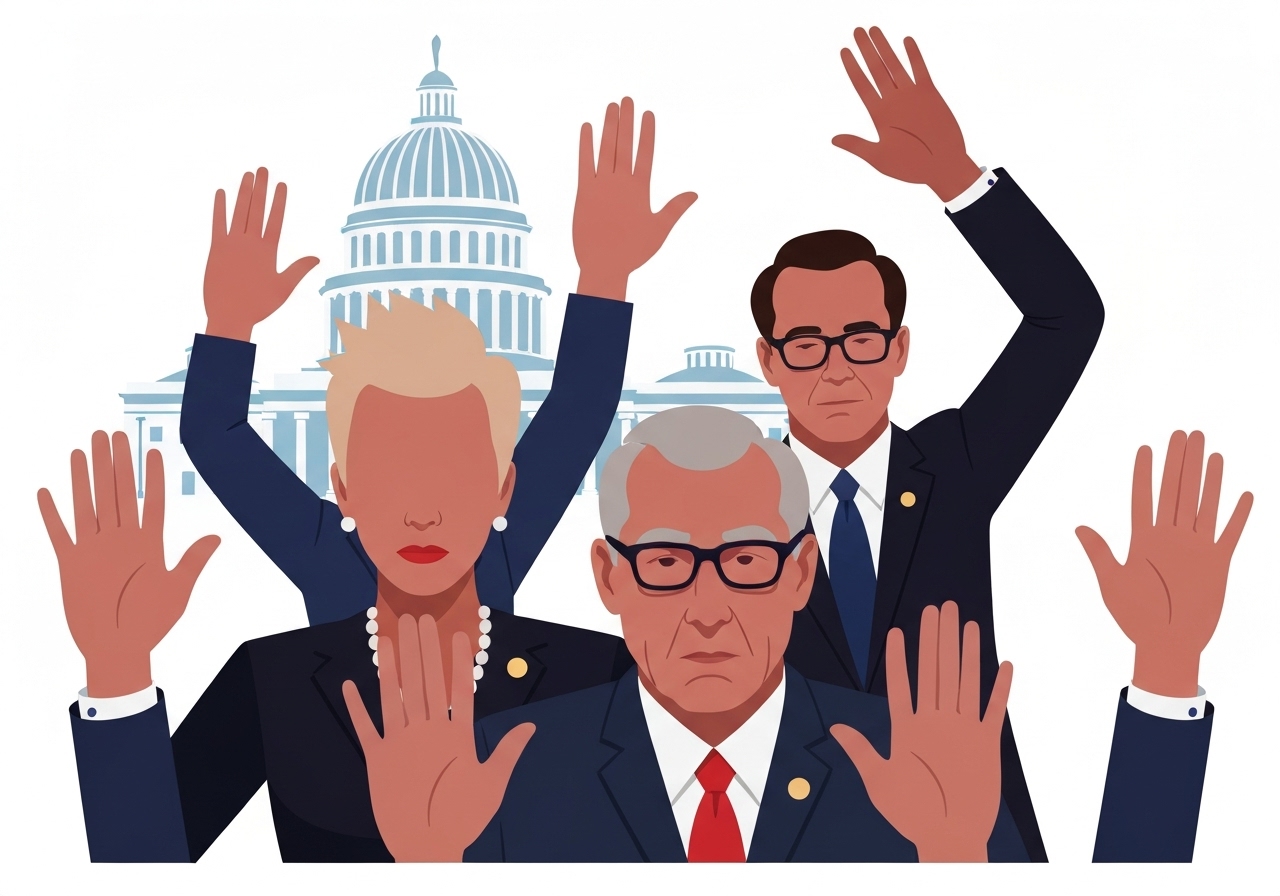
Lead: On 11 November 2025, top House Democrats pledged to oppose a stopgap spending bill that a Senate splinter group and Republicans advanced, saying it fails to extend Affordable Care Act (ACA) premium tax credits. The compromise would reauthorize government funding through January but leaves the tax credits, created under President Joe Biden and due to expire at year-end, untouched. President Donald Trump hailed the agreement as “a very big victory” during remarks at Arlington National Cemetery as the package moved to the House, where a vote was expected as early as Wednesday, 12 November 2025. The Democratic rebuke threatens a tight tally for Speaker Mike Johnson and raises the prospect of renewed shutdown risk.
Key Takeaways
- The Senate split produced a short-term funding bill that would keep government open through January 2026 but does not extend ACA premium tax credits that expire on 31 December 2025.
- House Democrats, led by Minority Leader Hakeem Jeffries, said on 11 November 2025 they will “strongly oppose” any funding measure that fails to address the healthcare tax-credit lapse.
- Speaker Mike Johnson has kept the House largely out of session for more than 50 days as leverage in negotiations, complicating the timing and math for a successful House vote.
- The Pentagon confirmed the USS Gerald R. Ford strike group entered the US Southern Command area of responsibility after an announced deployment, marking an escalation in naval presence near Latin America and the Caribbean.
- The US Supreme Court granted an administrative stay that lets the administration withhold $4 billion in SNAP funding temporarily; SNAP serves about 42 million people nationwide.
- The Federal Aviation Administration announced deeper flight reductions at 40 major airports, warning that cancellations and delays could worsen this week even if a shutdown is averted.
- The administration’s recent pardon activity and policy moves — from offshore drilling plans off California to a court challenge to the CFPB funding mechanism — have galvanized legal, political and state pushback.
Background
The immediate dispute centers on a classic budget standoff: Republicans pushed a short-term continuing resolution to prevent an immediate shutdown, while Democrats insist any stopgap must include an extension of ACA premium tax credits. Those credits, established under the Biden administration, help lower monthly premiums for millions of enrollees and are set to expire at the end of 2025, a change that Democrats say would raise premiums and increase uninsured rates.
For weeks, House and Senate negotiations have been fragmented. A Senate splinter group of Democrats joined Republicans to draft the compromise, angering party leaders who argue the deal concedes too much. Speaker Mike Johnson’s long recess strategy — leaving the House essentially sidelined for over 50 days — was intended to concentrate pressure on Senate Democrats, but it has also complicated the House’s ability to coordinate a unified response.
Main Event
Senators from a small cross-party bloc negotiated the short-term funding bill that would carry federal appropriations into January 2026 but omits an extension of the ACA premium tax credits. That move was framed by negotiators as a pragmatic stopgap to buy negotiators time, while Democrats characterize it as a political compromise that abandons working families facing rising costs.
President Trump publicly endorsed the Senate-crafted package during remarks at Arlington National Cemetery, calling the agreement “a very big victory” and saying, “We’re opening up our country. Should have never been closed.” His comments came as the legislation was formally transmitted to the House, where leadership prepared for a possible vote the following day.
On 11 November 2025, House Minority Leader Hakeem Jeffries told CNN the Democratic conference would oppose any bill that did not “decisively address the Republican healthcare crisis,” signaling unified resistance from top Democrats even as certain Senate Democrats joined Republicans in the compromise. The expected House vote put Speaker Johnson in a precarious position: with a slim GOP majority and factional divides, the bill’s passage was not assured.
Analysis & Implications
Politically, the dispute sharpens partisan contrasts going into 2026. Democrats have a clear messaging advantage on the healthcare credits: extending them is a tangible, voter-focused demand that affects premiums. If credits lapse on 1 January 2026, insurers and enrollees could face higher costs during open enrollment, a concrete outcome Democrats can highlight on the campaign trail.
Legislatively, the narrow arithmetic in the House means the fate of the stopgap depends on hardline Republicans who may reject any package seen as a concession. If Democrats hold firm and the chamber cannot find sufficient GOP support, a shutdown remains a real risk, with immediate operational impacts across federal services and long-term political fallout for both parties.
The broader suite of administration actions amplifies uncertainty. The Pentagon deployment of the USS Gerald R. Ford strike group to the Southern Command region increases regional military friction at a time when Britain has reportedly paused certain intelligence-sharing over concerns about potential lethal use, complicating diplomatic channels in the Caribbean and Latin America.
On the domestic front, the Supreme Court’s administrative stay on $4 billion in SNAP funding injects near-term instability into food assistance programs, while the CFPB funding challenge and proposed California offshore drilling plan signal a policy agenda that will generate litigation and state-level resistance. Each of these moves has economic and social consequences that extend beyond the immediate budget fight.
Comparison & Data
| Issue | Current | Recent Benchmark |
|---|---|---|
| Funding window | Through January 2026 | Typical short CRs: weeks–months |
| ACA premium tax credits | Scheduled to expire 31 Dec 2025 | Extended annually in prior years |
| SNAP funding pause | $4 billion paused; impacts ~42 million people | SNAP funding generally continuous |
The table highlights how this stopgap compares with prior continuing resolutions and program norms. A January extension is longer than some short-term CRs but still leaves the critical policy choice on healthcare unresolved. The SNAP funding pause — $4 billion affecting roughly 42 million beneficiaries — is an acute, quantifiable outcome that could prompt legal and congressional pushback if extended.
Reactions & Quotes
Democratic leaders framed the bill as inadequate on healthcare and pledged coordinated opposition ahead of the House vote.
“It’s our expectation that the House will vote at some point tomorrow and House Democrats will strongly oppose any legislation that does not decisively address the Republican healthcare crisis.”
Hakeem Jeffries, House Minority Leader (statement to CNN, 11 Nov 2025)
Shortly after the Senate package moved to the House, the president celebrated the compromise and argued it reopened government functions.
“This is a very big victory. We’re opening up our country. Should have never been closed, should have never been closed.”
President Donald Trump (remarks, Arlington National Cemetery, 11 Nov 2025)
The Pentagon described the Gerald R. Ford carrier strike group’s arrival as a planned operational deployment intended to support security and deterrence in the region.
“The Gerald R. Ford and its strike group are operating in the US Southern Command area of responsibility as previously announced to support regional stability.”
Department of Defense (official statement)
Unconfirmed
- Motivations of the Senate splinter group: some accounts attribute the deal to pragmatic governance, others to political calculation; definitive motives remain contested.
- Details of Britain’s intelligence suspension: precise intelligence items and the extent of operational impact on US-Caribbean maritime operations remain partially reported.
- Whether particular pardons will yield direct political or financial returns for the president is subject to investigation and legal scrutiny; motivations are not fully established.
Bottom Line
The immediate outcome hinges on whether House Republicans can assemble enough votes to pass the Senate-crafted stopgap without extending ACA premium tax credits. If Democrats maintain unified opposition, the House may fail to advance the bill and the risk of a government shutdown — with attendant service disruptions and political costs — will rise.
Beyond the short-term funding fight, parallel actions by the administration — from SNAP funding pauses and naval deployments to regulatory and legal challenges targeting agencies such as the CFPB — create a broader landscape of policy uncertainty. Watch for rapid developments: a House vote, court scheduling on SNAP funding, and state-level legal responses to offshore drilling and consumer-protection changes could reshape the story within days.
Sources
- The Guardian (news report) — original summary of developments transmitted to the House, and roundup of related stories.
- CNN (media) — coverage and transcript of Hakeem Jeffries remarks on 11 Nov 2025.
- U.S. Department of Defense (official) — announcement and operational notes on USS Gerald R. Ford deployment.
- U.S. Supreme Court (official) — docket/administrative stay documents regarding SNAP funding pause.
- Federal Aviation Administration (official) — notices on flight-capacity adjustments at 40 airports.
- The Washington Post (media) — reporting on the draft plan to open California offshore areas to drilling.
- The Wall Street Journal (media) — reporting on Fannie Mae ethics staff removals.
- American Alliance of Museums (industry survey) — survey data on museum grant and contract losses.