
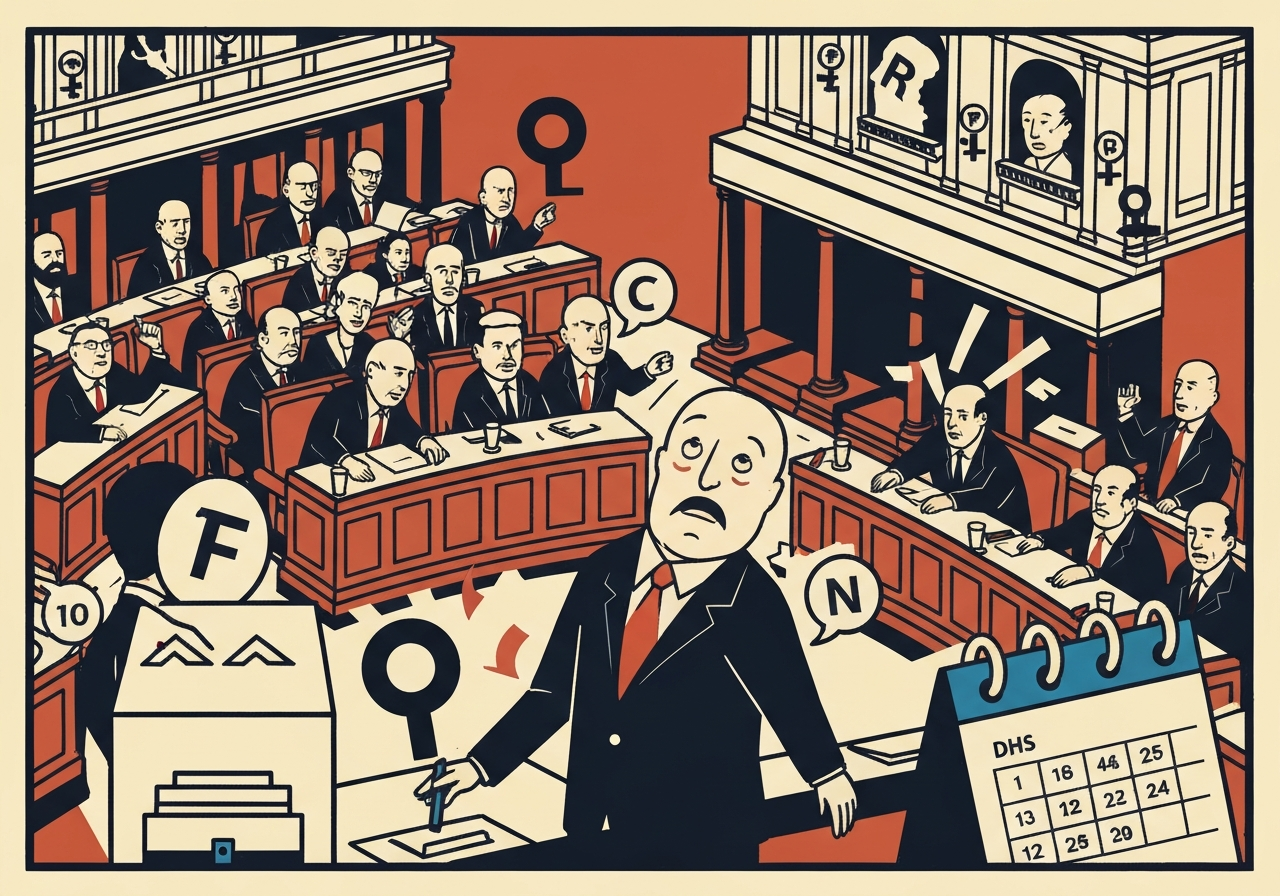
Speaker Mike Johnson (R-La.) announced Friday that the House will hold a separate vote on a short-term measure to fund the Department of Homeland Security for 60 days. He criticized the Senate-passed package—which funds most DHS components but omits Immigration and Customs Enforcement (ICE) and Customs and Border Protection (CBP)—calling that approach unacceptable. Johnson blamed Democrats for the outcome even though the Senate advanced the measure by unanimous consent and then left for a two-week recess. The move sets up a partisan standoff: House conservatives want ICE and CBP funding included, while Senate Democrats say they will block such funding without new guardrails on immigration enforcement.
Key takeaways
- The House speaker announced a planned vote on a 60-day continuing resolution to fund DHS, aiming to advance it through the Rules Committee before floor consideration.
- The Senate-passed text funds DHS broadly but excludes ICE and CBP; it advanced by unanimous consent before senators left for a two-week recess.
- Johnson urged a separate House approach after conservatives signaled they would oppose the Senate bill unless ICE and voter ID provisions were added.
- Senate Minority Leader Chuck Schumer said a House bill that funds ICE/CBP without restrictions lacks the 60 votes required in the Senate and would fail there.
- Some House Republicans called the Senate action a dereliction of duty for leaving without resolving ICE/CBP funding; Democrats warned against funding ICE absent accountability mechanisms following recent enforcement incidents.
Background
The fiscal fight over DHS is embedded in broader partisan disputes over immigration and border policy that have bedeviled Congress for years. Funding for DHS components is typically handled in appropriations bills, but when negotiations stall lawmakers resort to short-term continuing resolutions to keep agencies operating. This year, tensions have concentrated on ICE and CBP because of high-profile enforcement actions and differing Republican and Democratic priorities on immigration enforcement and oversight.
Senators moved a DHS funding package through unanimous consent, a procedure that accelerates measures but requires no recorded roll-call and can upset members who object to specific provisions. That maneuver produced a bill that many House conservatives viewed as incomplete because it did not include ICE and CBP funding. With the Senate departing for a two-week recess, House leaders faced pressure from right-wing hardliners to alter the bill before a House vote.
Main event
On Friday Speaker Johnson publicly rejected the Senate-passed text and said the House would hold its own vote on a 60-day continuing resolution to fund DHS. He framed the decision as necessary to restore full funding for all border and enforcement agencies and to avoid leaving critical functions unfunded. Johnson also said he had brief contact with the president and that the White House understood the House’s proposed course, though he did not state an explicit presidential endorsement.
Conservative House Republicans, including Reps. Tim Burchett (R-Tenn.), Keith Self (R-Texas) and Ralph Norman (R-S.C.), voiced sharp criticism of the Senate for excluding ICE and CBP and for advancing the bill rapidly before leaving town. Some demanded added language for ICE funding and voter identification measures as conditions for their support. Those demands complicate any quick path to passage in a closely divided House.
Democrats countered that funding ICE without new constraints would be unacceptable, pointing to recent episodes of aggressive enforcement and two deaths connected to ICE activity in Minneapolis as proof that reforms or oversight are needed. Rep. Susie Lee (D-Nev.) said Democrats would refuse to back a measure that effectively gave ICE a blank check. Moderate Democrats expressed frustration at the partisan impasse and urged lawmakers to reach a compromise to avoid interruptions to TSA and other DHS functions.
Analysis & implications
The House plan to split from the Senate approach increases the risk of legislative gridlock and heightens the chance of temporary funding gaps for agencies such as TSA, which has been grappling with staffing challenges and airport delays. A 60-day CR in the House that restores ICE and CBP funding could pass the House, but it faces a high bar in the Senate where 60 votes are needed to overcome a filibuster. That means the Speaker’s strategy may be aimed at satisfying his right flank while forcing negotiation or political pressure during the recess.
Politically, the episode underlines growing tensions within the GOP between conference leaders and conservative hardliners who demand policy wins on immigration. For Democrats, the standoff offers an opportunity to press for oversight measures and reforms tied to enforcement funding. If neither side yields, essential DHS operations could face uncertainty that would affect airports, border processing, and federally funded security programs nationwide.
On procedure, the use of unanimous consent in the Senate to advance a bill without recorded votes underscores how chamber rules and customs can shape outcomes but also provoke backlash when members feel excluded. The House’s intent to route a separate CR through the Rules Committee signals an expedited internal process—but that alone does not secure Senate approval or executive alignment.
Comparison & data
| Measure | Included in Senate Bill | House Conservatives Demand |
|---|---|---|
| ICE funding | No | Yes |
| CBP funding | No | Yes |
| TSA funding | Yes | Yes |
| Voter ID provisions | No | Yes (demanded) |
The table summarizes the immediate fault lines: the Senate measure funds most DHS components including TSA but excludes ICE and CBP, while House conservatives want those agencies funded and additional provisions like voter ID added. That divergence explains why a House-passed CR could fail to secure 60 Senate votes.
Reactions & quotes
“They have taken hostage the funding processes of government so that they can impose their radical agenda on the American people,”
Speaker Mike Johnson (R-La.)
Johnson used sharp language to pin responsibility on Democrats for what he described as a flawed Senate product and to justify a separate House vote.
“A 60-day CR that locks in the status quo is dead on arrival in the Senate,”
Senate Minority Leader Chuck Schumer (D-N.Y.)
Schumer warned that any House measure funding ICE and CBP without reforms would not clear the Senate floor because it would lack the 60 votes required.
“If this is just some trickery to get them home for a dad-gum vacation, then, no,”
Rep. Tim Burchett (R-Tenn.)
Burchett voiced anger at senators for leaving town after passing the measure by unanimous consent, suggesting some House members want longer negotiations rather than a quick recess.
Unconfirmed
- Whether President Trump has formally endorsed Speaker Johnson’s specific 60-day funding plan remains unclear based on available statements; Johnson said the president “understands” the approach but did not offer a formal endorsement.
- The exact text of the House CR and whether it will include specific rider language for voter ID or detailed ICE funding amounts has not been released publicly and therefore is unconfirmed.
Bottom line
The House’s decision to pursue a separate 60-day DHS funding vote reflects internal Republican pressure to restore ICE and CBP financing and to attach policy riders such as voter ID. While the move may placate conservative members, it substantially increases the chance of a clash with Senate Democrats who insist on accountability measures for immigration enforcement and who can block the measure with filibuster rules.
For stakeholders—airport travelers, border communities, federal employees—the dispute raises the prospect of continued uncertainty for TSA operations and other DHS programs if Congress fails to reach a bipartisan compromise. Expect negotiations to intensify once the House completes procedural steps, but a durable resolution will require concessions that reconcile House conservatives’ demands with Senate Democratic guardrails.