
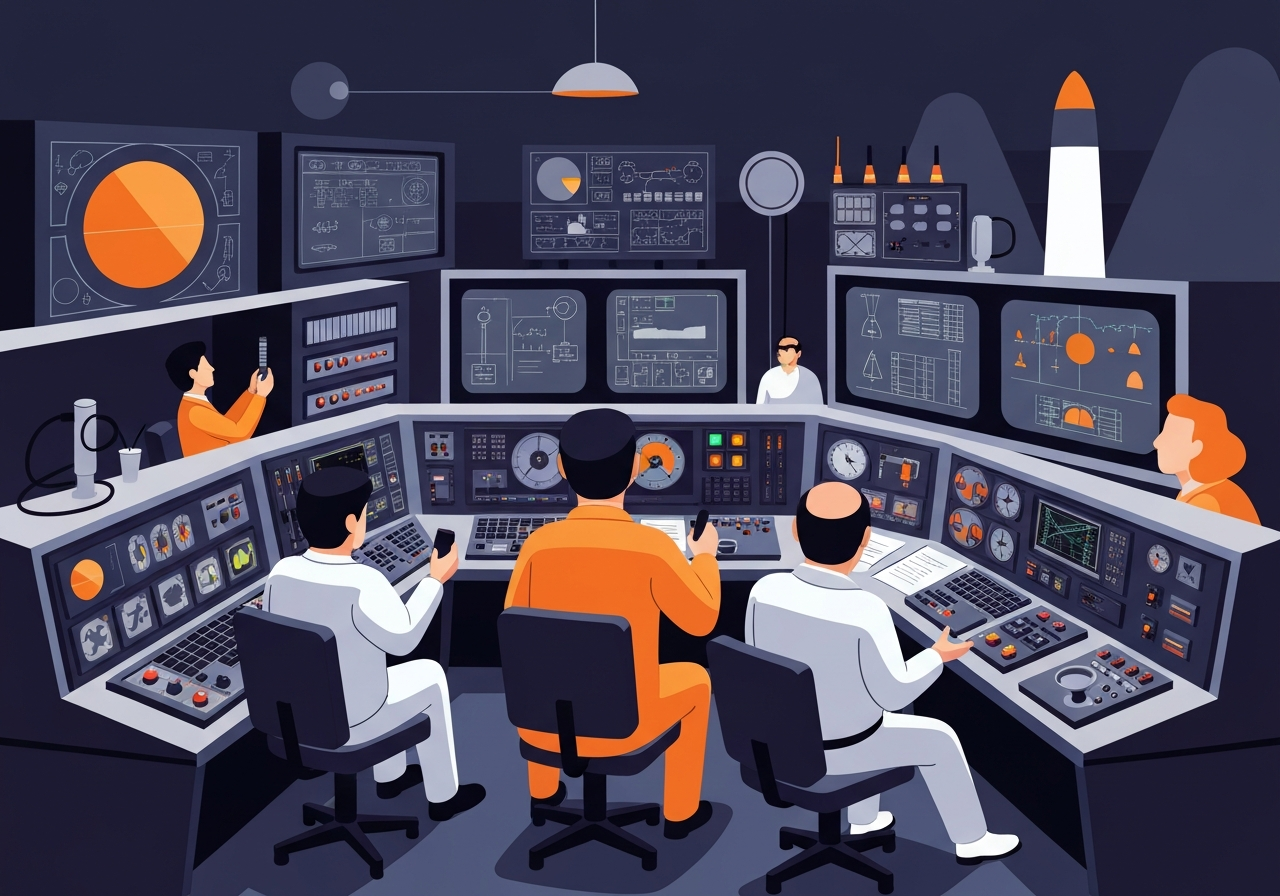
Lead: NASA’s Christopher C. Kraft, Jr. Mission Control Center in Houston will manage Artemis II, the first crewed lunar mission since 1972, currently targeting an April 2026 launch window. From this decades-old concrete complex, teams will monitor trajectory, life support and propulsion as four astronauts loop beyond the Moon and return roughly 10 days later. The operation blends legacy procedures developed during Apollo with modern consoles, international hardware and round‑the‑clock simulations aimed at ensuring crew safety. Mission control’s role is simple in purpose but complex in practice: keep the crew and spacecraft safe and achieve mission objectives.
Key Takeaways
- Artemis II is planned for launch in April 2026 and will carry four astronauts on a lunar flyby and return mission of about 10 days.
- Flight operations are run from NASA’s Christopher C. Kraft, Jr. Mission Control Center in Houston, the same site that supervised Apollo missions and is now paired with a modern operations room.
- The Orion crew module rides atop the Space Launch System (SLS) rocket; the European Space Agency (ESA) supplies the service module, built by Airbus in Germany, which provides propulsion, water and air.
- Mission control operates 24/7 in shifts, communicating with the crew via a single capsule communicator (capcom) while the flight director has final operational authority.
- Controllers conduct exhaustive simulations—intentionally breaking many systems—to prepare for scenarios where multiple failures occur simultaneously.
- Re-entry will bring Orion to roughly 25,000 mph (40,200 km/h) and expose the heat shield to temperatures above 2,000°C (3,632°F); Artemis I in 2022 recorded heat‑shield damage that influenced schedule and hardware checks.
- The Orion Mission Evaluation Room (MER) houses the engineers who designed the spacecraft and leads detailed troubleshooting distinct from the flight ops team.
Background
Mission control as a centralized concept dates to the early U.S. space program and Christopher C. Kraft Jr.’s innovation: consolidate all specialists under a flight director to coordinate complex missions in real time. The original Apollo flight control room—preserved now as a U.S. National Historic Landmark—set practices and desk names still used today, such as the Eecom (Emergency, Environmental, and Consumables Officer) role that once helped save Apollo 13.
Over six decades, the centre has evolved physically and culturally. Smoking and ashtrays are long gone and black‑and‑white consoles have given way to keyboard-and-touchscreen workstations and LED lighting, but the command structure remains familiar. Where Apollo controllers were overwhelmingly young white men in shirts and ties, today’s workforce is far more diverse and frequently led by women: among Artemis II’s flight directors is Fiona Antkowiak, one of nine assigned to the mission.
Main Event
From launch, Houston-based teams will track the SLS and Orion through ascent, translunar injection and the lunar far-side pass where communications blackout will last about 40 minutes. During that blackout the spacecraft will be out of direct reach of ground radio; trajectory physics guarantees a return, but the control room will watch telemetry and await the reappearance of signals with focused attention.
On day two of the mission the flight director must decide whether systems are ‘‘go’’ for sending Orion on the translunar injection burn that sends the vehicle toward the Moon. That decision hinges on exhaustive checklist reviews and real‑time engineering assessments; once the burn is executed there are limited rapid return options.
The Orion MER operates in parallel with flight operations. Staffed by the engineers who designed Orion and the ESA service module, the MER does not issue immediate operational commands but leads deeper diagnostics and fixes when issues arise. That separation of responsibilities—rapid operational response in the flight room, detailed system resolution in the MER—is intended to accelerate both detection and remedy of anomalies.
Controllers deliberately push systems hard during simulations. As MER lead Trey Perryman explains, the MER’s engineers are intimately familiar with every bolt and valve on the spacecraft, which positions them to interpret subtle signs and lead corrective engineering when complex or cascading failures occur. This discipline traces directly to hard lessons learned during Apollo and later programs.
Analysis & Implications
Operational continuity from Apollo to Artemis shows the durability of the flight‑director model: a centralized decision maker supported by specialized consoles remains effective even as hardware and software change. That institutional memory—procedures, desk nomenclature and an emphasis on simulation—reduces the risk that teams will be surprised by emergent problems on a crewed mission beyond low Earth orbit.
International partnership is now integral: the ESA‑provided service module houses vital consumables and the main engine for Orion. This dependence increases program resilience through shared expertise but also means cross‑agency coordination and supply‑chain assurance are mission‑critical factors that can affect schedule and on‑orbit response options.
Technological advances—digital telemetry, automated subsystems, touchscreens—improve situational awareness but also raise complexity. Automation can manage routine faults, yet controllers must be prepared for cases where automation and redundant systems fail simultaneously. That is why training scenarios often include multiple concurrent failures to test decision trees and contingency strategies.
Comparison & Data
| Item | Apollo era (example) | Artemis II (planned) |
|---|---|---|
| First crewed lunar sortie | Apollo 11, 1969 | Artemis II, targeting April 2026 |
| Crew size | 3 | 4 |
| Mission duration | ~8 days (Apollo 11) | ~10 days (Artemis II) |
| Re‑entry speed | ~24,500 mph | ~25,000 mph (40,200 km/h) |
| Notable re‑entry risk | Thermal protection and systems anomalies | Heat‑shield stress; Artemis I recorded heat‑shield damage in 2022 |
The table highlights continuity and change: crew size and mission duration differ slightly, re‑entry speeds are comparable, but modern missions rely on larger, more automated vehicles and international components such as the ESA service module.
Reactions & Quotes
Officials and engineers emphasize both the continuity of the flight‑director model and the intensified focus on simulation and recovery.
“We structure priorities to keep the crew and spacecraft safe first,”
Fiona Antkowiak, Artemis II flight director (NASA)
“MER’s role is to resolve complex engineering issues, not to run immediate flight operations,”
Trey Perryman, Orion MER Lead (NASA)
“Lessons from prior accidents inform every checklist and simulation we run here,”
Senior mission engineer (paraphrased)
Unconfirmed
- The exact launch date within April 2026 and the specific daily timeline remain subject to refinement as launch windows and readiness reviews proceed.
- Any hardware modifications to Orion’s heat shield after the Artemis I damage are described in agency briefings but detailed post‑repair performance data are not yet publicly disclosed.
- The precise composition of the flight‑controller on‑console roster for each shift during Artemis II may change up to launch and is not finalized in public materials.
Bottom Line
Mission control in Houston remains the operational core for human lunar missions, marrying institutional procedures developed in the Apollo era with modern computing, international hardware and a more diverse workforce. The same centralization of authority under a flight director persists because it works: it enables rapid decisions, coordinated responses and clear lines of responsibility when seconds matter.
Artemis II will test that blend under real stress—long communications gaps, high re‑entry energies and the integration of international systems. If simulations and preparedness hold, the mission will return valuable operational lessons for sustained lunar exploration; if anomalies occur, the MER and flight teams are explicitly drilled to diagnose, adapt and bring the crew home safely.