
Lead
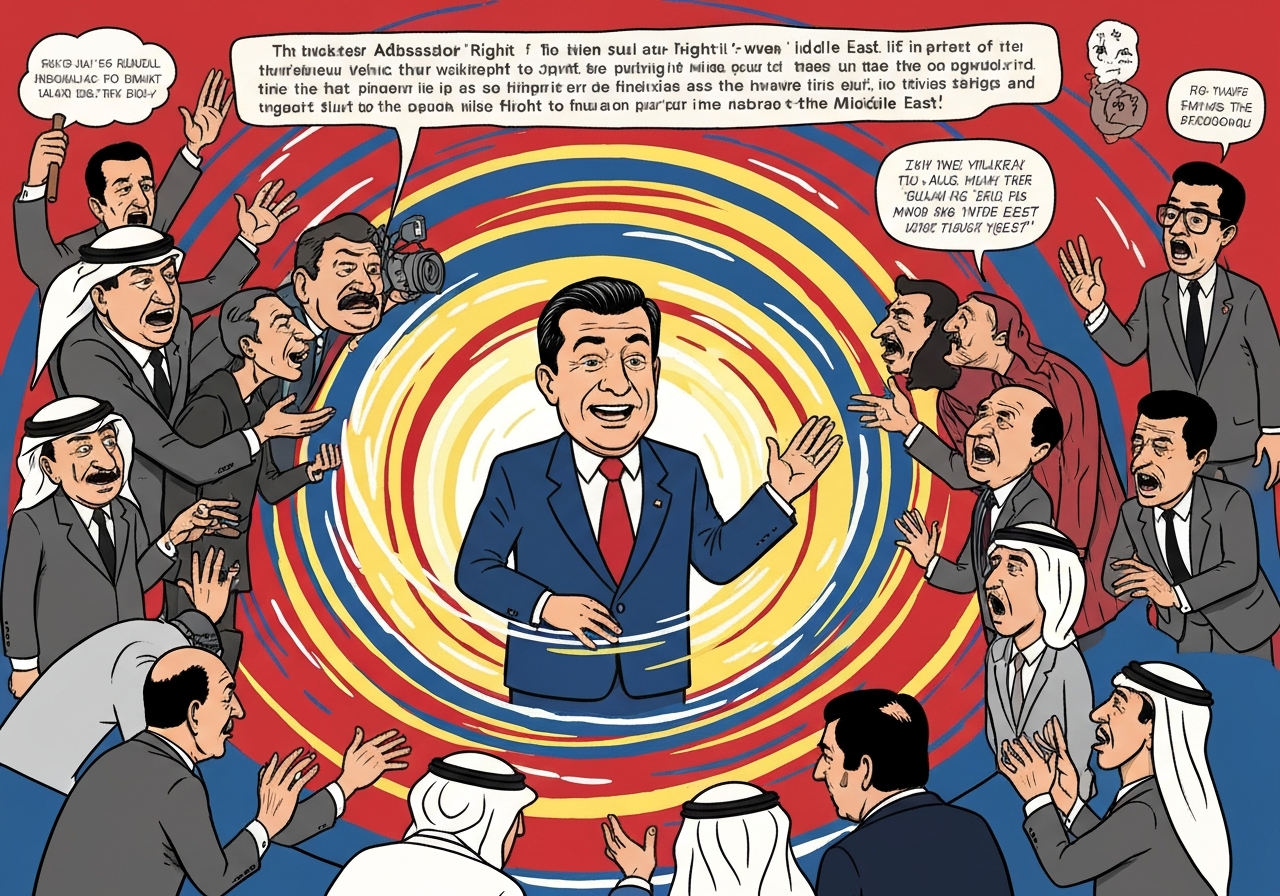
U.S. Ambassador to Israel Mike Huckabee sparked a diplomatic furor after saying Israel “has a right to much of the Middle East” in an interview aired Friday with Tucker Carlson. The remarks, framed around a biblical interpretation of land promises to Abraham, prompted sharp condemnations across Arab and Muslim states on Saturday. Saudi Arabia, Egypt, Jordan, the Organization of Islamic Cooperation and the League of Arab States called the comments unacceptable and at odds with international norms. There was no immediate official response from the U.S. State Department or the Israeli government.
Key Takeaways
- Mike Huckabee, serving as U.S. ambassador to Israel, told Tucker Carlson the Bible could be read to justify Israeli claims to much of the Middle East; he added Israel was not seeking expansion and has a right to security in its held territory.
- Saudi Arabia’s foreign ministry labeled the comments “extremist rhetoric” and demanded a State Department clarification; Egypt called them a “blatant violation” of international law.
- Regional bodies including the Organization of Islamic Cooperation and the League of Arab States issued separate condemnations, calling the statements provocative and inflammatory.
- Since 1948 Israel’s borders have not been fully recognized; the 1967 war saw Israel take the West Bank, east Jerusalem, Gaza, the Sinai Peninsula and the Golan Heights.
- Israel returned the Sinai to Egypt under a peace deal after the 1973 war and withdrew from Gaza in 2005, but has recently expanded settlement activity and tightened control in the West Bank.
- Recent security moves include Israel’s post-2024 seizure of a demilitarized buffer zone in Syria and continued occupation of five hilltop posts on Lebanese soil after the 2024 conflict with Hezbollah.
Background
Israel was established in 1948 and has since operated without universally recognized frontiers. Border lines have shifted through wars, armistices, annexations and negotiated peace agreements. The 1967 Arab‑Israeli war resulted in Israeli control of the West Bank and east Jerusalem from Jordan, Gaza and the Sinai from Egypt, and the Golan Heights from Syria. Egypt and Israel later negotiated a return of the Sinai, and Israel’s unilateral withdrawal from Gaza occurred in 2005.
For decades Palestinians have sought an independent state comprising the West Bank and Gaza with east Jerusalem as their capital, a position supported by much of the international community. Israeli governments have varied in approach, but recent months have seen intensified settlement construction, legalization of outposts and administrative moves that critics say deepen Israel’s hold on the occupied West Bank. U.S. policy has also shifted at times; former President Donald Trump publicly said he would block any formal annexation of the West Bank.
Main Event
The exchange that ignited the reaction took place in a Carlson interview broadcast Friday. Carlson cited a literal biblical reading that God promised Abraham land stretching from the Nile to the Euphrates and asked Huckabee whether that meant Israel had a rightful claim to much of the region. Huckabee replied, in part, “It would be fine if they took it all,” while later qualifying that Israel was not actively seeking to expand and must be secure in territory it legitimately holds.
Statements from Saudi Arabia’s foreign ministry and Egypt’s foreign ministry landed over the weekend, condemning the remarks as extremist and a violation of international law respectively. The Organization of Islamic Cooperation and the League of Arab States issued separate rebukes, warning that such rhetoric inflames religious and national sentiment. The Israeli and U.S. governments had not publicly commented at the time of those statements.
Huckabee has a record of opposing a two‑state solution and has previously questioned the use of the term “Palestinians” to describe Arab residents of former British Mandate Palestine. The latest interview therefore reopened longstanding debates over biblical narratives, modern state claims and the role of personal or religious beliefs in diplomatic positions.
Analysis & Implications
The immediate diplomatic cost is clear: Huckabee’s remarks risk straining U.S. ties with key Arab partners at a time when regional cooperation on security, energy and normalization remains fragile. Saudi Arabia and Egypt are central interlocutors for Washington on Iran, Gulf stability and Israel‑Palestine issues; their public rebukes increase pressure on the State Department to disavow or contextualize the ambassador’s comments.
Legally and normatively, the comments collide with established international positions that reject territorial claims grounded in religious texts as a basis for modern sovereignty. Egypt’s reference to a “blatant violation” of international law echoes long‑standing views that the occupied Palestinian territories remain subject to international protections and negotiations, not unilateral religiously justified claims.
Domestically in the United States, the episode exposes tensions between appointees whose personal views intersect with official diplomacy and career foreign‑policy professionals who aim to maintain predictable ties. A formal State Department clarification would aim to separate individual commentary from U.S. policy; failure to provide clear distancing could complicate American diplomacy in the region.
For Palestinians and regional publics, the episode risks hardening attitudes and feeding narratives that normal political negotiation cannot resolve religiously framed claims. It may also accelerate calls among Arab states for clearer U.S. assurances on the status of Palestinian territories and the primacy of international law in resolving borders.
Comparison & Data
| Territory | Captured in 1967 | Subsequent changes / current status (summary) |
|---|---|---|
| West Bank & East Jerusalem | Yes | Remains under Israeli military control and civil administration in many areas; persistent settlement expansion has occurred. |
| Gaza Strip | Yes | Israel withdrew forces and settlers in 2005; retains capability to control borders and has re-entered militarily during conflicts. |
| Sinai Peninsula | Yes | Returned to Egypt under a post‑1973 peace agreement; demilitarization and peace treaty remain in force. |
| Golan Heights | Yes | Under Israeli control; internationally disputed and a focal point in Israel‑Syria dynamics. |
| Lebanese hilltop posts | No (border incursions in past conflicts) | Five hilltop posts remain occupied by Israel after the 2024 brief war with Hezbollah. |
The table summarizes long‑running territorial changes that underpin contemporary disputes. Recent events — notably intensified West Bank settlement activity, Israel’s post‑2024 moves in Syria and continued tactical control in Gaza under ceasefire arrangements — feed the political sensitivities that turned Huckabee’s comments into a regional diplomatic issue.
Reactions & Quotes
Government and regional bodies issued blunt responses within hours of the interview’s broadcast, signaling broad official disapproval.
“Extremist rhetoric and unacceptable — the State Department should clarify its position.”
Saudi Arabian Foreign Ministry (statement)
“A blatant violation of international law; Israel has no sovereignty over the occupied Palestinian territory or other Arab lands.”
Egyptian Foreign Ministry (statement)
“Statements of this nature serve only to inflame sentiments and stir religious and national emotions.”
League of Arab States (press statement)
Unconfirmed
- Whether Huckabee’s comments reflect any change in formal U.S. policy; as of the latest public statements, the State Department had not issued a definitive clarification.
- Any concrete Israeli plan to pursue territorial expansion based on biblical claims; Israel has publicly characterized recent territorial changes as security measures rather than official annexations.
- The long‑term status and timeline for withdrawal from buffer zones created under recent ceasefire arrangements remain unsettled and subject to negotiation.
Bottom Line
Mike Huckabee’s televised remarks crystallize how personal, religiously framed views from a senior diplomat can trigger rapid diplomatic fallout in a volatile region. Key U.S. partners in the Arab world publicly rebuked the statements, underscoring the sensitivity of territorial claims tied to religious narratives.
The incident places pressure on Washington to delineate clearly between individual commentary and official policy to prevent damage to critical bilateral and multilateral relationships. Observers should watch for any State Department clarification and for whether regional partners seek formal assurances regarding the status of Palestinian territories and the primacy of international law.