
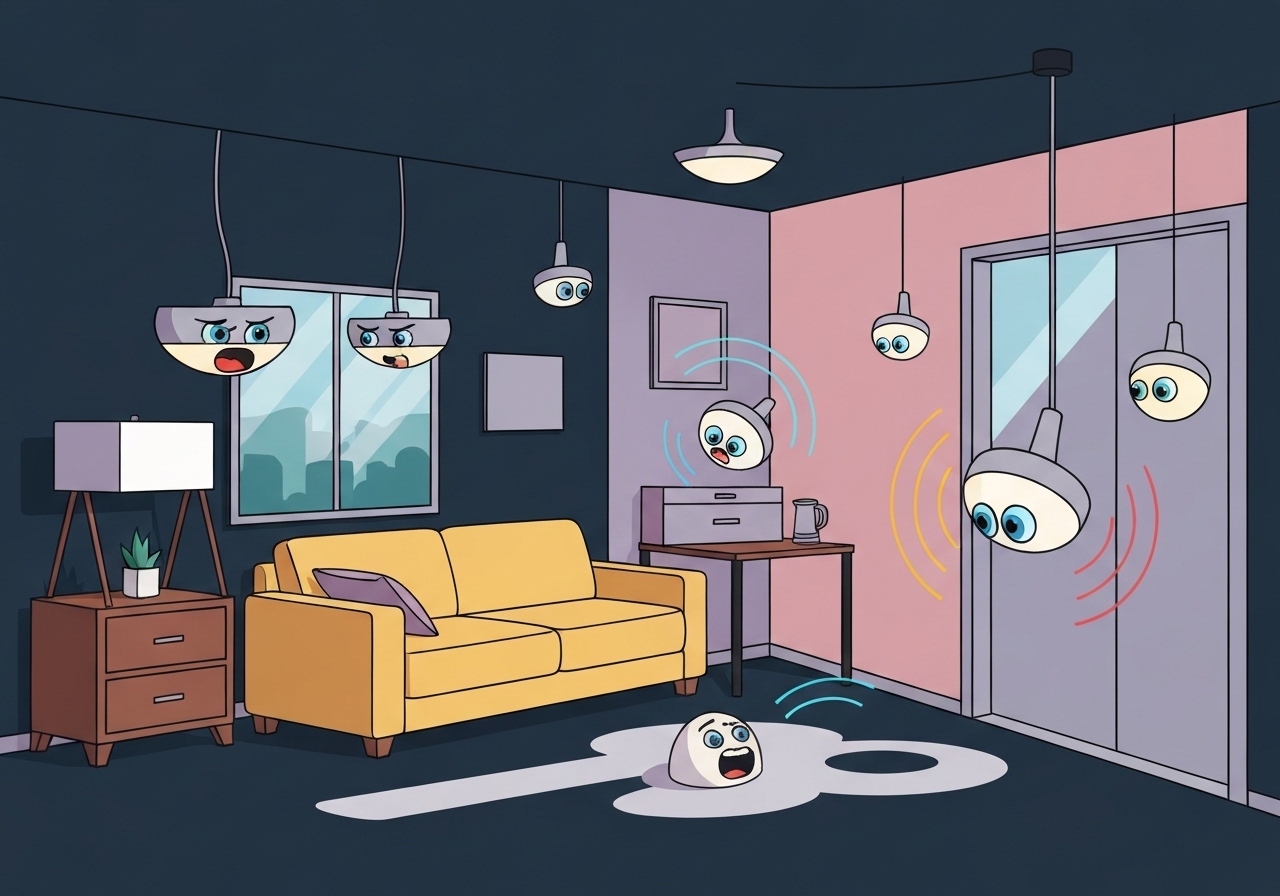
Philips Hue announced MotionAware on Sep 4, 2025 at IFA: the feature turns compatible Hue mains-powered lights into RF-based motion sensors, available to users who add the new Bridge Pro and enable the feature in the Hue app.
Key Takeaways
- MotionAware uses Zigbee radio‑frequency (RF) sensing to detect motion between mains-powered Hue lights.
- Activation requires the new Hue Bridge Pro (US $99) and at least three mains-powered Hue devices per sensing zone.
- The feature works with Hue lights and fixtures made since 2014 (second generation onward), covering about 95% of Hue’s installed base.
- Each Bridge Pro supports up to four MotionAware zones; detection runs locally but security alerts use the cloud.
- Security features link with Hue Secure (subscription required: from $40/year; motion-only alerts $1/month) while basic lighting automations are free.
- MotionAware is opt-in, stores motion data locally by default, and cannot currently trigger automations in third‑party platforms like Matter or Apple Home.
- The underlying RF sensing IP was developed with Ivani’s Sensify technology and adapted by Hue to run over Zigbee.
Verified Facts
Philips Hue’s MotionAware converts groups of mains-powered bulbs, light strips, and fixtures into motion-sensing zones by analyzing changes in the Zigbee signal across devices. To create a zone the user selects a room in the Hue app and picks at least three participating lights; Hue recommends arranging lights around the area to be monitored rather than clustering them in a row.
The capability is available to most existing Hue hardware produced since 2014 and to new compatible models via a firmware update. Portable battery devices (for example Hue Go or Table Lamp) and battery-powered accessories are not supported, and Hue’s current smart plug is excluded. Signify, Hue’s parent company, says this coverage represents approximately 95% of its install base.
Motion processing happens on the new Bridge Pro because the algorithms require more compute than Hue’s older V2 bridge provides. Each Bridge Pro can host up to four MotionAware zones to limit network load and false detections. Motion detection itself runs locally on the bridge; however, sending security notifications to a phone requires cloud connectivity and a Hue Secure subscription. Hue lists Hue Secure from $40 per year, or a motion-only alert tier at $1 per month.
MotionAware is occupancy-based and requires movement to trigger; it is comparable to passive infrared (PIR) motion sensors in behavior and can be set to different sensitivity levels in the app. The system can be triggered by pets and other motion sources. Hue notes that MotionAware cannot measure ambient light; users can optionally pair a light sensor to a motion zone to supply luminance data for automations.
Context & Impact
RF sensing has been used in smart-home products before, often over Wi‑Fi, but Hue’s implementation is the first widespread use over a Zigbee mesh. Hue says using Zigbee reduces false detections relative to Wi‑Fi approaches because the closed mesh has more predictable radio behavior across many mains-powered nodes.
Hue developed MotionAware using Sensify IP from Ivani and added its own constraints and optimizations to reduce latency and false positives in typical home environments. The company frames MotionAware as a step toward a less intrusive, more ambient smart home where lighting responds automatically to human presence without separate sensors.
There are practical limits: MotionAware requires at least three mains-powered radios to form a reliable sensing topology, zones are capped at four per bridge, and certain devices (battery-powered or portable units) are excluded. Hue also says MotionAware zones cannot currently be exposed as triggers to third-party automation platforms or Matter endpoints, though the feature is available via Hue’s public API.
Official Statements
“We’ve done something that’s quite a lot better than what else is out there,”
George Yianni, Hue CTO and founder
“There is no industry that is better positioned to roll out unobtrusive, room-level, real-time presence sensing than lighting,”
Matt Wootton, Ivani cofounder and CTO
Unconfirmed
- Whether Hue will increase the four-zone limit per Bridge Pro in a specific future firmware update is not yet confirmed.
- Timelines and exact plans for exposing MotionAware zones as Matter resources or full third‑party triggers remain under exploration by Hue.
- Potential non-motion use cases mentioned by Ivani (for example, fall detection or sleep monitoring) are possibilities but were not announced as shipped Hue features.
Bottom Line
MotionAware brings a significant new sensing capability to the Hue ecosystem by reusing existing mains-powered lights as RF motion detectors, with broad compatibility across the installed base and local processing for day-to-day detection. The requirement of the new Bridge Pro and the current limits on zones and third-party exposure mean the rollout is a careful, staged step rather than a complete reimagining of smart-home automation—but it marks a clear move toward more ambient, sensorless home experiences.