
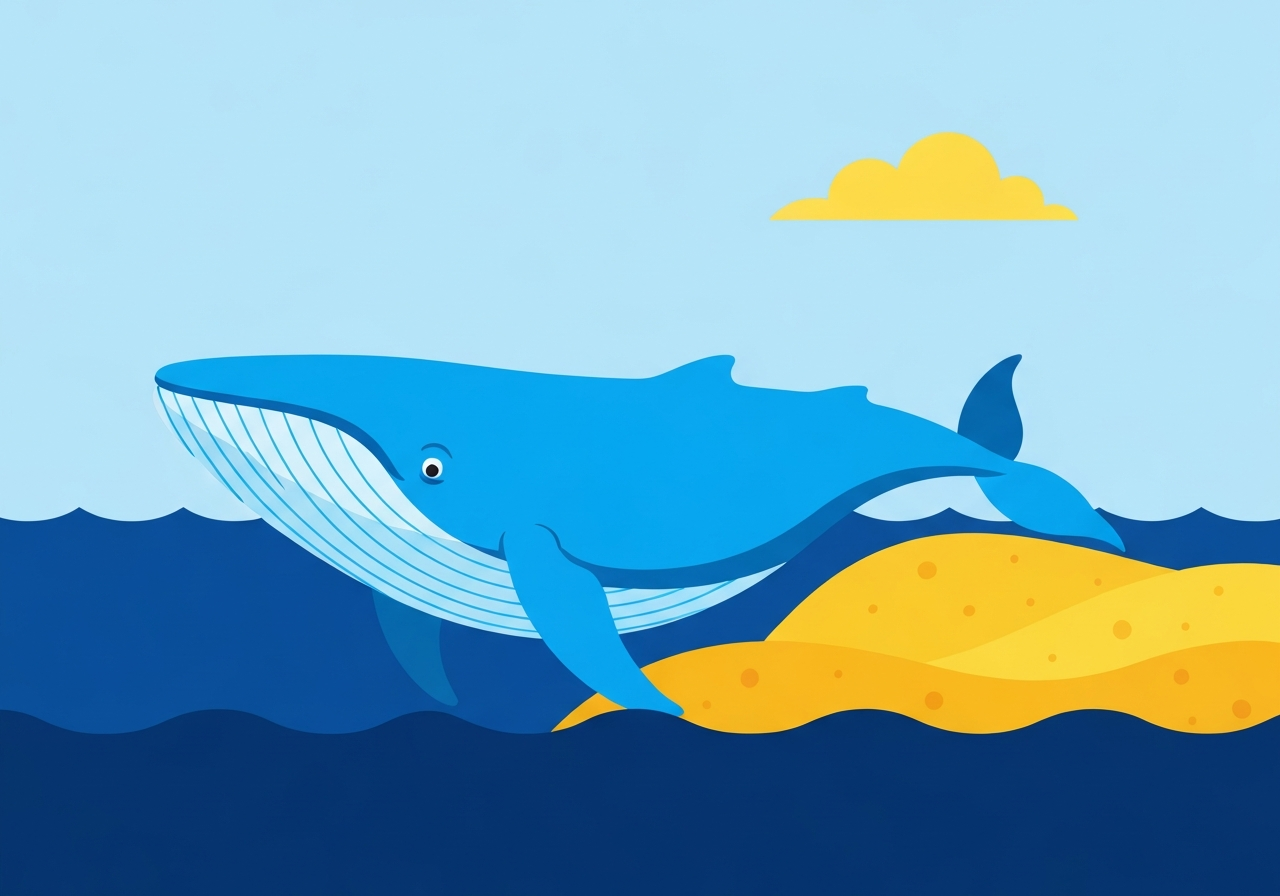
Rescuers say a humpback whale that had been stranded on a sandbank near the German Baltic resort of Timmendorfer Strand managed to swim free after an overnight push following a last-ditch trenching effort. The animal, estimated at 12–15 meters (39–49 feet) long, was first seen stuck in shallow water on Monday morning and remained grounded through several unsuccessful attempts to nudge it to deeper water. On Thursday crews used an excavator to dig an escape channel in front of the whale while marine biologist Robert Marc Lehmann guided operations; by early Friday the whale had swum off the bank and was moving out of Lübeck Bay. Authorities caution this is only an initial improvement: the animal still faces a long migration to the Atlantic and health risks from the stranding.
Key Takeaways
- Whale freed: The humpback swam off a sandbank near Timmendorfer Strand after rescuers dug a trench on Thursday and it moved overnight (early Friday).
- Size and location: Experts estimate the whale at 12–15 meters (39–49 feet); it was about 300 meters (nearly 1,000 feet) off the coast when tracked out of Lübeck Bay.
- Rescue effort: Coast guard and fire department boats first tried to create waves; excavators were brought in Thursday when tidal help was not available in the Baltic.
- Likely juvenile male: Researchers believe the animal is a young male and that it had been observed previously in the port of Wismar in recent weeks.
- Habitat mismatch: Humpback whales are not native to the Baltic; the animal faces several hundred kilometers through German and Danish waters to reach the North Sea and then the Atlantic.
- Ongoing escort: The whale was accompanied by a coast guard vessel and several boats as it moved out of the bay, but long-term survival is uncertain.
Background
The Baltic Sea has only weak tidal ranges compared with oceans, which reduces the natural chances that a large cetacean will be refloated by tide alone. That geographic reality complicated early rescue attempts after the animal was found high and dry on a shallow sandbank at the popular resort of Timmendorfer Strand on Monday morning. Local coast guard and fire teams initially tried to encourage the animal back to depth by using vessels to generate large waves and by other on-water measures, but these efforts failed to dislodge the whale. The repeated sightings in nearby Wismar suggested the same individual had been moving within the southern Baltic in recent weeks, raising questions about why it entered this shallow corridor.
Humpbacks are normally oceanic and are rarely recorded inside the Baltic basin; when they do appear it is often young or exploratory animals that can become disoriented. The rescue involved municipal authorities, marine biologists, and volunteers coordinating to protect the animal from additional harm during excavation and night operations. Veterinary teams and researchers monitor the whale’s breathing, orientation, and injuries when possible, but physical intervention is limited by the animal’s size and stress risk. If the animal cannot reach the Atlantic, prolonged time in shallow, cooler Baltic waters or repeated stranding could worsen its condition.
Main Event
Early in the week the whale was observed stuck on an underwater sandbank off Timmendorfer Strand, where initial attempts to guide it to deeper water did not succeed. Organizers brought in an excavator on Thursday to cut a trench ahead of the animal’s head, a tactic coordinated by marine biologist Robert Marc Lehmann to create an easier path to deeper water. Teams worked into the evening but paused overnight when conditions and safety required; by Friday morning the whale had used the channel and was swimming away from the sandbank.
Stephanie Gross of the Institute of Terrestrial and Aquatic Wildlife Research reported that the whale was moving out of Lübeck Bay and was tracked roughly 300 meters off the shore, accompanied by a coast guard ship and additional boats. Observers emphasized that while being mobile again is a positive sign, the animal’s ultimate recovery depends on whether it can navigate several hundred kilometers through German and Danish waters to the North Sea and on its physical condition after days stranded. Experts noted that the Baltic lacks the strong tidal assistance available elsewhere, so human intervention was necessary to give the whale an escape route.
The whale’s prior appearances in ports such as Wismar point to a short-term pattern of presence in the southern Baltic, though the reason for its move into shallow coastal waters remains unclear. Rescuers took measures to minimize stress and injury during the operation: they limited loud activity nearby, avoided direct physical contact when possible, and used vessels to shepherd the animal once it was free. Monitoring continues as the animal moves toward open water, with teams ready to assess whether further aid or medical attention will be required.
Analysis & Implications
Ecologically, a humpback’s presence and stranding in the Baltic raises questions about shifting movement patterns and the factors that draw oceanic species into marginal seas. Possible drivers include navigation errors, prey movement, illness or injury, or atypical exploratory behavior by juveniles; none are yet confirmed in this case. Because humpbacks are not regular Baltic inhabitants, local responders have limited routine protocols compared with regions where strandings are more common, complicating rapid medical assessment and long-term care options.
From a conservation perspective, the incident underscores gaps in regional preparedness for large whale strandings in enclosed seas. The use of heavy equipment—an excavator—to create a channel was an improvised but pragmatic response tailored to the Baltic’s weak tides. If such events become more frequent, authorities and researchers may need to develop protocols specific to large cetaceans in low-tide environments, including guided transit corridors and cross-border coordination with Danish and North Sea agencies.
Politically and logistically, the whale’s route crosses national waters and may require cooperative tracking and decision-making between German and Danish maritime authorities. The animal’s progress toward the North Sea will test the capacity for multinational response to a single animal’s welfare, including decisions about further intervention if it shows signs of weakness. Economically and for public perception, strandings at tourist sites like Timmendorfer Strand draw intense local attention and can spur investment in rescue resources—but sustainable planning requires scientific input and funding beyond ad hoc measures.
Comparison & Data
| Metric | Reported Value |
|---|---|
| Estimated length of whale | 12–15 meters (39–49 feet) |
| Distance from shore when tracked | ~300 meters (nearly 1,000 feet) |
| Date first reported stranded | Monday morning (reported week of rescue) |
| Excavation / trenching | Thursday, continued into evening |
The table above summarizes the confirmed measurements and timeline reported by field teams: size estimates, proximity to shore, and the sequence of rescue actions. These figures underline the scale of the rescue challenge—moving a 12–15 meter animal through shallow, low-tide waters without causing further injury. The whale’s remaining distance to reach the North Sea amounts to several hundred kilometers, a journey that will take days and requires both navigational ability by the animal and continued monitoring by human teams.
Reactions & Quotes
Marine experts and local officials framed the outcome as a cautious success while warning that the situation remains fragile.
“It’s a positive sign that the animal left the sandbank, but this is only the first step toward safety.”
Robert Marc Lehmann, Marine Biologist (reported via dpa)
Lehmann, who guided the trenching work, stressed that reaching the Atlantic would ultimately determine whether the whale can fully recover. Officials on site emphasized coordination between rescue crews and monitoring vessels as the animal moved out of the bay.
“The whale was accompanied by a coast guard ship and other boats as it moved away from Lübeck Bay.”
Stephanie Gross, Institute of Terrestrial and Aquatic Wildlife Research
Gross reported that observers tracked the whale approximately 300 meters off the coast early Friday and reiterated that long-term prognosis depends on distance, sea conditions, and the animal’s condition after the stranding.
Unconfirmed
- The precise cause for this whale entering the Baltic and becoming stranded remains unconfirmed; no definitive illness or injury has been publicly reported.
- Identification that the animal is the same individual previously seen in Wismar is based on field observations but has not been genetically or photo-confirmed in public statements.
- Whether the whale will successfully navigate to the North Sea and then the Atlantic without further problems is unknown and depends on its health and sea conditions.
Bottom Line
The coordinated trenching and escort operation produced a critical short-term win: the humpback left the sandbank and is moving away from Timmendorfer Strand. Yet the animal’s long-term survival is still uncertain; reaching the Atlantic will require sustained movement across several hundred kilometers and continued monitoring for signs of weakness or injury. The incident exposes both the ingenuity of local responders and the limits of regional preparedness for large whale strandings in low-tide seas.
For scientists and authorities, the case will likely prompt review of cross-border rescue protocols and investment in targeted strategies for large cetaceans in the Baltic. For the public, it is a reminder that singular wildlife events at popular shores can demand rapid scientific coordination and long-term follow-up to ensure an animal’s recovery beyond the initial rescue.
Sources
- AP News (news report, original article)