
Lead
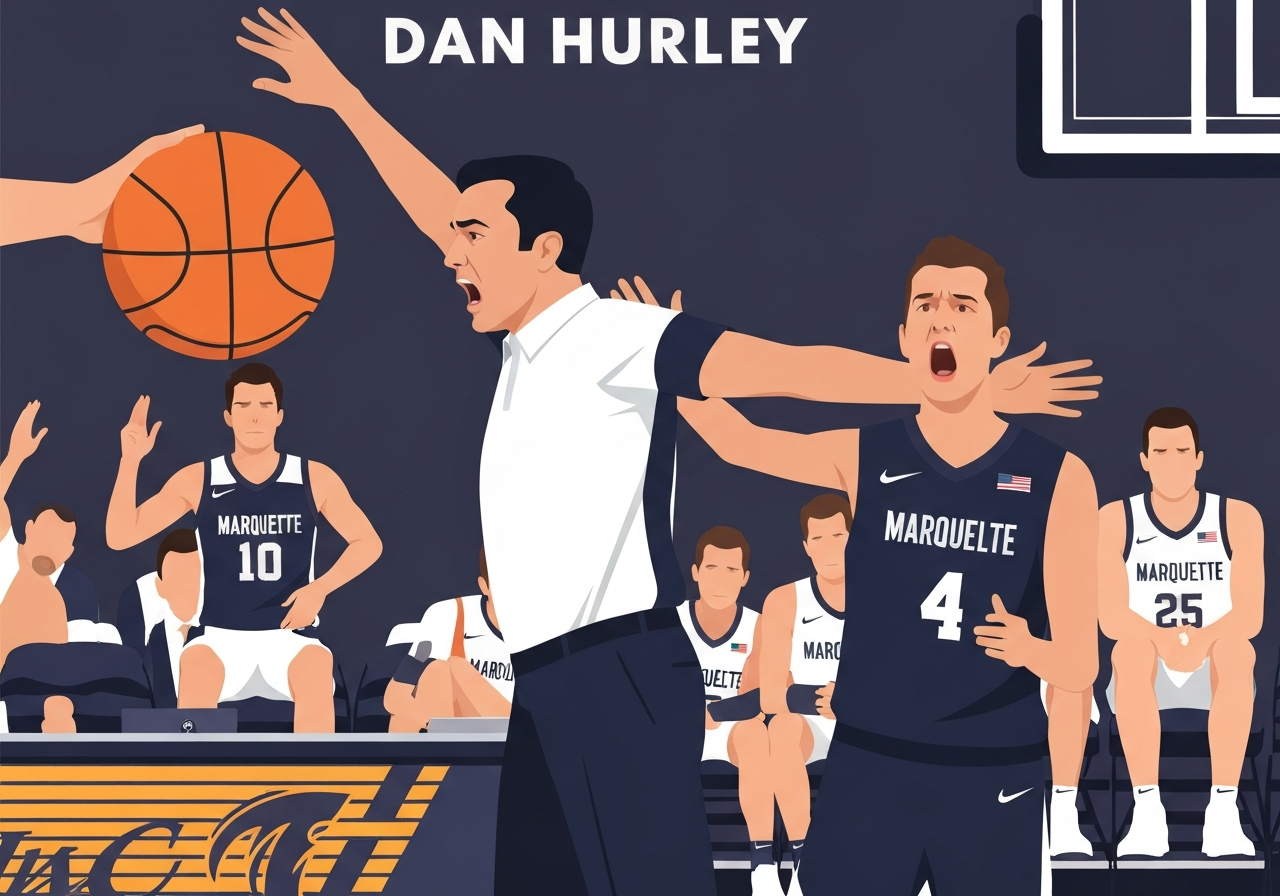
On March 7, 2026 in Milwaukee, UConn men’s coach Dan Hurley was ejected with one second remaining after a disputed no-call late in the Huskies’ game against Marquette. The play involved UConn guard Silas Demary driving to the basket with contact that drew protest from the UConn sideline. Referee Greg Evans assessed an ejection to Hurley after the confrontation, and Marquette converted four free throws to complete a 68-62 upset of No. 4 UConn. The sequence finished a game that ended with Marquette prevailing in the closing moments.
Key Takeaways
- Final score: Marquette 68, UConn 62; the difference followed a late sequence that produced four free throws for Marquette.
- The contested play occurred with roughly one second remaining after Silas Demary drove to the basket and contact was observed by spectators but not called as a foul.
- UConn coach Dan Hurley was ejected by referee Greg Evans immediately after the play; the ejection happened on March 7, 2026 in Milwaukee.
- Marquette made all four ensuing free throws, which accounted for the six-point margin that decided the game.
- UConn entered the contest ranked No. 4, making the result a notable upset in late-season play.
- An assistant coach intervened to restrain Hurley on the sideline and was rebuked on the spot, according to game coverage.
- The incident immediately drew scrutiny from fans and commentators about officiating and sideline conduct in the closing seconds.
Background
UConn arrived in Milwaukee as a top-5 team and a national title favorite during the 2025–26 season, with expectations high entering the final stretch of regular-season play. Marquette, playing at home, was positioned as an underdog but has a history of competing strongly in late-season conference matchups. Close games in late February and early March routinely increase attention on officiating and sideline behavior because outcomes influence rankings and postseason seedings.
Dan Hurley is widely known for his intensity on the bench and his vocal engagement during games; coaches with that profile occasionally receive technical fouls or ejections when interactions with officials escalate. Referees are likewise under pressure late in games to manage both the officiating and the emotional temperature on the sidelines. The game in Milwaukee became a flashpoint because a single non-call and a subsequent sideline confrontation coincided in the final second.
Main Event
With UConn trailing 64-62 in the final moments, guard Silas Demary drove to the rim and appeared to encounter contact in the paint. Many in the arena and watching nationwide anticipated a foul call that would put Demary on the line, but no whistle was blown. Hurley immediately raced onto the sideline to protest the decision and exchanged words with referee Greg Evans.
Footage and contemporaneous reports show a heated exchange between Hurley and Evans; outlets at the arena described physical contact during the confrontation, which officials do not tolerate. Following that interaction, Evans assessed an ejection to Hurley, removing the head coach with one second left on the clock. An assistant coach attempted to hold Hurley back during the confrontation but was reportedly chastised by Hurley for restraining him.
Under the ensuing stoppage, Marquette was awarded free throws—four in total—and the Golden Eagles converted them all, turning a two-point deficit into a six-point final margin. The sequence concluded with Marquette scoring 68 points to UConn’s 62, an outcome that many called an upset given UConn’s No. 4 ranking.
Analysis & Implications
The immediate effect of the sequence was decisive: four successful free throws erased UConn’s late hope and sealed an upset. In tight games, a single officiating decision—or a critical non-call—can swing momentum and final results, and this game is a clear example. The optics of a coach being ejected with one second left also draw attention from league officials and fans, potentially triggering a review of sideline conduct and the exchange itself.
For UConn, the loss could have short-term consequences for ranking and seeding discussions, as top teams rely on steady results late in the season to preserve NCAA tournament positioning. Beyond standings, the ejection interrupts the coach’s ability to manage the immediate postgame and may influence internal discussions about how to respond to contentious calls without jeopardizing personnel availability.
On the officiating side, referees face a dual mandate: enforce rules consistently while avoiding on-court escalation. An official’s assessment of whether contact during a coach-official interaction merits an ejection often hinges on perceived physical contact or language. If video review or league offices determine the interaction crossed a line, there could be formal follow-up, though any corrective action would be subject to institutional review procedures.
Comparison & Data
| Team | Final Score | Free Throws on Final Sequence | Time Remaining |
|---|---|---|---|
| Marquette | 68 | 4/4 | 1.0s |
| UConn | 62 | 0 (disputed no-call) | 1.0s |
The table highlights the decisive elements: Marquette made four free throws in the closing second while UConn received no foul call on the drive by Silas Demary. In raw points, the free throws turned a two-point margin into a six-point final, a net swing of four points directly attributable to the late sequence.
Reactions & Quotes
Game coverage and eyewitness accounts emphasized the intensity of the exchange on the sideline and the immediate consequence of Hurley’s removal. Observers noted that officials rarely tolerate physical contact with a referee and that such contact often precipitates an ejection.
Hurley was ejected after a sideline confrontation with referee Greg Evans following the disputed play with one second left.
OutKick (sports media coverage)
An assistant coach’s attempt to restrain Hurley drew attention when Hurley rebuked him while being held back, an image replayed in postgame highlights and social coverage. That sideline interaction compounded focus on referee‑coach dynamics at decisive moments.
An assistant stepped in to try to calm the situation but was admonished on the spot, according to contemporaneous reports.
OutKick (sports media coverage)
Fans and commentators immediately debated the no-call and the ejection on social platforms and postgame discussion shows, framing the sequence as an officiating controversy that decided the contest. Many viewers highlighted the timing—one second left—as a factor that magnified the stakes of the decision.
Marquette converted all four free throws in the closing sequence to secure a 68-62 victory over No. 4 UConn.
OutKick (game recap)
Unconfirmed
- Whether Hurley intentionally made physical contact with referee Greg Evans; footage shows a close encounter but intent has not been officially stated.
- Any future disciplinary action or fines from the conference or NCAA related to the ejection have not been announced.
- The precise words exchanged between Hurley and the official have not been published in an official transcript and remain based on eyewitness reports.
Bottom Line
The game in Milwaukee ended as a late, consequential sequence: a disputed non-call on Silas Demary’s drive, a sideline confrontation that led to Dan Hurley’s ejection with one second left, and four made free throws that sealed a 68-62 upset for Marquette. The result will be discussed for its officiating implications and for tangible effects on UConn’s position in late-season rankings.
Expect follow-up in the coming days from league officials and outlets covering both teams; any official statements or disciplinary actions would clarify whether the ejection carries additional penalties. For now, the decisive factors are on the scoreboard and in the video of the final minute, which will be replayed as stakeholders evaluate how a single no-call and a coach’s reaction altered the outcome.