
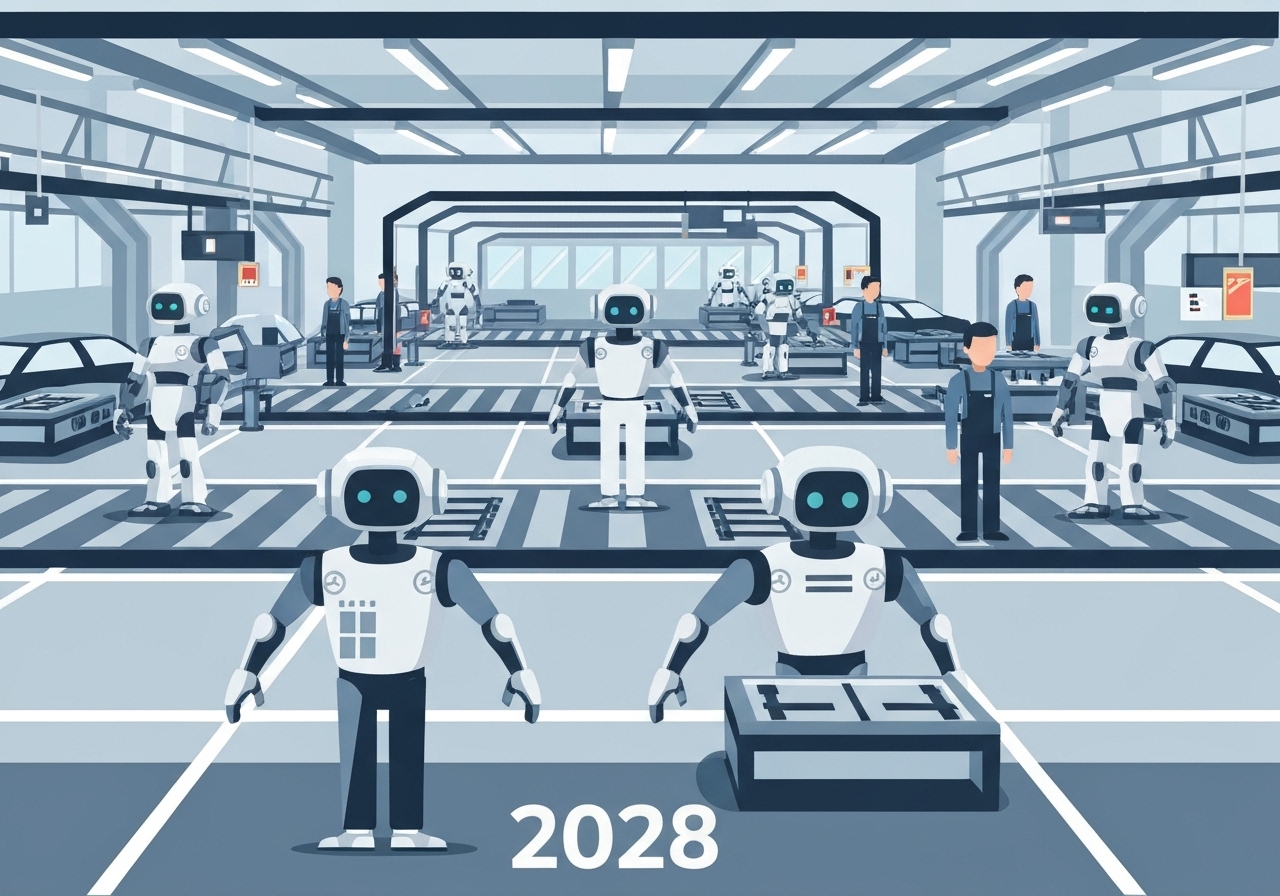
Hyundai Motor Group said it will begin using Atlas humanoid robots at its Georgia manufacturing complex from 2028, aiming to automate higher-risk and repetitive tasks while validating safety and quality benefits. The company unveiled a production version of the Atlas robot—developed by its Boston Dynamics unit—at CES in Las Vegas and described the move as part of a broader push into what it calls “physical AI.” Initial deployment will focus on parts sequencing at the Ellabell, Georgia plant, with staged expansion to assembly and heavier-duty work by 2030. Hyundai emphasizes the robots are intended to reduce physical strain on workers and to be introduced gradually as operational reliability is proven.
Key Takeaways
- Hyundai plans to begin Atlas robot deployment at its Georgia plant in 2028, starting with parts sequencing tasks.
- By 2030, Hyundai expects Atlas units to move into component assembly and then take on heavier loads and repetitive operations.
- Atlas features human-scale hands with tactile sensing and can lift up to 50 kg (110 pounds); it operates between -20°C and 40°C.
- The company did not disclose the number or cost of units to be purchased, leaving scale and economics unreported.
- Boston Dynamics developed the production Atlas; Hyundai cites partnerships with Nvidia and Google to accelerate safety and real-world performance.
- Labor groups, including a union at Kia Corp, have called for bodies or safeguards to address worker rights as automation expands.
Background
Hyundai’s move follows years of investment in robotics and automation across the automotive industry, where manufacturers have sought to reduce risk and increase throughput on repetitive production lines. Boston Dynamics, acquired by Hyundai Motor Group in 2021, has shifted from research-focused demonstrations to productizing humanoid platforms intended for industrial work. The term “physical AI” is used by Hyundai to describe systems that pair AI decision-making with hardware capable of sensing and acting in real-world environments, a category that spans robotics, smart factories and autonomous vehicles. Global chip and AI firms such as Nvidia and Google have been enlisted to help integrate perception, control and safety software into these systems.
U.S. production sites like the Ellabell, Georgia Metaplant are focal points for Hyundai’s broader electrification and capacity-expansion plans, and introducing humanoid robots there signals a step toward full-scale operational testing. Historically, automotive factories have automated discrete, repetitive motions with specialized machinery; humanoid robots aim to broaden automation into tasks that require more generalized dexterity and adaptability. Worker groups and unions in the region and at affiliated brands have previously voiced concerns about job impacts and the need for clear labor protections as automation accelerates. Regulators and industry standards for safe human-robot collaboration remain an evolving area.
Main Event
At the Consumer Electronics Show in Las Vegas Hyundai presented the production-ready Atlas, emphasizing industrial readiness and human-like manipulation. Company statements identify parts sequencing as the initial use case at the Georgia plant, a task that involves organizing incoming components for assembly lines and can be repetitive and ergonomically taxing. Hyundai says it will expand Atlas functions progressively, contingent on validating safety, reliability and quality outcomes in live production settings.
Technical details released by Hyundai indicate Atlas can lift up to 50 kg (110 pounds) and is equipped with tactile-sensing hands to handle components with greater finesse than earlier robot generations. The platform is engineered to operate across a broad temperature range, from minus 20°C to 40°C, enabling deployment in varied factory environments. Hyundai also highlighted collaborations with Nvidia and Google aimed at accelerating perception, compute and decision-making capabilities for real-world industrial tasks.
Hyundai did not provide figures for unit counts, rollout schedule per plant, or acquisition costs, leaving questions about near-term scale and capital expenditure. The company framed the deployment as part of a long-term strategy to make humanoid robots a leading segment of the physical AI market, which it predicts will expand across industrial and logistics settings. Labor representatives at Kia and other affiliates have asked for formal consultation mechanisms to address workforce implications before broader rollouts occur.
Analysis & Implications
Introducing humanoid robots in a U.S. assembly context signals a shift from fixed, purpose-built automation toward adaptable robotic laborers that can perform multiple tasks. If Atlas can safely and reliably handle sequencing and assembly work, factories could reallocate human labor to supervision, quality control, and higher-skilled roles, potentially improving ergonomics and reducing injury rates in the short term. However, the economic case depends on robot uptime, maintenance costs, and the purchase price per unit—data Hyundai has not released.
From a competitive standpoint, Hyundai’s step may accelerate similar investments by other automakers and suppliers eyeing flexible automation to support electric vehicle production, where layout and process variations are common. Partnerships with Nvidia and Google suggest Hyundai intends to leverage advanced perception and AI stacks rather than build full software ecosystems internally, which could speed deployment but also create dependency on external platforms for critical safety features.
Labor-market effects will vary by role, region and timeline. In the near term, staged adoption focused on repetitive tasks may reduce injury and fatigue without immediate large-scale job loss, but by 2030—if robots move into assembly and heavier tasks—the mix of occupations and required skills could shift substantially. Policymakers and companies will face pressure to design retraining, job-transition programs and collective bargaining frameworks that address automation-driven change.
Comparison & Data
| Year | Planned Task | Notes |
|---|---|---|
| 2028 | Parts sequencing | Initial deployment at Ellabell, Georgia; staged validation |
| 2030 | Component assembly | Expanded duties contingent on safety and quality validation |
| Long term | Heavy loads & complex ops | Planned shift to heavier and more repetitive tasks across sites |
The table above summarizes Hyundai’s public timeline and task roadmap for Atlas. While mechanical capabilities—50 kg lift, tactile hands, and a -20°C to 40°C operating range—are documented, economic metrics and deployment density remain unspecified. This creates uncertainty in forecasting productivity, ROI and labor displacement across different facilities.
Reactions & Quotes
Company and industry responses emphasize potential safety and productivity benefits, while labor voices stress the need for protections and oversight.
“Physical AI and humanoid platforms are expected to help reduce physical strain on workers by taking on higher-risk tasks,”
Hyundai Motor Group (company statement)
Hyundai framed Atlas as a tool to augment worker safety and to be introduced gradually after field validation. The company highlighted collaborations with global AI firms to enhance safety and real-world performance.
“We need transparent frameworks to govern how these systems are introduced so workers’ rights and job security are addressed,”
Kia Corp union representative
Labor representatives at affiliated brands have asked for formal mechanisms—such as dedicated committees—to address automation’s implications, reflecting concerns about pace and scale of technological change.
“Advances in robotics shift the competitive landscape; integration with reliable compute and perception stacks is a decisive factor,”
Industry analyst, automation sector
Analysts note that partnerships with Nvidia and Google could accelerate capabilities but also tie performance to third-party platforms and cloud/edge compute ecosystems.
Unconfirmed
- Unit counts and total capital costs for the Atlas rollout have not been disclosed and remain unverified.
- Exact timelines for plant-by-plant deployments beyond the initial Georgia site are not confirmed and may change based on validation results.
- Projected labor impacts by role and region have not been quantified publicly; estimates of job displacement or transition remain speculative.
Bottom Line
Hyundai’s planned introduction of Atlas humanoid robots at its Georgia plant from 2028 marks a notable shift toward more flexible, general-purpose automation in auto manufacturing. The staged approach—starting with sequencing and moving toward assembly by 2030—reflects an effort to validate safety and quality before wider adoption. While the technology promises ergonomic and operational benefits, critical details on scale, cost and worker transition measures remain undisclosed, limiting immediate assessments of economic and labor impacts.
For stakeholders, the immediate priorities will be transparent deployment plans, independent safety validations, and negotiated frameworks to protect workers during the transition. Observers should watch for further disclosures on unit economics, uptime and maintenance requirements, and the terms of engagement between Hyundai, its AI partners, and labor representatives to judge whether the initiative improves productivity without unduly harming job security.
Sources
- CNBC (media report summarizing company announcement)
- Boston Dynamics (company / developer information)
- Hyundai Motor Group (corporate statements and press releases)