
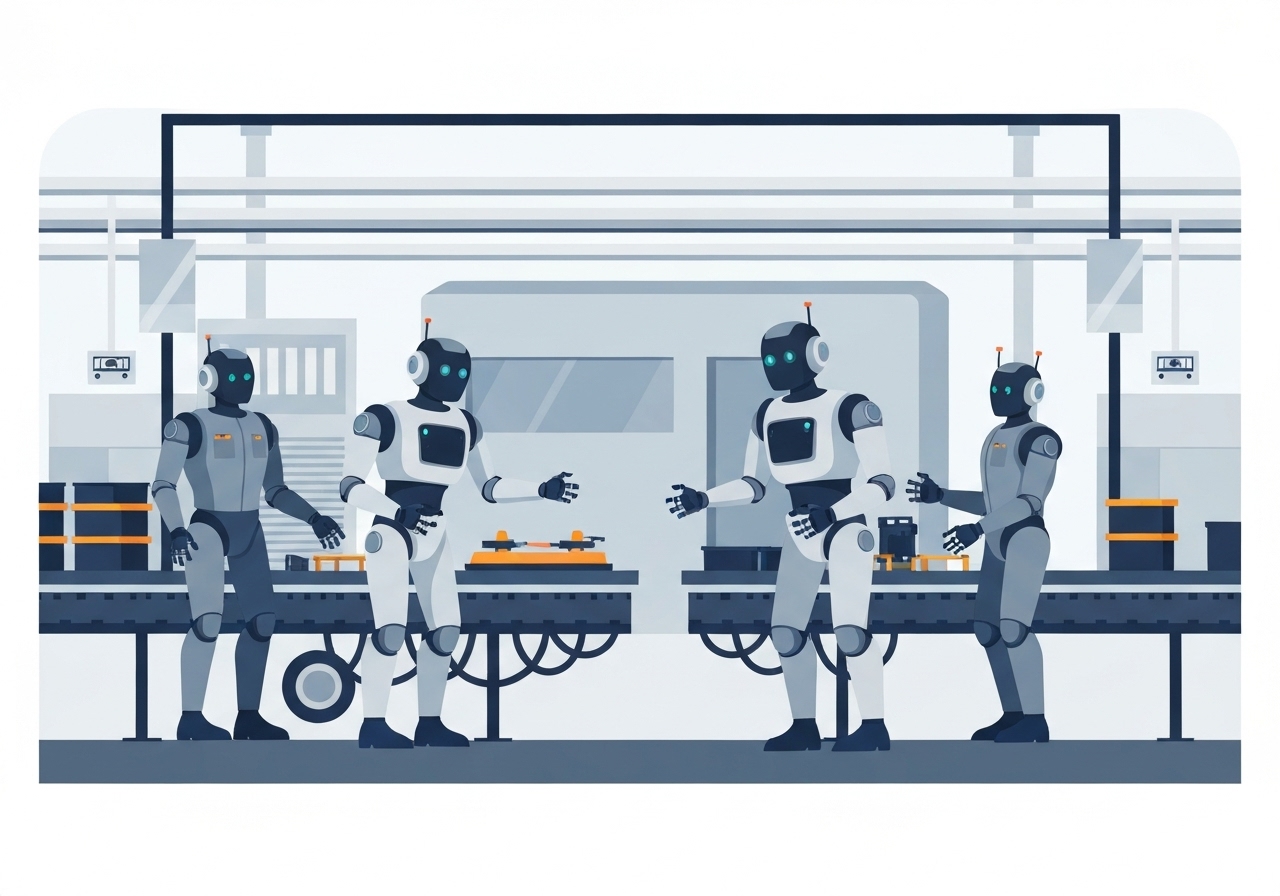
Hyundai Motor Group announced at CES in Las Vegas that it plans to begin deploying humanoid robots across its production network from 2028, including at a battery plant in Georgia, USA. The company demonstrated Atlas, a general-purpose humanoid developed by Boston Dynamics, and said the machines will be integrated gradually to assist human workers and handle dangerous or strenuous tasks. Hyundai — which owns a majority stake in Boston Dynamics — did not disclose how many robots will be deployed or the cost of the programme. The announcement follows Hyundai’s broader US investment push announced in 2025 and the high-profile immigration raid at its Georgia plant that same year.
Key takeaways
- Hyundai plans to roll out humanoid robots starting in 2028, integrating Boston Dynamics’ Atlas across its global factories, including a Georgia battery plant.
- Atlas is being developed for general industrial use to work alongside people and autonomously manage machines; Hyundai did not give numbers or budget for initial deployment.
- Hyundai acquired a majority stake in Boston Dynamics and showed Atlas at CES in Las Vegas on Monday as part of a push into robotics and AI.
- Other major companies pursuing humanoid robots include Amazon, Tesla (Optimus), and BYD, signalling an industry-wide race in automation.
- Hyundai previously said in 2025 it would invest more than $20bn in the US, expanding car production and AI/autonomous technology development.
- The Georgia battery plant, run in partnership with LG, was the site of a September 2025 immigration raid in which hundreds were arrested; at least 300 detainees were South Korean citizens.
- Hyundai framed robots as a way to reduce physical strain and to perform dangerous tasks, while acknowledging concerns about labour displacement and the need for human roles such as training the machines.
Background
Advances in humanoid robotics have accelerated in recent years, driven by improvements in sensing, locomotion and machine learning. Boston Dynamics, known for agile robots like Spot, has been developing Atlas as a bipedal platform intended for tasks that resemble human movement and dexterity. Hyundai’s majority stake in Boston Dynamics is part of a broader strategy to combine automotive manufacturing with robotics and AI research.
The move follows Hyundai’s 2025 commitment to invest more than $20bn in the United States, a plan aligned with US policy goals to onshore advanced manufacturing. The company’s Georgia battery plant is a key asset in that strategy; however, the September 2025 immigration raid there, which led to hundreds of arrests and images of detainees with legs shackled, strained diplomatic and investor confidence. Washington and Seoul later reached an agreement to release detained workers, and Hyundai executives and South Korean leaders publicly warned of the raid’s potential to deter foreign investment.
Main event
At CES in Las Vegas on Monday, Hyundai showcased Atlas and outlined a timetable to integrate humanoid robots into factory operations beginning in 2028. Company executives described Atlas as a general-purpose industrial robot designed to operate alongside human staff and to autonomously interface with machinery. The public demonstration emphasized mobility and manipulation capabilities rather than a specific production task list.
Hyundai said Atlas will be phased in gradually, with robots taking on physically taxing or hazardous duties first to reduce injury risk and physical strain on workers. The firm reiterated that humans will play essential roles in supervising and training robots, and in higher-value tasks that require judgement, creativity or complex decision-making.
The announcement did not include deployment figures, capital expenditure details or a rollout schedule by plant. Hyundai highlighted the Georgia battery facility as one location where Atlas could be integrated, a notable point given the plant’s 2025 immigration enforcement episode and its strategic importance for EV battery production in the US.
Analysis & implications
Operationally, introducing humanoid robots like Atlas represents a shift from fixed automation (robot arms and conveyors) toward flexible, mobile workers capable of varied tasks. For manufacturers, that flexibility can translate into shorter retooling times and greater responsiveness to model changes or fluctuating production lines. It also alters skills demand: fewer repetitive manual roles may exist, but demand for robotics technicians, trainers and systems integrators will likely rise.
From a labour perspective, Hyundai’s framing — robots to reduce strain and handle dangerous work — aligns with common industry messaging, but does not eliminate displacement risks. The pace and scale of adoption will determine net employment effects; gradual rollouts with investment in retraining can mitigate job losses, while rapid substitution in tight labour markets could cause disruption. Hyundai’s explicit emphasis on human oversight and training suggests a strategy oriented toward augmentation rather than wholesale replacement, at least initially.
Geopolitically and reputationally, the decision intersects with the Georgia plant’s fraught 2025 history. Deploying robots in a facility that was the focus of an immigration raid could be seen two ways: as a move to reduce dependence on vulnerable labour pools, or as a political and social flashpoint that raises concerns about dehumanising work practices. For US policymakers and foreign investors, the episode underscored how enforcement actions can ripple through investment and supply-chain decisions.
Comparison & data
| Company | Robot | Public plan | Notable focus |
|---|---|---|---|
| Hyundai | Atlas (Boston Dynamics) | Deploy from 2028; integrate across network | Factory assistance, dangerous tasks |
| Tesla | Optimus | Ongoing development; demonstrations and limited field trials | Vehicle factory tasks, long-term mass deployment aim |
| Amazon | Unnamed humanoid initiatives | Exploring use in logistics and warehouses | Inventory handling, order fulfilment |
| BYD | Domestic humanoid efforts | Publicly stated interest in production use | Auto manufacturing integration |
The table compares headline public plans and primary use cases; companies differ in maturity, investment scale and the specificity of deployment timelines. Hyundai’s 2028 target is a concrete schedule relative to some competitors’ vaguer statements, but Hyundai has not disclosed unit counts or capex. Measurable impacts on productivity, safety and employment will depend on trial outcomes and the extent of human-robot collaboration at line level.
Reactions & quotes
Hyundai’s announcement drew immediate attention from industry watchers and policymakers because of the company’s ownership of Boston Dynamics and the recent history of its Georgia plant. Observers say the move underscores how robotics and automation are becoming central to next-generation manufacturing strategies.
“People will still be needed to train the robots, among other roles,”
Hyundai (reported at CES)
This remark was offered by Hyundai leadership at CES and reported by news agencies as part of the company’s response to concerns about job displacement. Hyundai framed training and human oversight as continuing sources of employment even as physical tasks are automated.
“[The US has an] ‘understanding’ with the world on the need to bring in experts to set up specialised facilities and train local workers,”
Donald Trump (public statement on 2025 raid)
That quote reflects comments made in the wake of the September 2025 immigration enforcement at Hyundai’s Georgia plant and was cited by media reporting on reactions from US political leaders and Hyundai executives.
“The raid could deter foreign investment,”
President Lee Jae Myung (statement after 2025 arrests)
South Korean officials expressed public concern that high-profile enforcement actions would affect investor confidence; Hyundai’s later statements about US investment and robotics sit against that diplomatic backdrop.
Unconfirmed
- The exact number of Atlas units Hyundai will initially deploy and the total programme cost have not been disclosed and remain unconfirmed.
- Specific roles Atlas will perform at the Georgia battery plant versus other Hyundai facilities have not been publicly detailed and may change after trials.
- The timeline from 2028 to full integration across Hyundai’s network is a company projection and could be affected by technical, regulatory or labour factors.
Bottom line
Hyundai’s plan to deploy Atlas humanoid robots from 2028 is a significant signal that major automakers see flexible, human-like robots as a practical next step in factory automation. The company’s majority stake in Boston Dynamics gives it direct access to advanced mobility and manipulation technology, positioning Hyundai to experiment with new production models.
However, several crucial variables remain unresolved: unit counts, costs, regulatory approvals, and the social consequences at sites such as the Georgia battery plant. How Hyundai balances automation with workforce transition measures, and how public and political reactions evolve, will shape whether this initiative is perceived primarily as technological progress or as a disruptive risk to employment and local communities.