
Lead
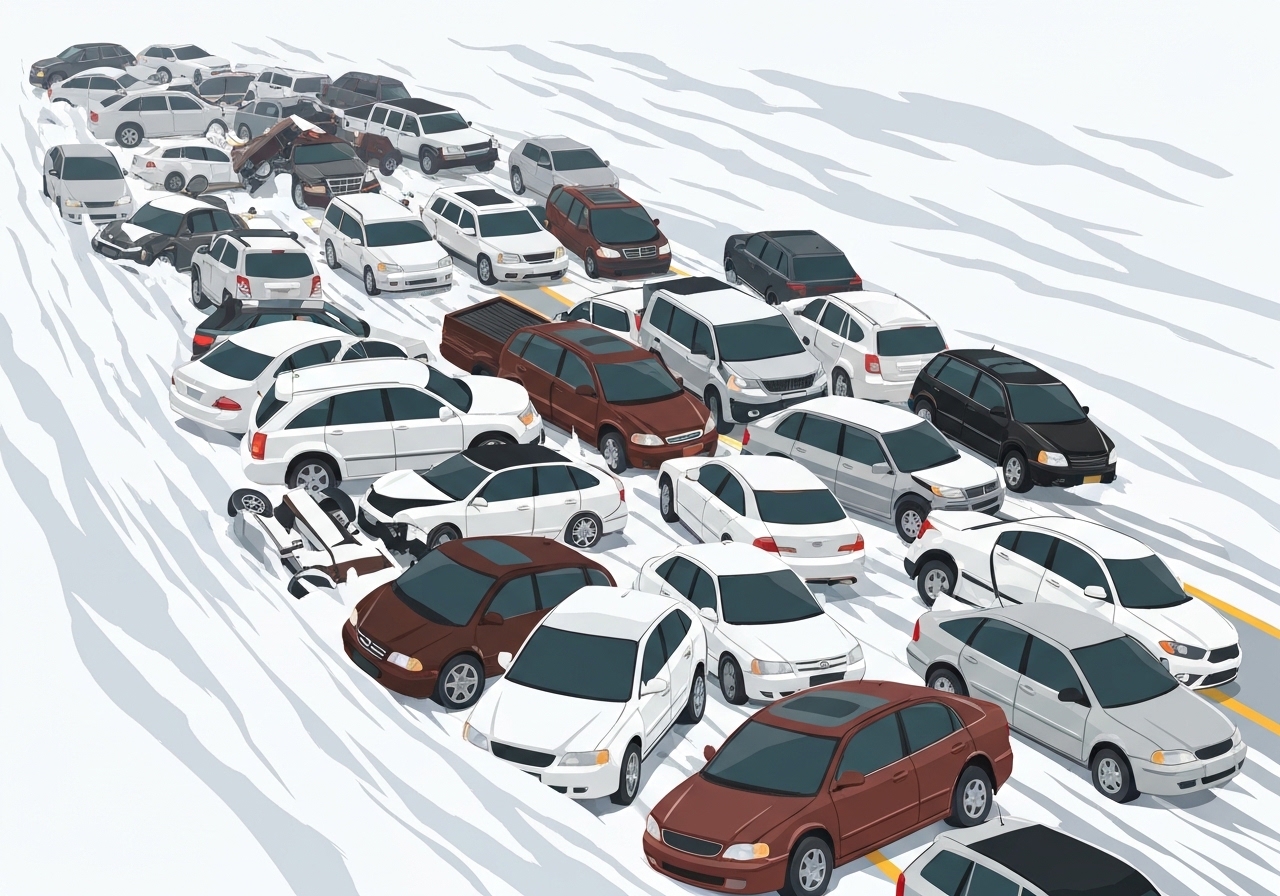
On January 19, 2026, a chain-reaction collision involving more than 100 vehicles, including more than 30 semitrailer trucks, occurred on Interstate 196 just southwest of Grand Rapids near Hudsonville, Michigan. Michigan State Police closed both directions of I-196 while crews worked to remove vehicles and assist stranded motorists; officials reported numerous injuries but no deaths. The pileup happened as a major winter storm driven by the Great Lakes dumped heavy snow across the state and prompted wider warnings from the National Weather Service. Local towing firms and law enforcement coordinated to clear the scene and transport stranded drivers to Hudsonville High School for shelter and aid.
Key Takeaways
- More than 100 vehicles were involved in the crash on I-196 near Hudsonville on Jan. 19, 2026, including over 30 semitrailer trucks.
- Both directions of I-196 were closed Monday morning for cleanup; officials said the closure would last several hours while vehicles were removed.
- Authorities reported numerous injuries; as of the latest statements no fatalities had been confirmed.
- Stranded motorists were bused to Hudsonville High School where they could call for help or arrange transport.
- Local companies, including Grand Valley Towing, deployed more than a dozen tow trucks to the scene amid subfreezing temperatures.
- The crash occurred as a larger storm system produced snowfall from northern Minnesota through parts of the Midwest and into the Northeast, with warnings extending to Florida’s interior for possible freezing overnight temperatures.
Background
The Great Lakes region commonly experiences intense lake-effect snow events in winter when cold air flows over relatively warmer lake water, producing heavy localized snow bands. On Jan. 19, 2026, that dynamic combined with a broad winter storm system that forecasters said would affect large swaths of the central and eastern United States. Interstate corridors such as I-196 are particularly vulnerable during rapid-accumulation events because high speeds and limited visibility increase the risk of multi-vehicle collisions.
Michigan transportation and public-safety agencies routinely prepare for these conditions with prepositioned plows, salt trucks and travel advisories; however, sudden visibility loss and slick surfaces can overwhelm even well-prepared responses. Commercial vehicles—especially semitrailers—pose additional hazards when they jackknife or lose traction, creating chain-reaction scenarios. Local emergency services, towing firms and schools are often called into service during major winter incidents to provide shelter, transport and staging areas for evacuations or rescues.
Main Event
According to the Michigan State Police and the Ottawa County Sheriff’s Office, the pileup unfolded Monday morning on I-196 southwest of Grand Rapids as snow and blowing conditions reduced visibility to near zero at times. Drivers reported traveling at reduced speeds—one witness said he was moving at roughly 20–25 mph (32–40 kph)—before encountering the chain-reaction sequence. Multiple semitrailers jackknifed, and many passenger vehicles either collided or slid into medians and ditches, contributing to the scale of the incident.
First responders on scene worked to triage injured occupants, coordinate tow operators and clear blocked lanes. Officials arranged buses to take stranded motorists to Hudsonville High School, where people could make phone calls, warm up and arrange rides. Local towing firms, including Grand Valley Towing, dispatched more than a dozen trucks; managers said crews were working in brutally cold conditions to remove vehicles as quickly as safety allowed.
Michigan State Police emphasized that while numerous injuries were reported, there were no fatalities confirmed by the time of the latest update. Authorities warned travelers to avoid nonessential travel while storm conditions lasted and said the roadway would remain closed until responders deemed it safe to reopen.
Analysis & Implications
The pileup underscores how rapidly deteriorating road conditions can amplify risk on major corridors: low visibility, slick pavement and the presence of heavy commercial traffic create a high-consequence environment. From an emergency-management perspective, the event taxed local towing capacity and required coordination between county sheriffs, state police and school officials to shelter and assist dozens of motorists. Such incidents also produce secondary economic impacts from delayed freight movement and lane closures affecting commuters and regional supply chains.
For public safety policy, the crash raises questions about the timing and communication of travel advisories, lane restrictions for heavy trucks during extreme conditions, and the placement of barriers or escape areas on interstates where frequent lake-effect bands occur. Transportation agencies weigh trade-offs between preemptive closures—reducing immediate crash risk—and keeping supply lines open; decisions are complicated by rapidly changing storm tracks and localized severity.
Looking ahead, the broader winter system that produced this incident remained active across a wide swath of the country, prompting continued NWS warnings for cold and winter-storm risks. If temperatures plunge as expected overnight into Tuesday in parts of the Southeast, isolated roads could see black-ice formation, increasing the likelihood of additional weather-related incidents beyond the Great Lakes region.
Comparison & Data
| Metric | Reported |
|---|---|
| Vehicles involved | More than 100 |
| Semitrailers | More than 30 |
| Fatalities | 0 reported |
| Injuries | Numerous (exact count unconfirmed) |
| Road closure | Both directions of I-196 for several hours |
The table summarizes the known, reported figures from law-enforcement and local responders. Exact injury counts and the eventual total number of impacted vehicles will depend on final scene reports and insurance/towing records processed after cleanup.
Reactions & Quotes
“I could barely see the cars in front of me as the snow blew across the road,” said a motorist who stopped his pickup and moved into the median to avoid being struck from behind.
Pedro Mata Jr., driver (witness)
Context: Mata’s account illustrates the sudden visibility loss drivers faced and why even reduced speeds could not prevent involvement once a chain reaction started.
“We’re trying to get as many vehicles out of there as quickly as possible, so we can get the road opened back up,” said a towing manager describing crews operating in harsh cold to clear the interstate.
Jeff Westveld, Grand Valley Towing manager
Context: Local towing operators described strenuous, time-sensitive work to recover vehicles and restore traffic flow under dangerous winter conditions.
Unconfirmed
- The precise number and severity breakdown of injuries have not been publicly released by authorities and remain unconfirmed.
- While snow and blowing conditions are cited as primary factors, a formal cause determination (including any mechanical failures or traffic-management decisions) has not yet been announced by investigators.
- The total time the highway remained closed beyond initial estimates will be finalized in after-action reports and traffic logs.
Bottom Line
The mass-collision on I-196 on Jan. 19, 2026, illustrates how winter storms concentrated by the Great Lakes can produce high-impact transportation disruptions, overwhelming local response capacity and creating cascading safety hazards. Although no deaths were reported, the incident produced numerous injuries and significant operational strain on towing and emergency services during subfreezing conditions.
Travelers should heed official advisories and expect that similar storms can cause prolonged closures and freight interruptions; transportation agencies and policymakers may consider targeted restrictions for heavy vehicles and enhanced traveler notifications in future events. Authorities will release further details as investigations and incident reports are completed.