
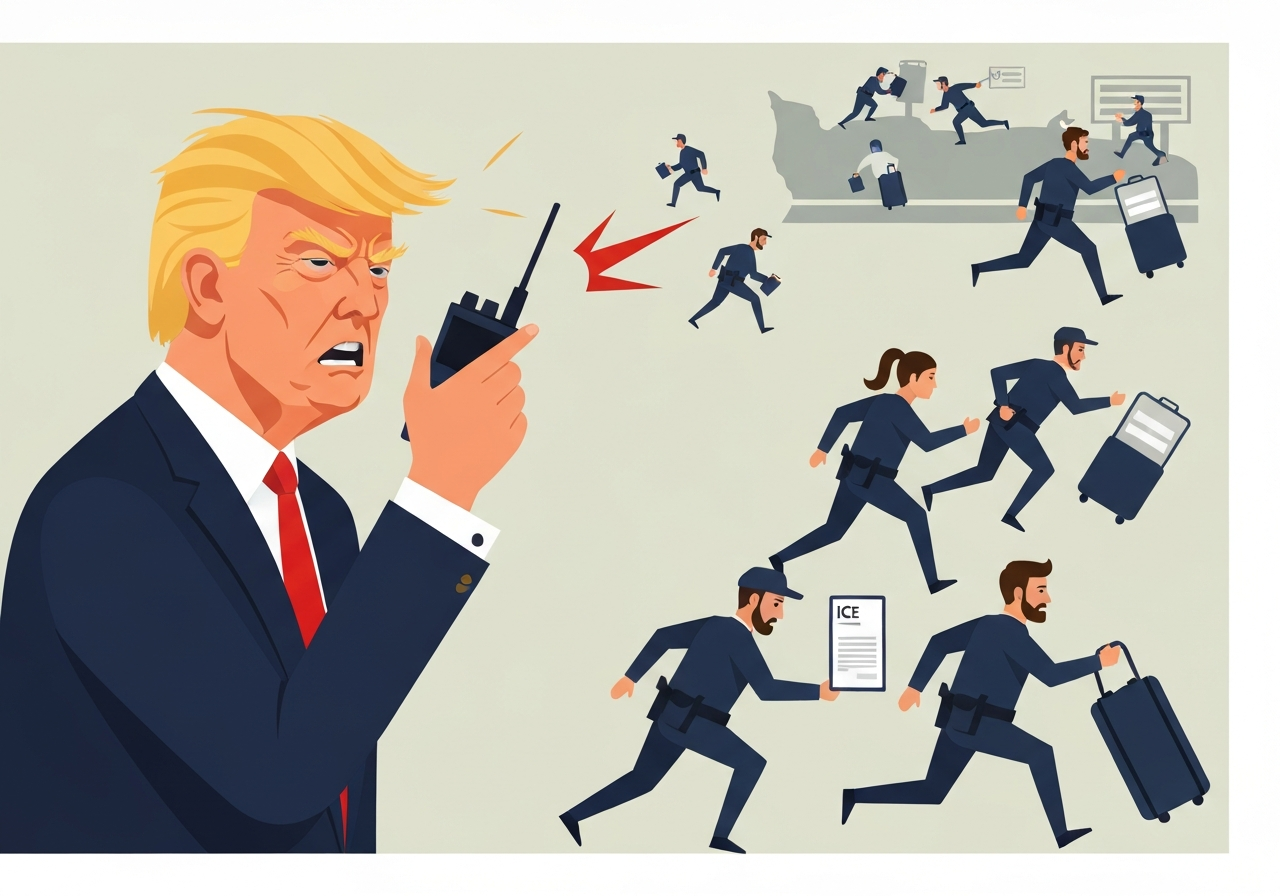
President Donald Trump announced that Immigration and Customs Enforcement (ICE) officers will begin deploying to U.S. airports on Monday to relieve Transportation Security Administration (TSA) staff strained by a partial Department of Homeland Security (DHS) funding lapse. The move, overseen by White House border czar Tom Homan, is intended to help with crowd control and let TSA focus on credentialed screening operations at hubs including Hartsfield-Jackson Atlanta International Airport. Lawmakers remain locked in negotiations over DHS funding as widespread TSA callouts and multi-hour security waits continue. The decision has prompted praise from some officials focused on short-term operational relief and strong objections from unions and Democrats who stress training gaps and possible chilling effects for travelers.
Key takeaways
- ICE deployment announced: The White House said hundreds of ICE officers will deploy to airports starting Monday, with Tom Homan coordinating the effort and Atlanta named as an initial site.
- TSA absences spike: DHS reported more than 11% of TSA employees called out on March 21, the highest single-day rate since the shutdown began, and several major airports saw over one-third of scheduled officers absent.
- Staffing losses: More than 400 TSA officers have quit since the shutdown started about a month ago; unions say over 50,000 TSA employees have gone without pay for weeks.
- Scope disputed: DHS and the mayor of Atlanta said federal personnel would support TSA operations and not conduct immigration enforcement, while some federal officials suggested ICE has relevant screening experience.
- Union and public pushback: The American Federation of Government Employees and flight attendant unions warned ICE lacks aviation security training and called for Congress to pay TSA workers instead.
- Passenger impact: Airports from JFK to LaGuardia and Newark reported multi-hour waits for some passengers; other airports such as Nashville and parts of Newark reported short or normal lines.
Background
The partial DHS shutdown began in mid-February after Congress failed to reach agreement on funding tied to immigration and other measures. DHS contains both TSA, which runs aviation security checkpoints, and ICE, which handles immigration enforcement and removals. As funding lapsed, TSA employees remained on duty without pay; many have called out, taken leave, or resigned, creating gaps in checkpoint staffing across the busiest U.S. airports.
Training and certification for TSA officers is extensive: recruits typically undergo an eight-step hiring process, medical and background checks, and training that includes two to three weeks at the Federal Law Enforcement Training Center plus supervised on-the-job training at assigned airports. ICE officers have different mission training focused on immigration enforcement and border screening, not aviation threat detection. Historically, placing personnel from one agency into another’s front-line security functions has raised legal and operational questions.
Main event
On Sunday the White House announced ICE-ERO and Homeland Security Investigations personnel would be sent to Hartsfield-Jackson Atlanta International Airport beginning Monday to assist with crowd control and to support TSA operations, according to statements from DHS and Atlanta Mayor Andre Dickens. Officials emphasized the deployment was not intended to carry out immigration arrests at checkpoints and that deployed officers would report to TSA for the assignment’s duration.
Tom Homan, named by the White House to oversee the rollout, told CNN agents would be placed in posts that free TSA to focus on credentialed screening — for example staffing exits or monitoring lines rather than operating X-ray machines. DHS said the action would “bolster TSA efforts to keep our skies safe and minimize air travel disruptions,” describing the officers as already funded by Congress.
Still, senior transportation officials offered mixed signals about what ICE officers could practically perform. Secretary of Transportation Sean Duffy pointed to ICE experience with screening assets at border posts as evidence of transferable skills, while former TSA and union leaders countered that X-ray operation, pat-downs and other checkpoint roles require specialized, months-long training.
Airports and passengers reported uneven effects on Sunday: some terminals, like Terminal 5 at JFK, saw 45-minute waits though posted estimates were lower, while Nashville and parts of Newark had short or normal lines. Travel unions urged immediate pay for TSA workers and warned that inserting untrained personnel into aviation security roles risks both safety and passenger confidence.
Analysis & implications
Operationally, deploying ICE officers is a short-term staffing measure aimed at alleviating visible crowding and reducing non-screening tasks that consume TSA time. If ICE personnel limit their activities to non-technical roles such as line monitoring or exit control, the immediate impact on checkpoint throughput could be modest but helpful in busy terminals. However, checkpoint throughput ultimately depends on trained X-ray operators and certified screeners to perform technically demanding tasks.
Politically, the move escalates leverage in the DHS funding standoff. The White House framed the decision as an operational fix, but critics view it as pressure on Democrats to accept broader policy measures tied to the “SAVE America Act.” That linkage risks prolonging the shutdown if either side treats the deployment as a bargaining chip rather than a practical remedy.
From a security and legal standpoint, the substitution raises questions about role clarity, chain of command, and liability. ICE officers lack TSA’s aviation security certifications; assigning them to roles that touch on screening could trigger legal, regulatory, and safety concerns. Community and civil-rights advocates warn that ICE presence may deter travel by noncitizens and families with mixed status, potentially disrupting passenger behavior and complicating airport operations.
Finally, longer-term implications hinge on whether Congress restores full DHS funding quickly. If lawmakers move to pay TSA workers and rebuild staffing levels, the need for cross-agency deployments would likely dissipate. If the shutdown stretches into weeks, airports could face sustained operational strain, more resignations, and cumulative economic impacts on airlines and local businesses.
Comparison & data
| Metric | Reported value |
|---|---|
| TSA callout rate (March 21) | More than 11% |
| Airports with >33% callouts | About half of the nation’s busiest airports |
| TSA resignations since shutdown | More than 400 |
| TSA employees unpaid | Union cites ~50,000 for over five weeks |
These figures illustrate why officials say supplemental personnel are necessary in the near term. Even with ICE present for line management, the bottleneck remains trained screeners. The data also show geographic variation: some airports report minimal disruption while others experience multi-hour waits, so a one-size-fits-all deployment will likely produce uneven effects.
Reactions & quotes
“ICE agents, who are untrained and have caused problems everywhere they’ve gone, lurking at our airports — that’s asking for trouble.”
Senate Minority Leader Chuck Schumer (Senate floor)
Schumer framed the deployment as dangerous and politically motivated, urging lawmakers to prioritize paying TSA workers over personnel substitutions.
“Replacing unpaid TSA workers with ICE agents is not a solution, but a dangerous escalation. ICE agents are not trained or certified in aviation security.”
Everett Kelley, President, American Federation of Government Employees (union statement)
The union emphasized months-long training requirements for aviation screeners and called on Congress to act immediately to restore pay for TSA employees.
“We’re simply there to help TSA do their job in areas that don’t need their specialized expertise, such as screening through the X-ray machine.”
Tom Homan (White House border czar)
Homan described a support-focused role for ICE, though his comment prompted debate over what constitutes “specialized expertise” and which tasks are appropriate for cross-trained personnel.
Unconfirmed
- The exact number of ICE officers to be deployed nationwide and to each individual airport has not been publicly confirmed.
- Precise duties ICE agents will perform at each site — particularly whether they will operate screening equipment or conduct any immigration enforcement — remain unclear.
- The duration of the deployment (“for as long as it takes”) is open-ended and not tied to a public timetable for restoring DHS funding.
Bottom line
The administration’s plan to deploy ICE officers to airports is a rapid-response measure to visible staffing gaps at TSA checkpoints caused by a partial DHS funding lapse. In the immediate term, ICE personnel could ease crowding and free TSA to focus on certified screening tasks, but those operational gains will be limited if trained screeners remain absent in large numbers.
Policy and legal concerns are significant: unions and Democratic leaders argue the move substitutes untrained personnel for specialized security roles and could deter vulnerable travelers, while the White House asserts the measure is temporary and narrowly scoped. The most direct and durable fix remains a legislative resolution to restore DHS funding and pay frontline TSA officers—an outcome that would remove the need for cross-agency stopgaps and address both safety and morale.