
Lead
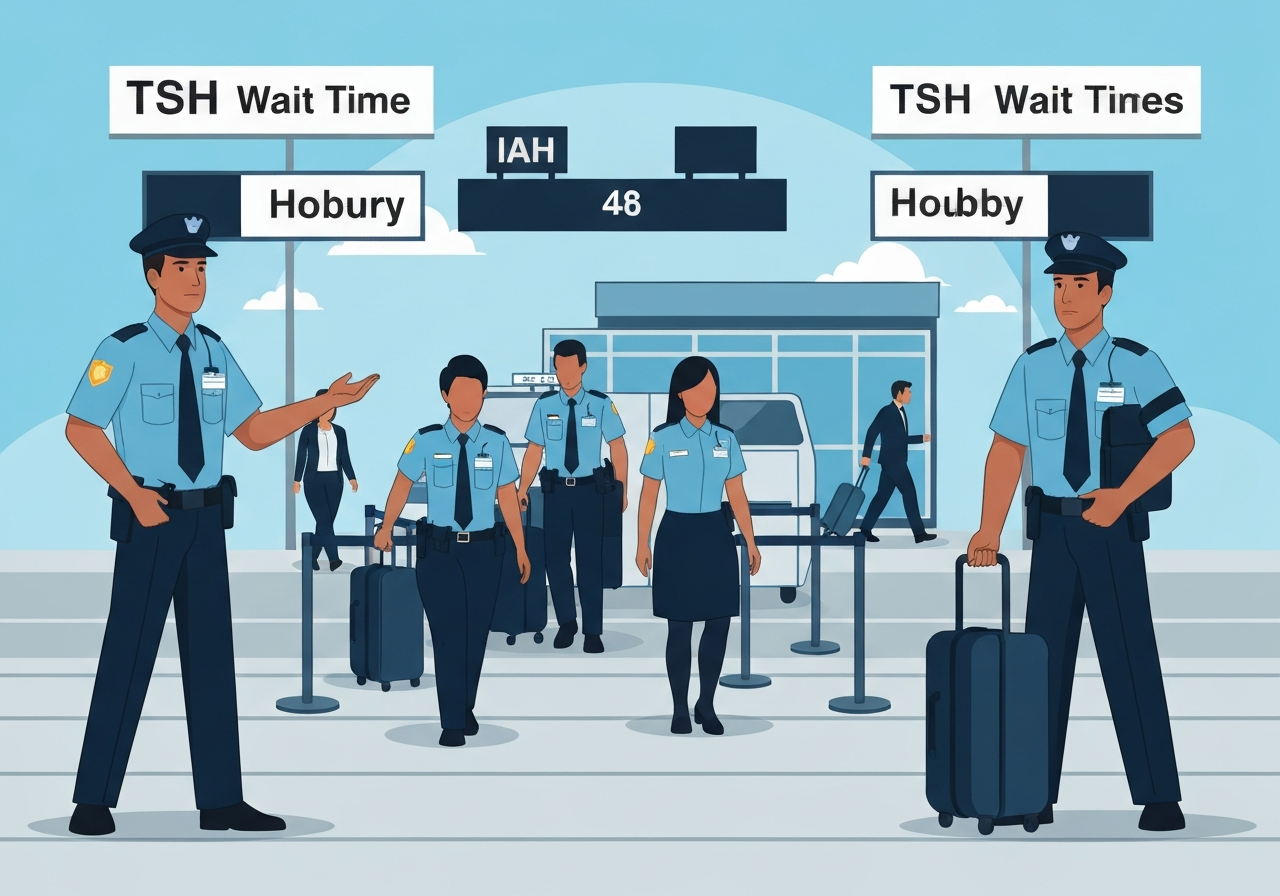
Federal immigration officers were deployed to Houston’s George Bush Intercontinental Airport (IAH) and William P. Hobby Airport on March 23, 2026, as Transportation Security Administration (TSA) checkpoint wait times climbed to roughly four hours in parts of IAH. The presence came amid an ongoing partial federal government shutdown that has left TSA understaffed and several terminals operating with reduced screening capacity. Airport officials warned travelers that only Terminals A and E at Bush were open that afternoon and urged passengers to check with airlines because many could miss evening flights. Airlines and union leaders cautioned that immigration agents are not TSA-certified screeners and that staffing gaps persist until Congress acts.
Key Takeaways
- On March 23, 2026, TSA security lines at George Bush Intercontinental Airport reached about four hours in Terminals A and E, according to airport officials.
- ICE officers were observed at both IAH and Hobby airports beginning in the morning; they largely monitored lines and assisted with crowd movement rather than conducting public enforcement actions.
- TSA has been without appropriations for more than a month amid a partial government shutdown tied to immigration funding debates in Congress.
- TSA callout rates peaked nationally during the shutdown; on Saturday before March 23, more than 47% of scheduled TSA officers at Hobby and over 42% at Bush reported absent, per TSA agency figures.
- PreCheck and CLEAR services were fully or partially closed at Bush Airport that day, pushing more passengers into reduced open checkpoints.
- Passengers and advocacy groups expressed mixed reactions: some welcomed extra personnel for order; others said ICE’s presence in terminals felt intimidating or inappropriate.
- Union leaders and transportation officials warned that ICE lacks TSA’s specialized screening training and cannot substitute for certified TSA officers at checkpoints.
Background
The partial federal government shutdown in early 2026 cut funding for several Department of Homeland Security components, leaving the TSA operating without a full budget. The political impasse centers on immigration enforcement and border policy; Democrats have resisted certain funding conditions, and Republicans have sought stricter enforcement measures. That standoff has produced repeated episodes in which TSA officers have gone unpaid or called out of work, creating gaps in routine airport security staffing.
Large airports have been particularly affected because a smaller percentage of absent officers translates into longer queues when passenger volumes remain high. Bush Airport and Hobby serve distinct traveler mixes—IAH is a major international hub with multiple terminals, while Hobby handles more domestic and regional traffic—but both faced disruptions when checkpoints and expedited lanes were closed or limited. The current deployment of ICE to assist at checkpoints follows a public announcement from the White House that federal immigration officers would be sent to U.S. airports to help manage lines during the shutdown.
Main Event
On the morning of March 23, a group of ICE officers gathered near baggage claim in Terminal A at Bush Airport and were directed by airport staff to spread across areas of the queue. Some agents positioned themselves alongside the winding standard screening line on the terminal’s upper level; others helped guide passengers between segments of the line. At Hobby Airport, ICE officers were observed walking along concourses and standing at intervals without engaging passengers directly.
Airport officials said Terminals A and E were the only fully open checkpoints at Bush that afternoon; CLEAR and most PreCheck operations were closed, and PreCheck had shut down entirely by midmorning in at least one terminal. That consolidation of screening into fewer checkpoints concentrated passengers into longer queues and forced some travelers to transit between terminals to reach an open lane. Houston Airport System staff publicly advised travelers to contact carriers because missed flights were likely.
Passengers reported widely varying experiences. Some, like a Hobby traveler who saw roughly 10-minute waits, said the ICE presence felt unnecessary. Others at Bush described multi-hour, serpentine lines that caused missed flights and significant stress; one passenger said she missed a morning flight to New York and called the trip a “horrible decision” because of the delays. Union leaders for TSA employees criticized the White House decision, arguing ICE lacks the training to perform screening work.
Analysis & Implications
The immediate operational impact of deploying ICE to airport terminals is primarily logistical and symbolic rather than procedural. ICE officers can assist with crowd control and monitoring, but they are not trained or certified for TSA screening tasks such as explosives detection or checkpoint X-ray operation. Unmet staffing needs for TSA therefore cannot be fully closed by reassigning immigration agents, and reliance on ICE shifts attention from the underlying appropriations impasse that produced the shortages.
Politically, the deployment raises tensions between the administration and opponents who view the move as politicizing airport security. Supporters argue that any additional federal presence can help restore order and reassure travelers during a busy travel season. Critics contend the policy risks creating fear among immigrant communities and conflating immigration enforcement with passenger screening, with possible chilling effects on airport patronage for affected groups.
Economically, prolonged checkpoint delays have measurable downstream costs: missed flights, disrupted business travel, and extra staffing or rebooking costs for airlines. For a hub like IAH, repeated severe delays could affect airline schedules, connecting passengers’ itineraries nationwide, and erode traveler confidence. Unless Congress reaches an agreement to appropriate funds, those economic frictions are likely to continue or recur during high-demand travel periods.
Comparison & Data
| Airport | Peak TSA callout rate (reported) | Primary open terminals (Mar 23) |
|---|---|---|
| William P. Hobby (HOU) | 47%+ | All open but high callouts; short waits reported in some areas |
| George Bush Intercontinental (IAH) | 42%+ | Terminals A and E open; PreCheck partially closed |
The table above summarizes publicly reported callout rates cited by TSA and the airport system for the days leading up to March 23. Those callout percentages represent the share of scheduled officers who did not report for duty and are a proximate cause of the consolidated checkpoint operations at Bush. While Hobby saw higher relative callouts on the cited Saturday, passenger experiences varied: Hobby lines were shorter in some terminals that day, whereas Bush experienced multi-hour queues when fewer checkpoints were open.
Reactions & Quotes
Officials, union leaders and travelers offered sharply different perspectives on ICE’s presence and the broader staffing crisis.
Department of Homeland Security leadership framed the deployment as necessary support for travelers strained by staffing gaps.
“Because of the Democrat shutdown, President Trump is using every tool available to help American travelers who are facing hours-long lines,”
Lauren Bis, Acting Assistant Secretary, Department of Homeland Security (official statement)
DHS’s statement placed responsibility for current staffing shortfalls on the funding standoff in Congress and presented ICE deployment as a stopgap for travelers during high-volume periods.
Union representatives pushed back, emphasizing training gaps and safety risks if non-TSA personnel operate at checkpoints.
“Putting untrained personnel at security checkpoints does not fill a gap. It creates one,”
Everett Kelley, National President, American Federation of Government Employees (union leader)
Kelley and other union officials urged Congress to restore funding and criticized what they called a political solution that does not address technical screening requirements.
Passengers interviewed expressed mixed emotions ranging from unease to support depending on personal experience and perspectives on immigration enforcement.
“I don’t feel they have a place here,”
Erika Lawson, Hobby Airport passenger (traveler)
Lawson and other travelers said the sight of immigration agents inside terminals made them uncomfortable; other passengers, however, welcomed the added federal presence as helpful for order during long lines.
Unconfirmed
- Whether ICE officers will conduct enforcement removals or immigration arrests inside terminals on this deployment remains unconfirmed; observers reported monitoring activity but no confirmed enforcement actions that day.
- It is not yet verified whether ICE deployment materially reduced queue times at IAH and Hobby beyond assisting with crowd management; official metrics attributing time-savings to ICE presence were not released.
Bottom Line
The immediate cause of the long TSA lines at Houston airports on March 23, 2026, was a staffing shortfall driven by a partial government shutdown and high callout rates among TSA officers. ICE officers were deployed in a support role and primarily observed assisting with line monitoring and crowd flow rather than operating as certified screeners. The move addresses short-term order but does not substitute for TSA training or the appropriations needed to restore full checkpoint staffing.
Absent a congressional resolution on DHS funding and immigration policy, similar disruptions are likely to recur during peak travel periods. Travelers should check airline communications, arrive early, and verify which terminals and expedited services are operating before their trips. Policymakers face pressure to resolve the funding impasse to prevent further service degradation and the operational and economic costs that flow from multi-hour airport queues.
Sources
- Houston Chronicle (local news report; primary article)
- TSA — Transportation Security Administration (federal agency statements and operational notices)
- U.S. Department of Homeland Security (official press releases and statements)
- U.S. Immigration and Customs Enforcement (ICE) (agency news and statements)
- The Associated Press (photo coverage and wire reporting)