
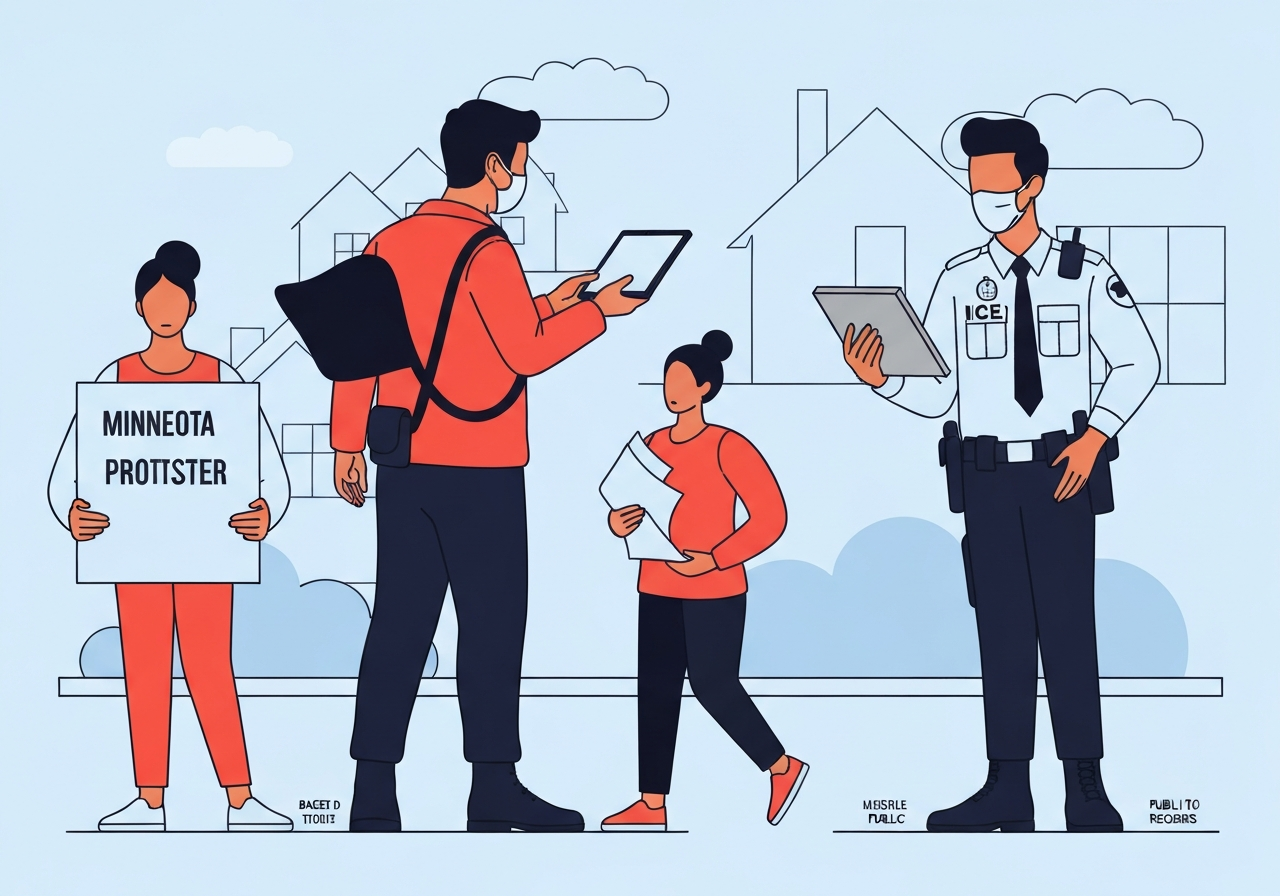
Lead: Federal immigration agents operating in Minneapolis–St. Paul reportedly located and visited the private residences of several protesters, according to nearly 100 sworn statements filed in federal court on Feb. 13, 2026. Protest monitors and witnesses say the encounters included vehicles and officers appearing outside homes, in some cases after citizens followed agents’ movements across the Twin Cities. One monitor, Daniel Woo, 29, said agents arrived at his Plymouth house about 40 minutes after he observed them in St. Paul. The court filings allege a pattern of targeted visits that critics say were intended to intimidate civic observers.
Key Takeaways
- Nearly 100 sworn statements were filed in federal court on Feb. 13, 2026, documenting civil-monitoring encounters with federal agents in the Twin Cities.
- More than a dozen statements describe federal agents appearing at or near protesters’ homes; one witness said his home was reached roughly 40 minutes after agents were seen elsewhere.
- A protest monitor, Daniel Woo, 29, tracked an ICE-associated SUV from St. Paul to his Plymouth residence, alleging the stop was intended to intimidate him.
- Some monitors suspect agents used license-plate identification or other tracking methods to find home addresses, but filings do not establish a single confirmed method.
- Civil-rights organizations and attorneys say the visits raise First and Fourth Amendment concerns; authorities contend operations followed federal enforcement protocols.
- Officials have not publicly confirmed a coordinated policy to visit protesters’ homes; filings and witness accounts form the primary public record so far.
Background
The events described in the sworn statements occurred amid an expanded federal immigration enforcement presence in Minnesota during the early months of 2026. Federal agents, including personnel tied to Immigration and Customs Enforcement operations, were observed at public locations in Minneapolis and St. Paul while activists and volunteers monitored enforcement actions. Civilian monitoring networks—composed of local residents who track agent movements and alert communities—have long been part of protest and oversight efforts around immigration enforcement nationwide.
Historically, tensions between federal immigration authorities and local activists have escalated when enforcement activity expands or becomes more visible. In several U.S. jurisdictions over the past decade, confrontations at entry points, public protests and legal challenges have followed public reports of aggressive enforcement tactics. Minnesota’s recent spike in federal activity drew increased attention from civil-rights groups, local elected officials and lawyers who track potential overreach or intimidation tactics.
Main Event
The filings filed on Feb. 13, 2026 collect nearly 100 sworn witness statements describing encounters across Hennepin and Ramsey counties. In multiple accounts, civilians who were monitoring agents at public sites say they later encountered those same agents at or near their homes. One account details a gray SUV leaving a St. Paul parking lot, being followed by a monitor who later saw the vehicle park outside his Plymouth residence about 40 minutes after the initial sighting.
Witnesses reported that agents sometimes photographed cars and license plates and, in several incidents, approached or lingered near residences. Monitors characterized those actions as overtly intimidating because they indicated a knowledge of protesters’ private addresses. The sworn statements do not uniformly identify precisely how agents obtained addresses, and investigators have not publicly confirmed the mechanisms used.
Federal authorities responded to inquiries by emphasizing the legal basis for immigration enforcement, while local advocates and lawyers detailed potential constitutional implications. The filings—now part of a federal court record—have become the primary source for public scrutiny, prompting calls for a formal inquiry and for disclosure of enforcement protocols used during the operations in question.
Analysis & Implications
If substantiated, visits by federal agents to protesters’ homes mark a notable expansion of enforcement tactics into private spaces and raise complex legal and policy questions. The First Amendment protects peaceful monitoring and expression; showing up at monitors’ residences can chill civic participation by signaling personal exposure. The Fourth Amendment also limits unreasonable searches and seizures, and home visits tied to enforcement activities can trigger legal scrutiny if they lack appropriate legal authority or oversight.
The alleged use of vehicle tracking, license-plate recognition, or other data sources to locate monitors would reflect wider technological shifts in how law enforcement identifies individuals. Law enforcement agencies increasingly rely on automated license-plate readers, commercial data brokers and interagency databases—tools that can rapidly convert a public sighting into a private address. Those capabilities have outpaced some policy frameworks, prompting debates over oversight, retention limits and disclosure to the public.
Politically, the episodes could intensify friction between federal agencies and local officials in Minnesota, where elected leaders and community groups have pushed back against immigration sweeps in the past. Legal challenges based on the statements could force courts to evaluate whether agents exceeded statutory or constitutional authority and whether notice, scope or intent of the visits warrant remedies or injunctions.
Comparison & Data
| Item | Reported Count / Detail |
|---|---|
| Sworn statements filed | Nearly 100 (filed Feb. 13, 2026) |
| Statements describing home visits | More than a dozen |
| Example case | Daniel Woo, 29 — vehicle followed from St. Paul to Plymouth (~40 minutes) |
The table summarizes the specific counts included in the filings and highlights a representative case. While the filings quantify the scope of witness reports, they do not establish prosecutorial or administrative findings; those determinations remain subject to review by courts or oversight bodies.
Reactions & Quotes
Local monitors and civil-rights advocates have framed the reported home visits as a form of intimidation that chills lawful civic oversight. Below are representative statements from stakeholders and institutions, with context.
Context: A protest monitor who followed an ICE-associated vehicle described an encounter that culminated with agents appearing near his home. He later submitted a sworn statement to federal court.
They said the agents came by to intimidate and to make clear they knew where the monitor lived.
Local protest monitor (sworn statement)
Context: A civil-rights group called for transparency and possible investigation, arguing that the involvement of federal agents at private residences raises constitutional concerns and warrants oversight.
Showing up at people’s homes for merely observing enforcement chills speech and raises serious civil‑liberties questions.
ACLU of Minnesota (organization statement)
Context: Federal authorities provided a standard defense of immigration enforcement operations when contacted, emphasizing legal authority and public-safety considerations.
We conduct immigration enforcement consistent with federal law and internal policies; operations are carried out under legal authorities.
ICE spokesperson (official statement)
Unconfirmed
- No independent public record has yet confirmed a single, uniform method (such as license-plate readers or database queries) that agents used to identify monitors’ home addresses.
- It is unconfirmed whether visits outside residences were coordinated as an agency policy directive rather than isolated operational choices by individual officers.
- There is no public court finding yet that the reported visits violated constitutional or statutory requirements; legal outcomes remain pending.
Bottom Line
The sworn statements filed on Feb. 13, 2026 present a consistent set of allegations that federal agents were present at or near the homes of citizens who had been monitoring public immigration enforcement. If corroborated, those actions could alter expectations about the boundary between public enforcement and private life, intensifying calls for oversight and clearer rules on data use and field conduct.
In the near term, expect demands for administrative records, internal reviews and possible litigation to clarify how addresses were identified and whether actions complied with law. For communities and advocates, the key issues will center on transparency, accountability, and whether existing protections are sufficient to prevent chilling of lawful protest and oversight.
Sources
- The New York Times — news report summarizing sworn statements and witness accounts (media).
- U.S. Immigration and Customs Enforcement (ICE) — agency news and official statements (official source).
- ACLU of Minnesota — regional civil‑liberties organization statements and advocacy (civil‑rights group).