
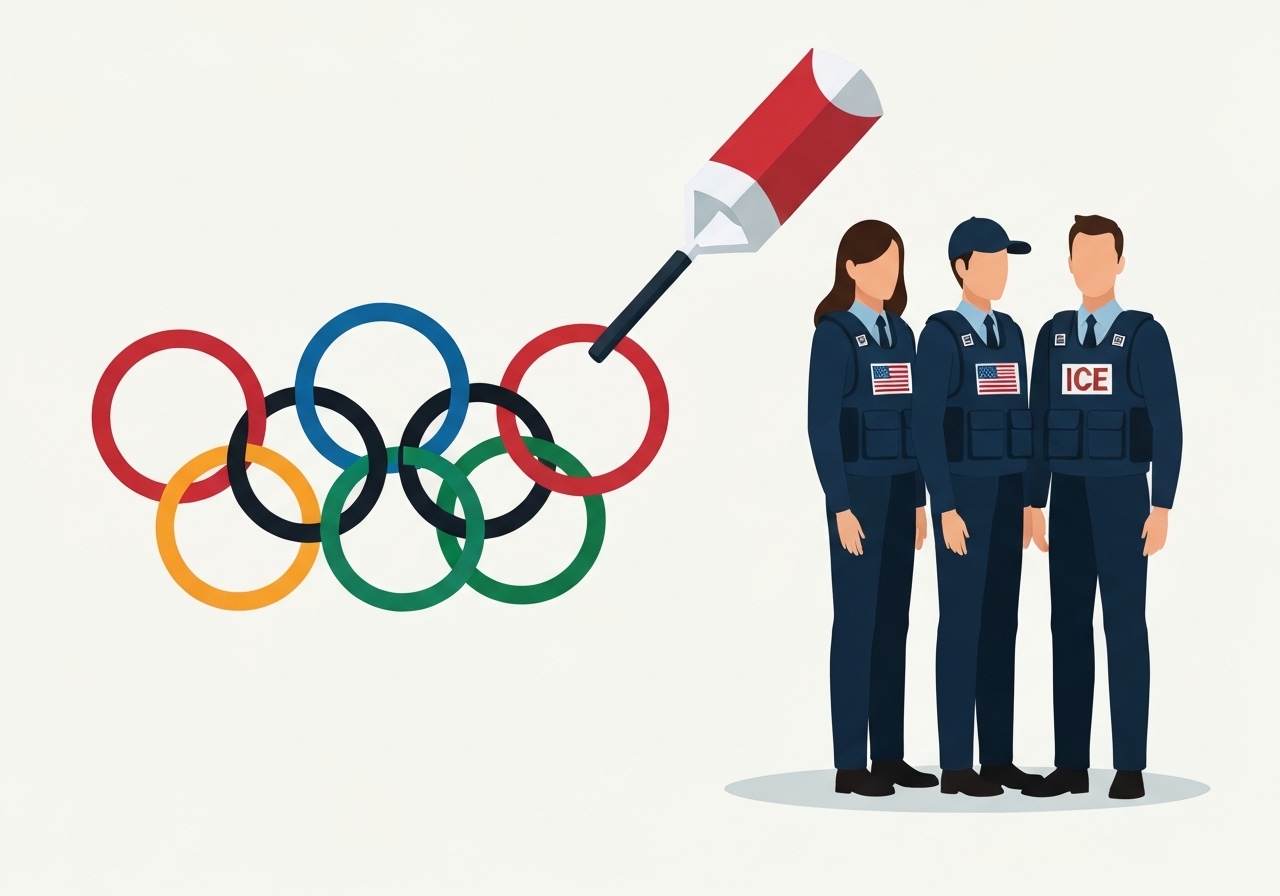
US Immigration and Customs Enforcement (ICE) confirmed it will deploy Homeland Security Investigations (HSI) personnel to support American security arrangements at the Milan–Cortina Winter Olympics, which begin on 6 February. The announcement came amid public outrage in Italy after images and reporting from Minneapolis — where federal agents have been linked to two fatal shootings — renewed scrutiny of ICE. Italian local officials and national politicians reacted with alarm, saying the presence of US immigration agents on Italian streets was unwelcome. ICE and embassy sources emphasized that operational responsibility and authority would remain with Italian authorities.
- ICE stated HSI personnel will assist the US Department of State’s Diplomatic Security Service and host-nation partners to vet and mitigate transnational criminal threats during the Games.
- The 2026 Winter Olympics run in Milan–Cortina from 6 to 22 February; the Games will host athletes and delegations from dozens of countries.
- Reports referenced two fatal shootings in Minneapolis that involved federal agents, and the death of Alex Pretti has intensified political sensitivity in Italy.
- Milan Mayor Beppe Sala publicly said ICE agents were “not welcome in Milan,” reflecting local leaders’ unease.
- Italy’s interior minister, Matteo Piantedosi, later insisted ICE would not carry out immigration enforcement on Italian territory and that national security responsibility rests with Italy.
- Rai reporters in Minneapolis reported being threatened by ICE officials while covering the events, a development that fueled Italian media reaction.
- Regional officials and opposition politicians warned the episode raises questions about sovereignty, oversight and transparency in multinational security cooperation.
Background
The presence of foreign law-enforcement personnel at Olympic Games is not unusual; diplomatic security and intelligence-sharing between allies typically increase around major international events. US federal agencies have historically worked alongside host countries to protect US delegations and to identify transnational criminal or terrorism-related risks. What changed this time is the backdrop: recent incidents in Minneapolis in which federal agents were linked to two fatal shootings have generated intense public concern and media coverage.
Those images and reports resonated strongly in Italy, where memories of policing controversies and debates over migration and civil rights are politically salient. Italy’s national government, regional authorities and local mayors have different accountability layers and sensitivities about foreign security presences in public spaces. Prime Minister Giorgia Meloni’s right-leaning government faces criticism from opposition parties that any perceived acquiescence to US requests could be framed as undermining national sovereignty.
Main Event
ICE provided a statement confirming that HSI will support the US Department of State’s Diplomatic Security Service and the host nation in vetting and mitigating risks posed by transnational criminal organisations during the Milan–Cortina Games. The agency explicitly said it would not conduct immigration enforcement operations outside the United States. That clarification followed reporting that prompted alarm among Italian officials and the public.
Italian embassy sources told local media that multiple US federal agencies have participated in security planning at previous Games, though it was unclear whether ICE itself deployed officers in prior events. The initial lack of detailed notification to Italian authorities and the public contributed to diplomatic friction and demands for clarification from Rome.
Local reactions were swift. Milan’s mayor, Beppe Sala, said ICE agents were unwelcome after images from Minneapolis, where ICE officers have been connected to two fatal shootings, circulated in Italian media. Italy’s interior minister Matteo Piantedosi first appeared unaware of the planned ICE presence and later stated ICE would not operate on Italian soil in an enforcement capacity.
Reports also noted that two Rai journalists covering the Minneapolis events said they were threatened by ICE officials while filming, an incident that amplified concerns in Italy about how ICE agents behave in public. Regional figures, including Lombardy governor Attilio Fontana, attempted to calm the situation by suggesting any US security personnel would be deployed to protect visiting US officials, naming US Vice President JD Vance and Secretary of State Marco Rubio as examples raised in public discussion.
Analysis & Implications
The episode highlights a recurring tension between cooperative international security practices and domestic political sensitivities. On one hand, embedding liaison officers from allied agencies can improve threat detection and coordinate protective measures for visiting delegations. On the other, visible deployments by a foreign immigration enforcement agency carry reputational risk and can inflame local opposition when recent controversies exist.
Diplomatically, the US faces the task of balancing operational support for its delegations with respect for host-nation authority and public sentiment. For Italy, the incident forced rapid public messaging to reassure citizens that sovereignty and policing authority remain Italian while managing relations with a key NATO ally. The interior minister’s reassertion that ICE will not perform enforcement tasks on Italian territory was aimed at limiting legal and political fallout.
For ICE and HSI specifically, association with contested incidents abroad — even in a support role — can complicate cooperation with foreign partners and reduce trust among local populations. If host cities or regions insist on strict limits or public transparency about foreign personnel, future deployments could become more constrained or conditional on detailed oversight arrangements.
Comparison & Data
| Item | Detail |
|---|---|
| Milan–Cortina Olympics | 6–22 February (17 days), multiple venues in northern Italy |
| Minneapolis incidents | Two fatal shootings involving federal agents reported in local coverage; linked reporting has driven international scrutiny |
The table summarizes the timing of the Games and the catalyst — Minneapolis reporting — that intensified Italian scrutiny. The key context is that the Games will be a concentrated, high-profile event with many international delegations, increasing the stakes for both security and public perception.
Reactions & Quotes
Local and national figures publicly expressed concern and demanded clarity. Reactions combined political critique with calls for Italy to assert control over public security decisions.
“They are not welcome in Milan,”
Beppe Sala, Mayor of Milan (local official)
Milan’s mayor linked the planned presence to images from Minneapolis and framed it as incompatible with the city’s expectations for democratic policing. His comment reflects municipal-level unease that can shape local logistics and reception.
“ICE’s HSI is supporting the US Department of State’s Diplomatic Security Service and host nation to vet and mitigate risks from transnational criminal organisations. It will not conduct immigration enforcement outside the US,”
ICE spokesperson (agency statement)
ICE’s statement aimed to be narrowly procedural, emphasizing a vetting and threat-mitigation role and denying any extraterritorial immigration enforcement. That distinction is central to how the deployment is framed legally and politically.
“ICE will certainly not operate on Italian national territory,”
Matteo Piantedosi, Italy’s Interior Minister (government official)
The interior minister’s reassertion sought to reaffirm Italian jurisdiction and to calm tensions after initial confusion about notification and roles.
Unconfirmed
- Exact roster and number of ICE/HSI personnel to be deployed to Italy have not been publicly released.
- Whether ICE officers will have any frontline, visible patrol duties in public urban areas of Milan or Cortina remains unclear.
- Full operational arrangements between US agencies and Italian security services, including formal agreements or limits on activity, have not been published.
Bottom Line
The planned deployment of ICE HSI personnel to the Milan–Cortina Winter Olympics underscores the friction that can arise when routine international security cooperation intersects with high-profile domestic controversies. Italian leaders and local officials have reacted strongly because of fresh images and reporting from Minneapolis that linked US federal agents to two fatal shootings, and public sentiment has shaped a rapid political response.
Practical cooperation to protect delegations and counter transnational threats remains feasible, but it will depend on clear, transparent arrangements that respect Italian authority and address reputational concerns. How the US and Italian governments document roles, notify host communities and manage public information in the coming days will determine whether the episode becomes a temporary diplomatic hiccup or a longer-term source of tension.
Sources
- BBC News (international news media)
- U.S. Immigration and Customs Enforcement (ICE) (official agency site; statement cited)
- U.S. Department of Homeland Security (DHS) (official federal department)
- Agence France-Presse (AFP) (news agency referenced in reporting)
- Associated Press (AP) (news agency referenced in reporting)