
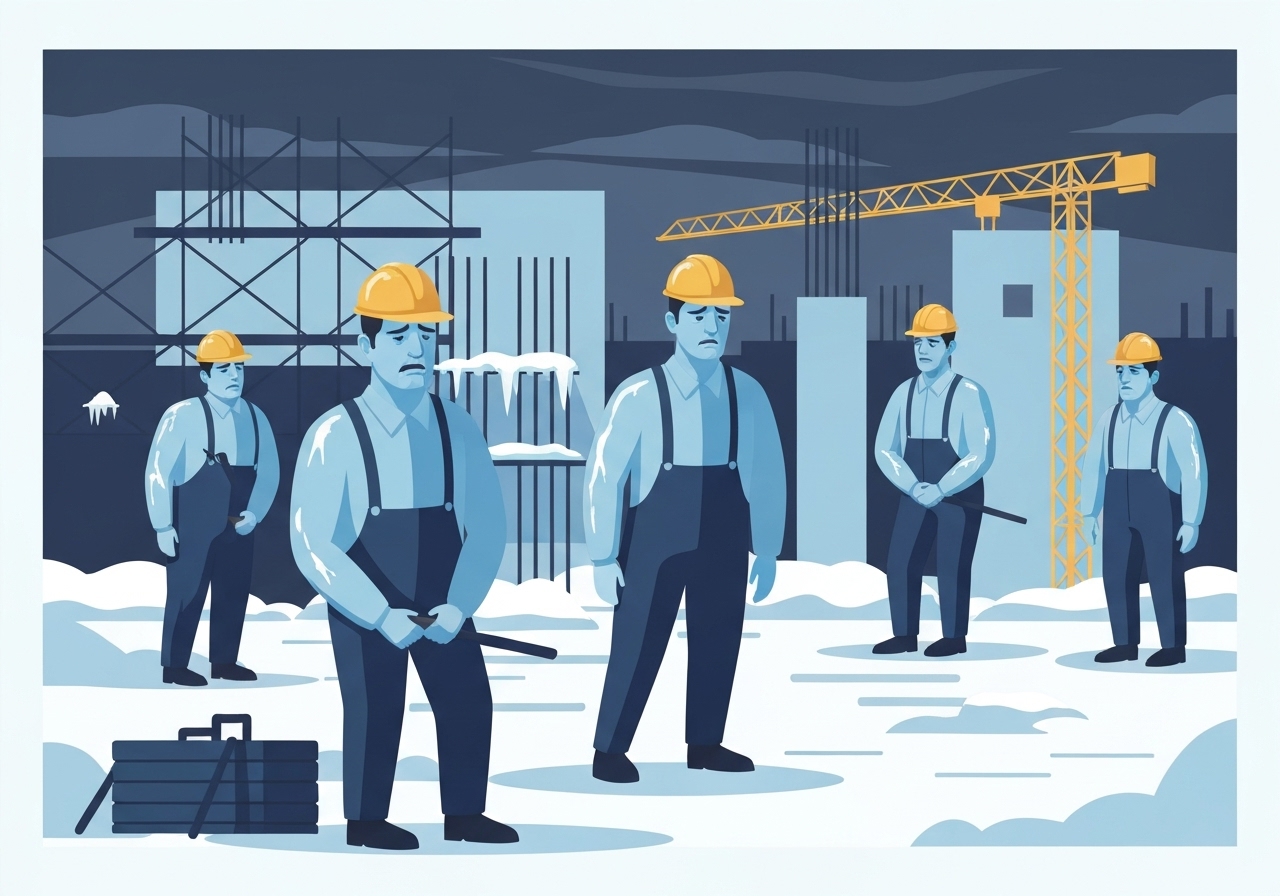
Across multiple U.S. job sites this year, Immigration and Customs Enforcement (ICE) activity is unnerving crews and slowing projects. Contractors and union and non-union workers say intensified enforcement — including checkpoints and targeted arrests — has reduced labor availability, raised costs and delayed federally and privately funded work. In Washington, D.C., a contractor with a 30-person crew says routine stops by agents interrupted a $128 million bridge refurbishment and left managers reluctant to hire. Industry groups warn the enforcement comes on top of a labor shortage that predates the current administration and could deepen construction bottlenecks nationwide.
Key Takeaways
- ICE enforcement has coincided with project disruptions: a Washington bridge crew of about 30 reported delays on a $128 million federal refurbishment after workers were detained en route to the site.
- Industry-wide labor scarcity is acute: an Associated General Contractors (AGC) summer survey found 92% of firms reporting trouble filling positions, and 28% saying immigration actions affected staffing in the prior six months.
- Measured impacts include missed shifts and crew shrinkage: 5% of AGC respondents said ICE visited a jobsite, 10% lost workers to confirmed or rumored raids, and 20% reported subcontractors losing staff due to fears of enforcement.
- Policy shifts have removed or driven out workers: DHS reported roughly 400,000 formal removals since the start of the administration’s second term and an agency estimate that 1.6 million people self-deported.
- Structural shortages predate the crackdown: unionization has fallen to just over 10% of construction workers from nearly 40% in 1973, reducing a traditional training pipeline.
- Regional concentrations heighten vulnerability: a 2023 NAHB report shows California and New Jersey at 41% foreign-born construction workforces; Texas and Florida at 38% each.
- Economic consequences are measurable: the Home Building Institute estimates worker shortages cost the home-building industry about $11 billion annually, while the gap in housing supply is near 1.5 million units.
Background
The U.S. construction sector has long relied on immigrant labor to fill skilled and semi-skilled roles across residential, commercial and infrastructure projects. Over the past 25 years, employers have increasingly turned to foreign-born workers — both documented and undocumented — as native-born participation in trades declined and enrollments in four-year colleges grew. Economists and trade groups say the pattern accelerated after the Great Recession, when many U.S.-born workers left construction and immigrant labor became central to meeting demand during the recovery.
Starting the first day of his second term, President Trump issued a series of executive actions aimed at reducing illegal immigration, coupled with expanded enforcement by ICE and DHS. Officials report hundreds of thousands of removals and agency estimates of large numbers who have left the country without formal deportation. At the same time, the administration has proposed workforce measures and temporary offices intended to expand legal hiring channels, but industry leaders say details and capacity remain vague.
Main Event
On a federally funded bridge project in Washington, D.C., contractor Rurick Palomino — a U.S. citizen who grew his business to 45 employees before trimming staff — says his 30-person crew has been disrupted by immigration stops. Palomino reports that ICE checkpoints on nearby highways have detained workers for hours, leaving tasks unfinished and schedules pushed back on a $128 million Theodore Roosevelt Bridge refurbishment.
Across the country, federal agents have conducted raids and site arrests tied to immigration enforcement. DHS says ICE carried out more than 100 arrests at a Tallahassee construction site in June; other operations in October and summer actions near Los Angeles supply stores also drew attention. In some incidents, people fleeing enforcement suffered harm, including a Guatemalan man struck and killed after attempting to cross a freeway.
Survey data and trade-group interviews indicate the enforcement climate is producing absenteeism beyond those directly detained. Firms report workers not showing up, crews operating short-handed mid-shift, or subcontractors declining contracts because employees fear transit to sites. Industry economists warn those interruptions slow the stepwise sequencing of construction tasks and increase costs for owners and contractors.
Analysis & Implications
The immediate effect of intensified enforcement is a reduction in available labor-hours, forcing firms to delay stages of work that require skilled tradespeople such as roofers, drywall installers, plasterers and flooring specialists. Those skill gaps are not easily filled by casual or short-term hires: training and experienced trade knowledge matter for safety and quality. As a result, projects already facing supply-chain and financing pressures can become significantly more expensive and protracted.
Wage pressures are likely to rise. Analysts expect contractors to pay more for certified and documented workers as the pool shrinks, squeezing margins for small and mid-sized firms and raising costs for homebuyers and public owners. At the same time, declining union density has weakened a domestic pathway for training apprentices, which limits the capacity to replace lost immigrant labor with U.S.-born workers in the short to medium term.
Policy responses touted by the administration — workforce modernization orders and a temporary Department of Labor immigration office — could create channels for legal hiring if implemented quickly and at scale. But experts caution that structural changes in pay, safety standards and career ladders are needed to attract native-born workers. Without parallel reforms, rapid enforcement may trigger business closures, reduced project starts and slower infrastructure delivery.
Comparison & Data
| Metric | Figure | Source |
|---|---|---|
| Construction firms struggling to hire | 92% | AGC summer survey (trade association) |
| Firms reporting immigration impacts (6 months) | 28% | AGC survey |
| Estimated removals since second term start | 400,000 | DHS (official) |
| Estimated self-departures | 1.6 million | DHS (estimate) |
| Home-building annual loss from shortages | $11 billion | Home Building Institute (industry) |
| Housing supply shortfall | ~1.5 million units | NAHB (trade association) |
| Foreign-born share — CA / NJ | 41% | NAHB 2023 report |
| Union share of construction workforce | ~10% (record low) | Associated Builders & Contractors analysis |
The table highlights how enforcement intersects with an existing structural shortfall. Regions with higher shares of foreign-born workers — notably California, New Jersey, Texas and Florida — face disproportionate exposure to workforce disruptions. For contractors, the arithmetic is straightforward: fewer reliable workers means slower completion, higher hourly rates or hiring through brokers at greater cost.
Reactions & Quotes
Contractors and industry groups offered mixed responses, balancing policy support for enforcement with practical concerns about project continuity.
“There is no shortage of American minds and hands to grow our labor force,”
Abigail Jackson, White House spokeswoman (statement)
The White House framed enforcement as an opportunity to expand American hiring, saying administration policies aim to open jobs for U.S.-born workers and enforce immigration laws. Industry leaders counter that low unemployment and long-standing barriers to skilled-trades careers make rapid replacement unlikely without major changes to pay and recruitment.
“Firms say it’s extremely disruptive when workers fail to show up or leave in the middle of a task,”
Ken Simonson, Chief Economist, AGC
AGC’s chief economist noted that missing crew members interrupt sequential work stages, increasing owner and contractor costs and slowing projects. The association’s survey quantifies those disruptions and flags potential escalation if enforcement activity continues.
“That in and of itself is resulting in crews not showing up,”
Sergio Barajas, National Hispanic Construction Alliance
Barajas emphasized that anxiety — not only actual arrests — is affecting attendance and operations, and that some Latino-owned firms are altering visible branding to avoid attention. Such behavioral changes can reduce subcontractor capacity and complicate scheduling for larger prime contractors.
Unconfirmed
- Nationwide tally of ICE jobsite visits remains incomplete; many local reports are anecdotal and not yet compiled into a single federal dataset.
- Precise counts of productivity losses due solely to enforcement are estimated by trade groups but lack a standardized, peer-reviewed methodology.
- The long-term effects of the administration’s temporary labor offices and executive orders on hiring flows are not yet measurable.
Bottom Line
Enforcement activity by ICE is amplifying a construction labor shortage that has deep, structural roots. In the short term, crews are showing up in smaller numbers, projects are slowing, and owners face higher costs — outcomes that are already visible in bridge and building projects reported this year. For many contractors, the choice is stark: bid higher for scarce legal labor, rely on informal hiring practices that carry legal and reputational risks, or scale back work.
Longer term, policymakers and industry leaders will need coordinated strategies that combine clear legal hiring channels, investment in domestic training pathways, and improved compensation and safety standards to attract U.S.-born workers. Without that mix, enforcement alone risks shrinking the available workforce and leaving critical infrastructure and housing projects delayed or unaffordable.
Sources
- NPR — reporting on ICE enforcement and construction impacts (media)
- Associated General Contractors (AGC) — summer survey results (trade association)
- U.S. Department of Homeland Security (DHS) — enforcement statistics and statements (official)
- National Association of Home Builders (NAHB) — workforce and housing gap data (trade association)
- Home Building Institute (HBI) — industry cost estimates (industry organization)
- Economic Policy Institute (EPI) — modeling of deportation scenarios and labor impacts (research institute)
- Associated Builders and Contractors — analysis of unionization trends (trade association)
- Center for Urban Economic Development, University of Illinois Chicago — expert commentary on immigrant labor (academic)