
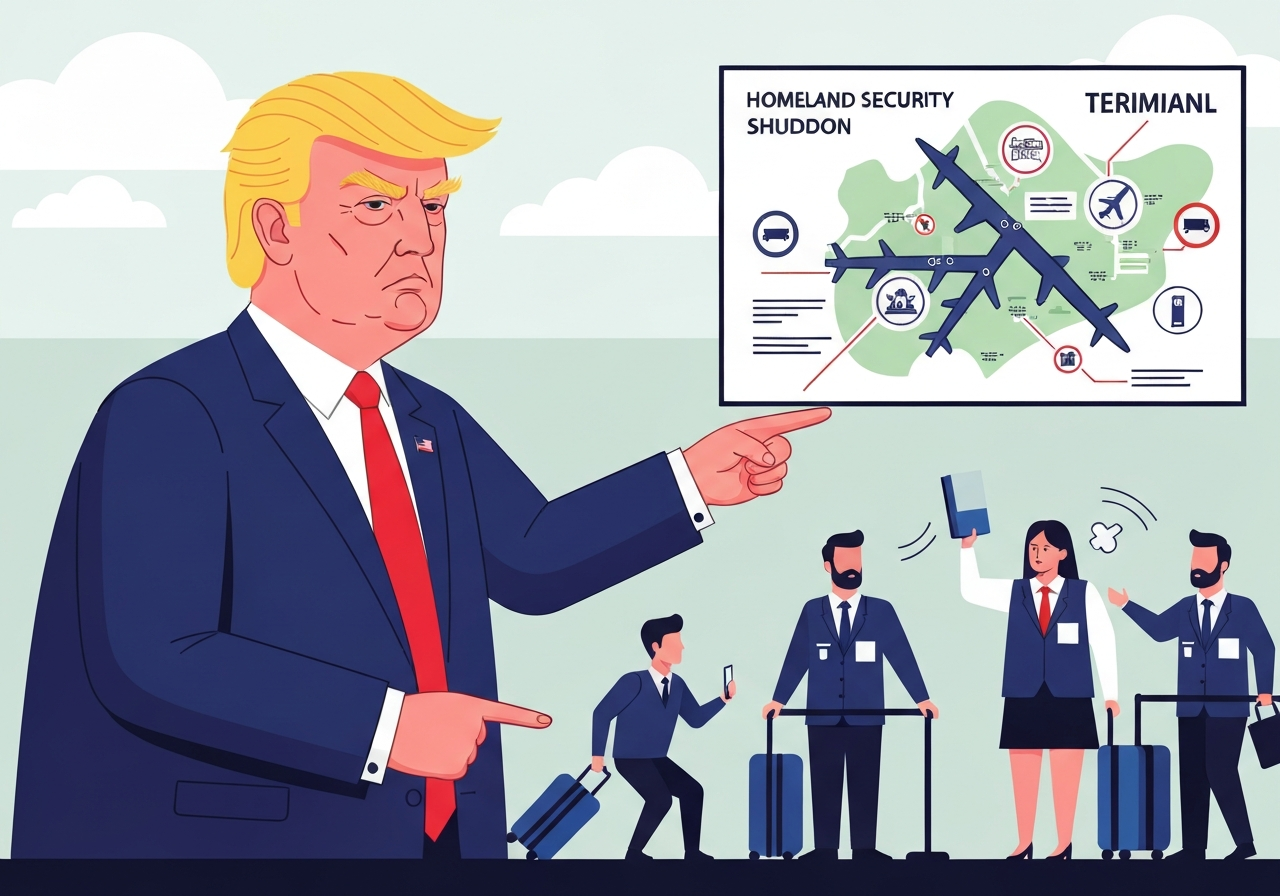
President Donald Trump said on Saturday he would order Immigration and Customs Enforcement (ICE) agents into U.S. airports as a response to a five-week partial Department of Homeland Security (DHS) funding lapse that has left Transportation Security Administration (TSA) staff working unpaid. The announcement, posted on his social platform, framed the move as a remedy for long security lines and staffing shortfalls while placing new emphasis on immigration arrests. The comments follow growing operational strain at airports, where some TSA officers have quit or called out sick, producing delays at major hubs. The president also singled out migrants from Somalia for stepped-up enforcement, renewing earlier attacks on that community.
Key Takeaways
- The statement came at the five-week mark of a partial DHS shutdown after Congress missed a February 14 funding deadline, affecting agencies including TSA, ICE and Customs and Border Protection (CBP).
- About 50,000 TSA employees have been working without pay; the agency reported 366 resignations as of March 17 and a 55% callout rate at Houston Hobby International Airport on March 14.
- Trump said he would move ICE into airports to perform security tasks and to arrest undocumented migrants, with specific emphasis on individuals from Somalia.
- Legal and operational experts question whether ICE has the training and statutory mandate to perform TSA screening duties at civilian airports.
- Democrats are pushing for DHS enforcement reforms — including clearer identification and warrants in some operations — while Republicans have rejected separating TSA funding from immigration enforcement budgets.
- Two recent fatalities linked to immigration enforcement operations in Minnesota — the deaths of Renee Good and Alex Pretti — are part of the background to the political impasse.
Background
The impasse began after Congress failed to pass a full DHS appropriation by the February 14 deadline, triggering a partial shutdown that has left critical parts of the department operating on limited funds. DHS houses a broad set of missions from border management to counterterrorism, and the current funding gap has disproportionately affected frontline screening and aviation security personnel. TSA officers, who continue to staff airport checkpoints, have been operating without pay for weeks; that strain has translated into increased resignations and absences, and longer passenger wait times at several airports.
Lawmakers are divided over how to resolve the funding gap. Democrats have sought changes to immigration enforcement practices and proposed oversight measures for ICE and CBP, including steps to reduce racial profiling and to require clear identification and judicial oversight for certain home entries. Republicans, including the president, have demanded that Congress approve funding that encompasses stricter immigration measures, and have resisted efforts to separate TSA funding from funding for ICE and CBP.
Main Event
On Saturday, President Trump used his social platform to warn that, unless Democrats agreed to his terms, he would deploy ICE agents to airports to address what he described as security failures caused by the shutdown. He framed the move as an operational fix for understaffed checkpoints and also as an enforcement action targeting undocumented migrants. The tweets and posts came during a week that marked five weeks of the DHS funding lapse and amid public frustration over long airport lines.
The president explicitly tied the threat to the broader budget fight, saying he would withhold signature from appropriations unless they met his demands. He also reiterated earlier, derogatory criticisms of Somali migrants and blamed Democrats for undermining airport safety. That rhetoric echoed comments from December in which he disparaged Somali communities and singled out Minnesota, which has the largest Somali American population in the U.S. and is home to Representative Ilhan Omar, a frequent critic of the president.
Federal officials and airport operators have pushed back on the practicality of the proposal. TSA screening requires specialized training and certification; ICE officers are principally charged with immigration investigations and removals, not screening inbound passengers for explosives or prohibited items. Agency spokespeople and independent analysts warned that substituting ICE for TSA could create legal, operational and safety complications inside crowded terminals.
Analysis & Implications
Operationally, moving ICE into checkpoint roles faces immediate hurdles. TSA officers receive training specific to aviation security procedures, checkpoint technology and standardized screening protocols. ICE has distinct mission training focused on immigration enforcement and investigations, and lacks the routine checkpoint training TSA personnel complete. Substituting personnel without comparable training could increase safety risks and slow processing times rather than speed them up.
Legally, the proposal touches on jurisdiction and authority within DHS. TSA operates under statutory aviation-security mandates and works closely with carriers and airport authorities; ICE’s statutory responsibilities center on immigration enforcement and removals. Placing immigration agents in passenger-processing roles could raise questions about mission creep, Fourth Amendment protections, and whether passengers would be subject to civil immigration enforcement actions in transit areas where they expect security screening but not immigration arrests.
Politically, the threat is a pressure tactic in a high-stakes appropriations fight. The president’s warnings are designed to push reluctant lawmakers to fund his immigration priorities by framing the choice as one between national security and political obstruction. Democrats have leveraged public concern about civil liberties and agency conduct, especially after fatal enforcement operations in Minnesota, to demand oversight and reform; Republicans have used the airport delays to argue for stronger border and interior enforcement.
Internationally and domestically, the move could produce reputational costs and legal challenges. Airports are sensitive civilian spaces with families, elderly passengers and international visitors; visible immigration raids or the appearance of militarised enforcement could provoke outcry, litigation and diplomatic complaints, particularly if operations target specific national-origin groups.
Comparison & Data
| Metric | Reported Figure |
|---|---|
| TSA employees working unpaid | ~50,000 |
| TSA resignations (as of March 17) | 366 |
| Highest recorded callout rate (Houston Hobby, March 14) | 55% |
| Length of partial DHS shutdown | Five weeks (as of March 21) |
These figures show acute staffing pressure on TSA checkpoints. A 55% callout at a single airport translates into severely reduced screening capacity for that location on the reported day, and continued resignations compound the shortage. While TSA is responsible for immediate passenger screening, ICE is primarily staffed and trained for immigration cases and removals; substituting ICE for TSA would not instantly replace institutional expertise quantified above.
Reactions & Quotes
Official and public responses split along political lines, with some Republican officials welcoming a forceful approach to border security and Democratic leaders warning of civil-rights harms and operational impracticality.
“If the Radical Left Democrats don’t immediately sign an agreement…I will move our brilliant and patriotic ICE Agents to the Airports,” the president wrote, signaling a forceful enforcement posture tied to the funding fight.
President Donald Trump (social post)
Administration remarks framed the proposal as a solution to airport backlogs; opponents argued it risked turning security checkpoints into immigration enforcement sites and could undermine public trust.
“TSA screening is a specialized mission; moving other agencies into that role raises safety and legal questions that cannot be ignored,” a former federal security official said, urging Congress to resolve funding to restore trained personnel.
Former federal security official (expert comment)
Some local leaders and civil-rights advocates cautioned that targeting specific national-origin communities would inflame tensions and could lead to discriminatory enforcement in public spaces.
“We are concerned that these threats, and singling out Somalis, will lead to profiling and community harm,” a Minnesota community advocate said, citing prior comments and recent enforcement-related fatalities.
Minnesota community advocate
Unconfirmed
- Whether ICE can be legally and immediately authorized to perform TSA screening duties without formal reassignments or new statutory authority remains unconfirmed.
- Specific operational plans, timelines or airport-by-airport deployment orders from the administration have not been publicly released or corroborated.
- The president’s claim that ICE would make immediate mass arrests at airports and the projected scale of such actions are not independently verified.
Bottom Line
The president’s threat to deploy ICE to airports is both a political maneuver tied to the DHS funding standoff and a proposal with tangible operational and legal complications. TSA staffing shortfalls are real and affecting passenger flows, but ICE does not currently have routine checkpoint training or a statutory mandate equivalent to TSA’s aviation-security role. Implementing the president’s proposal would require legal authorization, rapid retraining, and careful coordination with airports and carriers — processes that are unlikely to deliver quick fixes.
For lawmakers, the choice is framed as trade-offs between immediate security optics and longer-term legal, civil-liberty and safety considerations. Unless Congress resolves DHS funding and clarifies roles, airports are likely to remain vulnerable to staffing disruptions, public frustration and heightened political contention. Observers should watch for formal operational orders, judicial challenges and any proposed legislation that separates aviation security funding from immigration enforcement priorities.
Sources
- Al Jazeera (news report)
- Transportation Security Administration (TSA) (official newsroom/agency data)
- Department of Homeland Security (DHS) (official department information)
- President Trump’s posts (Truth Social) (primary social-media posts)