
Lead
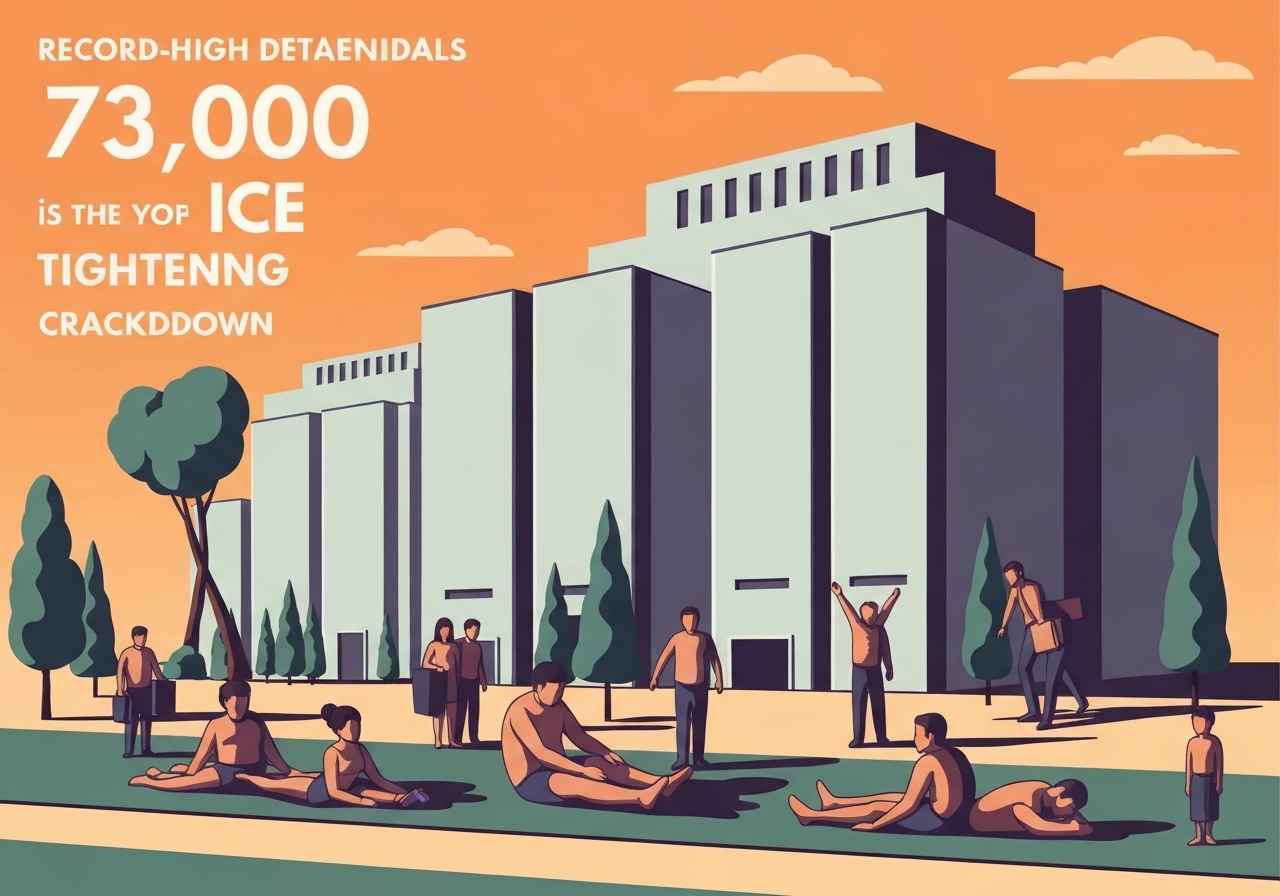
U.S. Immigration and Customs Enforcement (ICE) held roughly 73,000 people in custody as of Thursday, January 2026, the largest detainee population in the agency’s 23-year history. Internal Department of Homeland Security (DHS) figures obtained by CBS News show an 84% increase from the same time in 2025, when the population was below 40,000. The surge accompanies a broadened enforcement mandate from the current administration and a major funding boost to expand detention capacity. Local clashes, expanded use of facilities and questions about the mix of criminal and non-criminal detainees have followed.
Key Takeaways
- ICE custody totaled about 73,000 detainees nationwide as of Thursday, the highest level on record for the agency (DHS internal data).
- That number represents an 84% increase from the same point in 2025, when the population was reported as below 40,000.
- Nearly 67,000 detainees were single adults; about 6,000 were family units (parents with minors) as classified in the DHS data.
- Roughly 47% of the detainee population — about 34,000 people — were listed as having criminal charges or convictions in the U.S.; the remainder were classified as immigration violators only.
- ICE-recorded non-criminal detainees initially arrested by ICE rose from 945 on Jan. 26, 2025 to 24,644 on Jan. 7, 2026 — a roughly 2,500% increase in that subgroup (government data).
- The administration has set an operational goal to be able to detain up to 100,000 people at any given time and received major new funding through the One Big Beautiful Act, including $45 billion reported for detention expansion.
- ICE has broadened arrest priorities and deployed thousands of officers and agents to large-city operations; those tactics have provoked protests and criticism from local leaders.
Background
ICE was formed after the 2002 reorganization that split the former Immigration and Naturalization Service into multiple agencies; its modern detention system has grown into one of the world’s largest. For much of the past decade detention levels fluctuated but generally remained well below the 73,000 mark now reported. The current surge follows policy changes that rescinded narrower enforcement priorities from the prior administration and directed officers to pursue a wider set of immigration violations.
Funding and capacity decisions have reshaped how ICE operates. The One Big Beautiful Act provided a historic influx of funds reported at $45 billion earmarked for detention expansion, prompting the agency to add beds by contracting with county jails, private prisons, state facilities and even military sites such as Fort Bliss. Some state and local jurisdictions — notably in Florida and Louisiana — have offered or proposed nontraditional sites for housing detainees, reflecting political alignment in some states with federal enforcement goals.
Main Event
The DHS internal numbers obtained by CBS News show the agency holding roughly 73,000 people in custody nationwide as of the most recent reporting week. The breakdown in the data identifies nearly 67,000 single adults and about 6,000 family-unit detainees. ICE’s internal counts also indicate that approximately 47% of the total detainee population had criminal charges or convictions listed in U.S. records, while the remainder were held as immigration-only cases.
When analysts focus on detainees who were initially arrested by ICE rather than Border Patrol, the rise in non-criminal detainees is especially pronounced: the count moved from 945 on Jan. 26, 2025 to 24,644 on Jan. 7, 2026, an increase of roughly 2,500%. Over the same interval ICE-recorded detainees arrested by ICE with criminal convictions rose by about 80%, while those with charges increased by approximately 243%, according to government-published periodic reports.
DHS public affairs, through Assistant Secretary Tricia McLaughlin, told CBS News that 70% of those arrested by ICE under the current administration have criminal charges or convictions in the U.S., and she noted that some categorized as immigration violators may have records or security concerns from other countries. DHS also emphasized that ICE has sought additional detention space to prevent crowding and cited recent funding as enabling an average daily capacity goal of 100,000.
Analysis & Implications
The spike to 73,000 detainees has immediate operational implications. Expanding capacity across a mixture of county jails, private facilities and military or state sites strains coordination, oversight and medical and legal services. Facilities not designed for long-term detention — including some field offices — are being used episodically, raising questions about standards of care and due process for people held there.
Politically, the larger detention footprint reflects a central policy priority for the administration: increase arrests and removals broadly rather than focus narrowly on serious criminal offenders. That shift alters incentives for local jurisdictions, some of which have cooperated by offering space, while others have vocally resisted enforcement raids as disruptive and heavy-handed. The policy also amplifies tensions between federal and municipal leaders in large cities where visible operations have sparked protests.
Legally and judicially, the change is likely to produce increased litigation. Rapid expansion of non-criminal detention and the use of unconventional sites raise potential challenges under immigration and constitutional law, especially where access to counsel, conditions of confinement or the legality of arrest operations are contested. Courts may be asked to review both individual cases and systemic practices as numbers and public scrutiny grow.
Comparison & Data
| Metric | Reported Value | Notes |
|---|---|---|
| Total ICE detainees (Jan 2026) | ~73,000 | Highest recorded level in ICE history (DHS internal data) |
| Population vs same time 2025 | +84% | 2025 level described as below 40,000 |
| Single adult detainees | ~67,000 | Individuals held separately from family units |
| Family-unit detainees | ~6,000 | Parents with minor children |
| Detainees with U.S. criminal charges/convictions | ~34,000 (47%) | Severity of records not detailed in the internal data |
| ICE-arrested non-criminal detainees | 945 → 24,644 | Jan. 26, 2025 → Jan. 7, 2026 (~2,500% increase) |
These figures show both scale and composition shifts: the total population rise is driven in large part by a rapid growth in non-criminal detainees initially arrested by ICE. The internal data do not provide granular offense categorizations for every case, limiting public assessment of risk profiles within the population.
Reactions & Quotes
“It is absolutely a record, certainly in modern times.”
Migration Policy Institute / Doris Meissner
Meissner, who led the former INS, framed the current totals as historically unprecedented and warned the system’s size and recent expansion mark a major shift in U.S. immigration enforcement capacity.
“As we arrest and remove criminal illegal aliens and public safety threats from the U.S., ICE has worked diligently to obtain greater necessary detention space while avoiding overcrowding.”
Department of Homeland Security / Tricia McLaughlin (public affairs)
DHS emphasized the need for more beds and framed the policy as a public-safety operation, while also noting steps to avoid overcrowding as capacity increases.
“Their tactics have been criticized as overly harsh and indiscriminate by local leaders and some residents.”
Local officials / City leaders (reported)
City leaders in places subject to large-scale operations, including Los Angeles and Chicago, described enforcement tactics as aggressive; protests and legal pushback have followed several high-profile raids.
Unconfirmed
- The DHS claim that 70% of those arrested by ICE under the current administration have U.S. criminal charges or convictions is based on a DHS public affairs statement; independent verification of that specific share by case-level review was not available in the source material.
- Assertions that some individuals categorized as “immigration violators” have terrorism ties or foreign criminal histories were made by DHS public affairs but are not corroborated with public case-level evidence in the internal data provided to CBS News.
- Details and circumstances surrounding the reported killing of Minnesota resident Renee Good by an ICE officer are still under investigation in several public reports and have not been fully adjudicated in court at the time of this reporting.
Bottom Line
The rise to about 73,000 people in ICE custody marks a substantive escalation in the scale of U.S. immigration detention and reflects both policy choices and new funding. Operational strains — from site selection to oversight and legal access — will intensify as the system adapts to larger, more dispersed populations.
Watch for several near-term developments: (1) litigation or oversight inquiries focused on conditions and arrests; (2) state and local decisions to offer, limit or regulate detention sites; and (3) whether ICE’s capacity targets and reported criminal-case mixes hold up under independent scrutiny. Those outcomes will shape the balance between enforcement objectives and legal, humanitarian and fiscal constraints going forward.
Sources
- CBS News (media: original reporting with DHS internal data)
- U.S. Department of Homeland Security (official: public affairs statements and agency data)
- Migration Policy Institute (think tank: expert commentary and historical context)
- U.S. Immigration and Customs Enforcement — Detention Statistics (agency: public detention reports and biweekly snapshots)