
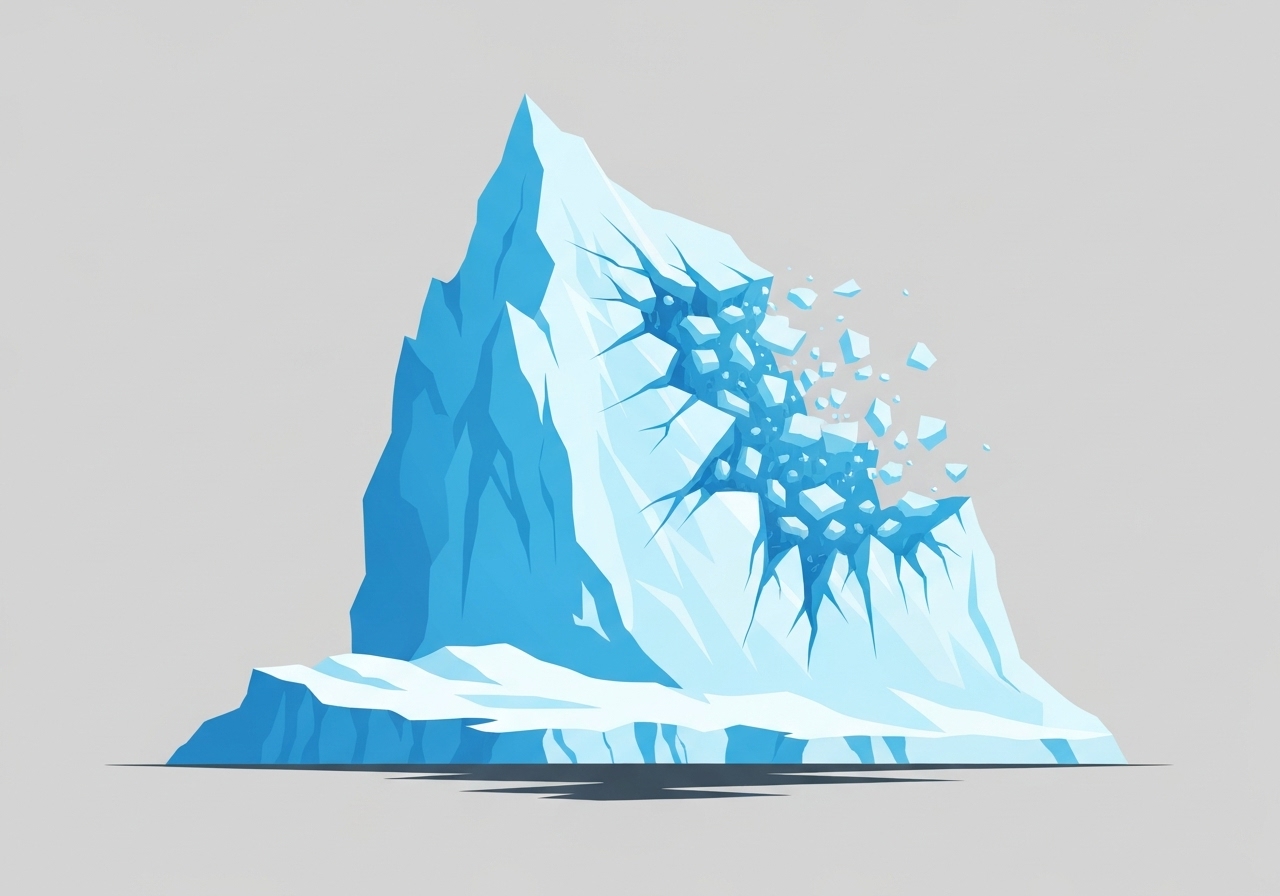
— Satellite and crewed-space imagery show iceberg A23a, once about 4,000 square kilometers and at times twice the size of Rhode Island, now drenched in blue meltwater and deteriorating rapidly as it drifts in the South Atlantic off the eastern tip of South America. NASA reported images taken on Dec. 26 and Dec. 27, 2025 that reveal large surface melt pools and deep rills; scientists say those features — and signs the berg has “sprung a leak” — suggest the ice mass could collapse within days to weeks. The U.S. National Ice Center estimates A23a’s area in early January 2026 at 1,182 square kilometers, still larger than New York City but a small fraction of its original size. Researchers warn warmer seasonal conditions and ocean currents pushing the berg into even milder waters will likely accelerate its breakup.
Key Takeaways
- A23a measured about 4,000 km² when it detached from Antarctica in 1986 and hosted a former Soviet station; it stayed grounded for more than three decades before freeing in 2020.
- NASA imagery from Dec. 26–27, 2025 shows extensive blue meltwater pools and surface channels; scientists interpret the weight of pooled water as having fractured the ice.
- U.S. National Ice Center assessment (early Jan 2026) places A23a at roughly 1,182 km² — still larger than New York City but greatly reduced from its peak area.
- Iceberg striations visible on the surface are remnants of scour marks formed when the berg was part of Antarctic bedrock centuries ago, directing meltwater flow now.
- Experts, including Chris Shuman (retired, UMBC) and Walt Meier (NSIDC), say seasonal warming and ocean currents make complete disintegration this austral summer the most likely near-term outcome.
- Last summer several major fragments separated from A23a; in January 2025 it narrowly avoided colliding with a remote penguin colony.
Background
A23a began as a piece of Antarctic ice more than a century ago, carrying surface patterns called striations produced by long-ago bedrock scouring. In 1986 the berg calved with an estimated area near 4,000 square kilometers; at the time it even hosted a Soviet field station. For decades the iceberg remained largely stationary, held by local ocean forces, until it finally escaped in 2020 and began a slow northward drift.
As it moved into warmer latitudes the iceberg periodically shed large fragments. Observers tracked its long path with satellite imagery and occasional higher-resolution photographs from the International Space Station. Sea-surface temperatures, seasonal air warming during the austral summer, and the mechanical stresses from melt ponds and fractures have combined to weaken the berg over the past several seasons.
Main Event
NASA said a satellite captured a view of A23a on Dec. 26, 2025 showing bright blue pools of meltwater standing out against white ice; an International Space Station photograph taken on Dec. 27 provided a closer look, revealing an even larger melt basin. That collection of melt ponds and channels concentrates weight and heat on the berg’s surface, which can drive water through preexisting weaknesses and form vertical conduits.
According to NASA’s assessment, pooled meltwater appears to have punctured through the ice — a phenomenon sometimes described as a berg “springing a leak” — which accelerates structural collapse from the top downward. Ocean currents carrying the berg northward will likely bring progressively warmer water, increasing basal melting at depth and favoring further fragmentation.
Officials at the U.S. National Ice Center provided the most recent size estimate: about 1,182 km² in early January 2026. That figure places the remnant far below its 1986 area but still notable for its sheer scale; researchers emphasize that the remaining mass can produce additional large calving events as it weakens.
Analysis & Implications
The observable transformation of A23a illustrates how long-lived Antarctic ice features can persist for decades yet still be vulnerable to relatively rapid collapse once they encounter sustained warmer conditions. Surface melt ponds play an outsized role because their dark blue water absorbs more solar energy than surrounding ice and focuses mechanical stress where water funnels into crevasses.
When a megaberg such as A23a breaks apart, its fragments alter local oceanography and can pose navigational hazards. In this case, the berg’s trajectory past the eastern tip of South America brings it into shipping lanes and nearer to biologically sensitive areas; previous close approaches included a near-miss with a penguin colony in January 2025.
On a broader scale, single events like A23a’s disintegration do not by themselves prove continent-scale ice loss trends, but they add to a pattern of increasing iceberg mobility and melt in a warming climate. Researchers use these high-profile cases to refine models of calving, meltwater routing, and iceberg lifetime, which in turn improve forecasts of iceberg hazards and freshwater inputs to the Southern Ocean.
Comparison & Data
| Moment | Area (km²) | Note |
|---|---|---|
| 1986 (detachment) | ~4,000 | Hosted Soviet research station; original large size |
| 2020 (freed from grounding) | — | Began sustained northward drift |
| Early Jan 2026 | 1,182 | U.S. National Ice Center estimate; still larger than New York City |
Context: A23a’s area has declined by roughly 70% since its 1986 estimate. The visible striations and emerging melt basins make it a case study in how surface morphology and seasonal heating interact to shorten an iceberg’s service life.
Reactions & Quotes
“I certainly don’t expect A-23A to last through the austral summer.”
Chris Shuman, retired scientist, University of Maryland, Baltimore County
Shuman’s assessment reflects the consensus that the combination of large surface melt pools and northward advection into warmer waters makes a near-term breakup likely.
“The striations formed parallel to the direction of flow, which now direct the meltwater across subtle ridges and valleys on the berg’s top.”
Walt Meier, senior research scientist, National Snow and Ice Data Center
Meier’s explanation links the berg’s ancient bedrock features to current melt patterns, underscoring how long-embedded structure can govern modern decay pathways.
“We’re grateful to have the satellite resources that let us follow its evolution so closely.”
NASA (agency statement)
NASA emphasized that the combined satellite and ISS imagery allowed near-real-time monitoring of A23a’s morphological changes.
Unconfirmed
- The precise timeline for complete disintegration remains uncertain; scientists estimate days to weeks but cannot provide an exact date.
- Specific downstream ecological impacts from A23a’s eventual breakup have not been quantified and would depend on fragment trajectories and local conditions.
Bottom Line
A23a’s rapid visual transformation from a white berg to a patchwork of blue melt ponds and fractured ice is a clear signal that its remaining structure is precarious. With area reduced to roughly 1,182 km² and seasonal warming ahead, experts judge that the iceberg is likely to fragment completely during the current austral summer.
While one high-profile iceberg’s demise is not a direct measure of long-term Antarctic mass trends, A23a provides a valuable, observable example of the physical processes that can shorten iceberg lifespans and alter Southern Ocean conditions. Continued satellite and in situ monitoring will be essential to refine expectations for the berg’s breakup, downstream hazards, and localized environmental effects.