
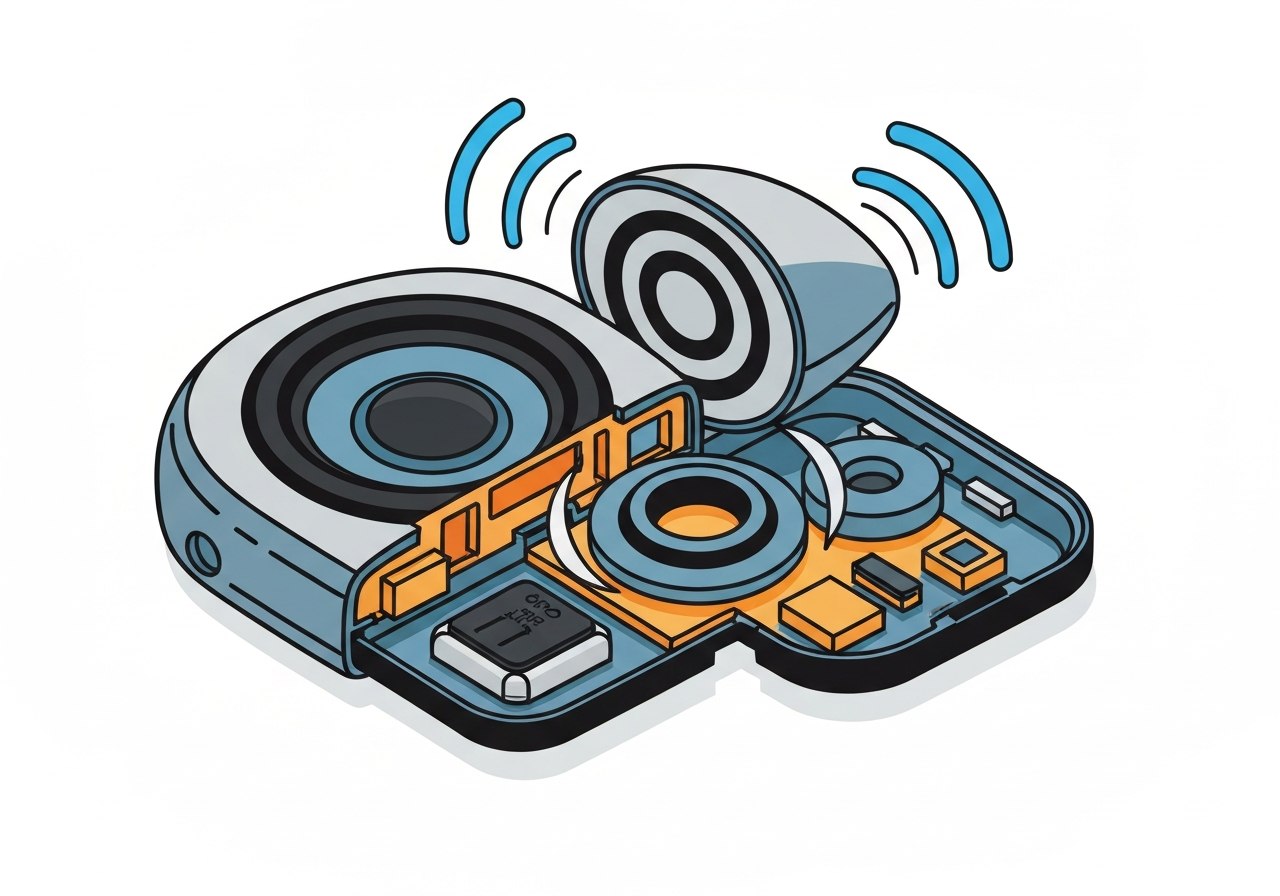
iFixit published a teardown on Feb. 5, 2026, of Apple’s newly released AirTag, revealing the speaker is about 50% louder than the prior model but remains simple to silence. The team showed two thin wires linking the speaker coil to the printed circuit board and demonstrated non‑destructive disabling that leaves tracking functions intact. The teardown also exposed an upgraded system-on-chip for Bluetooth/NFC and Apple’s U2 Ultra Wideband chip, which enables Precision Finding with an iPhone 15 or later. The findings raise fresh questions about hardware tamperability versus Apple’s software-based anti‑tracking measures.
Key takeaways
- The new AirTag’s speaker measures roughly 50% louder than the previous model, according to iFixit’s teardown testing.
- iFixit demonstrated that removing or desoldering two fine wires from the speaker coil disables the alert sound without affecting location tracking.
- The underside of the PCB shows an upgraded SoC handling Bluetooth and NFC functions alongside Apple’s U2 Ultra Wideband chip.
- Precision Finding using the U2 chip requires an iPhone 15 or later for enhanced directional locating.
- Apple describes new software protections—cross‑platform alerts and frequently changing Bluetooth identifiers—aimed at reducing unwanted tracking.
- Physical tampering remains a practical risk for users relying on the speaker as an anti‑stalking safeguard.
- Disabling the speaker requires basic tools (e.g., a soldering iron) and a small amount of technical skill, per iFixit’s demonstration.
Background
Apple introduced AirTag in 2021 as a small, Bluetooth‑enabled locator designed to help users find personal items. From the start, privacy and safety concerns accompanied the product: civil liberties groups and law enforcement warned that tracking devices could be abused for stalking. In response, Apple has iteratively added software mitigations, including audible alerts, unwanted‑tracking notifications, and rotating Bluetooth identifiers to make covert tracking harder.
Hardware teardowns by repair sites like iFixit have become a routine part of major device launches because they reveal internal design choices that software documentation cannot. Apple’s latest AirTag update is positioned as both a hardware refresh and a software improvement; Apple says it added a louder speaker and a suite of “industry‑first” protections against unwanted tracking. Independent analysis of the internals is necessary to test whether hardware changes align with the company’s privacy claims.
Main event
In its Feb. 5, 2026 teardown, iFixit opened the new AirTag and documented the speaker assembly, showing two fine wires that run from the speaker coil to pads on the PCB. The repair team demonstrated that those wires can be cut or desoldered non‑destructively, which silences the unit while leaving radio and location circuits operational. iFixit noted the speaker is louder than before but emphasized that the louder output does not prevent a technically adept person from disabling the sound.
The same teardown photographed the PCB underside, revealing an upgraded SoC responsible for Bluetooth and NFC as well as Apple’s U2 Ultra Wideband chip. The presence of the U2 chip aligns with Apple’s Precision Finding improvements, which Apple limits to iPhone 15 and later models. iFixit confirmed the radio and chip placements but did not find hardware interlocks that would make speaker removal detectable to the device.
Apple’s product materials highlight new software defenses—cross‑platform alerting and frequently changing Bluetooth identifiers—that aim to reduce unwanted tracking. The teardown, however, shows that a user with modest repair skills can defeat the audible alert, potentially undermining one layer of the company’s anti‑stalking strategy. iFixit’s video demonstration serves as the primary evidence for the practical ease of silencing the device.
Analysis & implications
At a technical level, the ability to silence an AirTag without disabling its radio functions is unsurprising: the speaker is an additive component rather than a control element for the tracking stack. Apple focused on software countermeasures—notification logic and identifier rotation—because software can address large‑scale misuse without requiring complex hardware changes. Nevertheless, the teardown highlights a gap: audible alerts can be tampered with, leaving software alerts and cross‑platform detection as the remaining defenses.
From a privacy and safety standpoint, that gap matters. Audible alerts provide an immediate, local signal to a nearby person that an unwanted tracker is present; if a malicious actor can reliably silence that signal, victims may not notice the presence of a device until a notification arrives on their phone, which may come later or not at all depending on the platform and proximity. Apple’s cross‑platform alerts seek to close that window, but deployment and behavioral assumptions (e.g., people checking notifications promptly) shape real‑world effectiveness.
For law enforcement and regulators, the teardown may prompt renewed scrutiny of hardware design choices for consumer trackers. Regulators could ask whether manufacturers should incorporate tamper‑evident or tamper‑resistant features for devices intended in part as safety tools. At the same time, stronger hardware protections could raise repairability and end‑user rights questions, creating a tradeoff between safety and device openness.
Comparison & data
| Model | Speaker relative volume | Ease of speaker disable | Notable radio chips |
|---|---|---|---|
| Original AirTag (2021) | 100% | Moderate — soldering/case access required | Bluetooth/NFC SoC, original U1 (UWB) |
| New AirTag (2026) | ~150% (iFixit measured) | Easy — two fine wires accessible to desolder | Upgraded Bluetooth/NFC SoC, U2 Ultra Wideband chip |
The table summarizes iFixit’s comparative observations: nominal speaker output increased by roughly 50%, but the physical routing of the speaker leads remains a straightforward target for someone attempting to silence the unit. The upgraded U2 chip improves directional Precision Finding for compatible iPhones, but it does not affect the unit’s susceptibility to speaker tampering. These measurements are qualitative and based on iFixit’s disassembly and demonstration rather than formal acoustic lab tests.
Reactions & quotes
“The speaker may be louder, but it’s still easy to disable.”
iFixit teardown video
“Apple introduced a suite of industry‑first protections against unwanted tracking, including cross‑platform alerts and unique Bluetooth identifiers that change frequently.”
Apple product materials (company claim)
iFixit’s direct demonstration supplies the practical evidence that hardware tampering is possible. Apple’s documentation frames the update as a combination of hardware and software features intended to improve detection and reduce misuse; the teardown shows those software protections remain the primary line of defense when hardware can be physically altered.
Unconfirmed
- Whether the new AirTag contains hidden hardware sensors or impedance checks that detect speaker removal; iFixit did not observe such interlocks in its teardown.
- Whether Apple will issue a software update to detect or mitigate speaker disablement through alternate telemetry; no official plan has been announced.
- Whether removing the speaker wires voids warranty in a manner Apple will enforce; warranty policy implications remain unclear without an explicit company statement.
Bottom line
The iFixit teardown makes a clear and narrow point: Apple increased the AirTag’s speaker volume but left the component physically accessible enough that someone with basic tools can silence it while leaving tracking hardware intact. That finding does not negate Apple’s software‑level anti‑tracking measures, but it does mean audible alerts cannot be relied upon as the sole line of defense against misuse.
For users, the practical takeaway is layered: rely on device notifications, keep phones and operating systems updated, and be aware of unexpected alerts or devices. For Apple and the broader industry, the teardown underscores a design tension between making a device serviceable/repairable and making it tamper‑resistant for safety; how manufacturers reconcile those priorities may shape future tracker generations.