
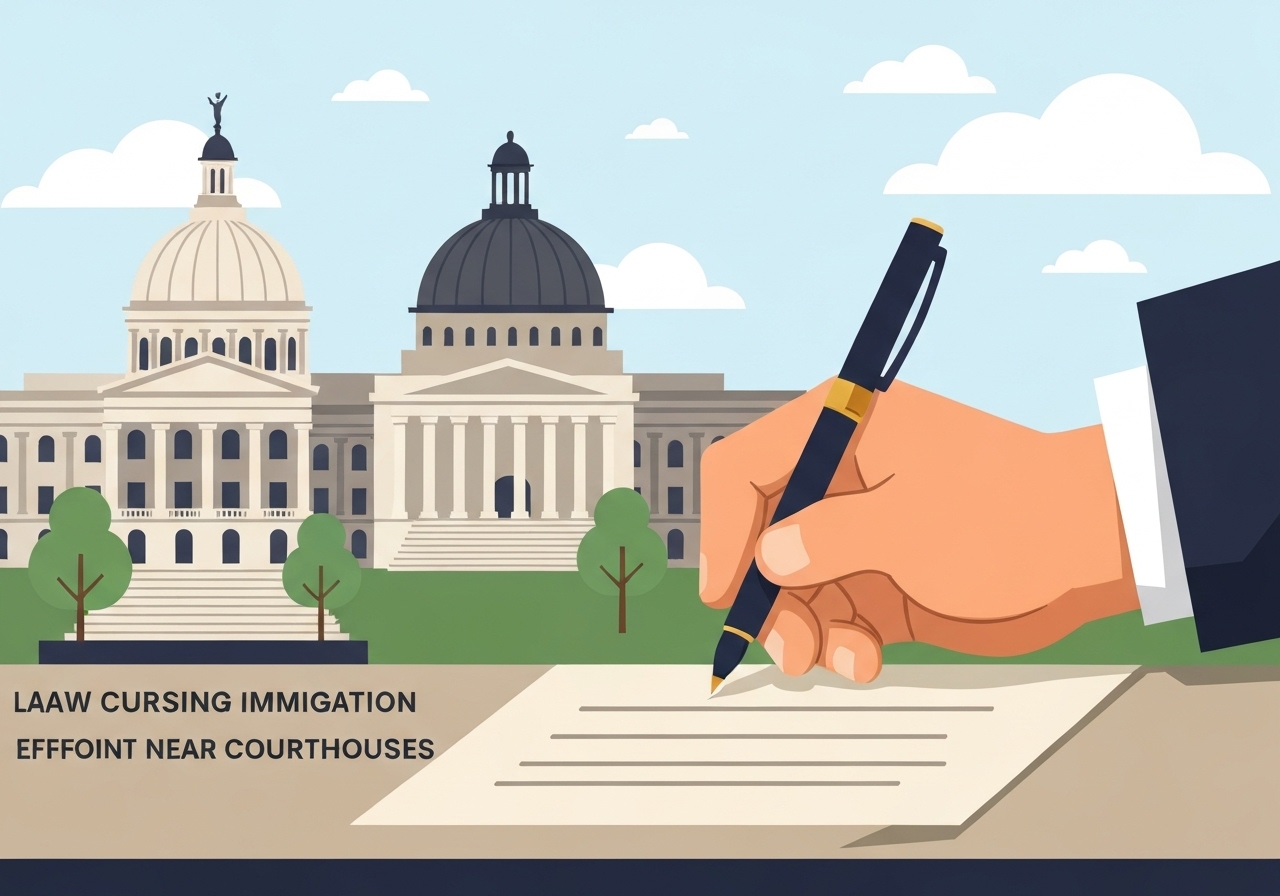
Lead: On Dec. 9, 2025, Illinois Governor J.B. Pritzker signed a bill that limits civil immigration enforcement around state courthouses and narrows the types of information hospitals, day cares and colleges may share with federal immigration agents. The law, approved by the state legislature in October amid a recent federal enforcement surge in the Chicago area, also creates clearer grounds for residents to sue immigration agents who they say violated their rights. Supporters framed the measure as a protection for access to public institutions; critics, including state Republicans and the Department of Homeland Security, warned of legal conflict and public-safety risks.
Key Takeaways
- The law, signed Dec. 9, 2025, bars civil immigration arrests at state courthouses and within 1,000 feet of those courthouses, creating a defined buffer zone around court facilities.
- Legislators passed the measure in October 2025 as a response to a federal enforcement campaign in the Chicago area that led to thousands of arrests across the region.
- It restricts the types of personal information that hospitals, day-care centers and colleges in Illinois can share with federal immigration authorities.
- The statute lowers the legal hurdles for civil suits against immigration agents, enabling residents to seek damages or injunctions if they believe rights were violated.
- Illinois Republicans and the Department of Homeland Security have publicly criticized the law and predicted legal challenges, with some Republican leaders saying the U.S. Supreme Court may overturn parts of it.
- California and New York already have measures limiting civil immigration arrests at courthouses, a point state lawmakers cited in legislative debate.
Background
For several years Illinois has limited cooperation between local law enforcement and federal immigration authorities, reflecting a broader trend among Democratic-led states and cities to protect immigrant communities. The immediate legislative push came during a federal enforcement surge in and around Chicago in 2025, when thousands of arrests and several confrontations between agents and residents heightened public concern. That enforcement campaign was presented by federal officials as necessary to uphold immigration laws; opponents said it undermined public trust in courts, hospitals and schools.
Courthouse arrests — often categorized by officials as civil immigration enforcement when they relate to civil immigration violations rather than criminal charges — became a flashpoint. Advocates argued people avoided filing cases, using medical services or enrolling in classes out of fear of apprehension near public institutions. Lawmakers who backed the bill cited comparable restrictions in California and New York as precedents for reducing barriers to civic participation.
Main Event
The bill was placed on Gov. Pritzker’s desk after the Illinois General Assembly approved it in October 2025, and he signed it into law on Dec. 9, 2025. The statute establishes a 1,000-foot no-arrest zone for civil immigration detentions around state courthouses and curtails agency access to certain records held by hospitals, day-care providers and colleges. In public remarks tied to the signing, Pritzker framed the law as protecting families’ ability to use public services without fear of sudden federal enforcement.
Republican lawmakers, led by State Senator John Curran in floor debate, criticized the measure as hampering federal law enforcement and argued it would increase risks by pushing enforcement actions into less controlled settings. The Department of Homeland Security issued a statement saying nothing in the Constitution bars arresting a suspected lawbreaker wherever found and emphasized operational efficiency when federal agents act near predictable targets.
Supporters pointed to concrete harms observed during the recent enforcement surge: delayed court appearances, lower clinic attendance and students declining campus services. The bill also expands civil remedies, allowing plaintiffs to sue for alleged constitutional or statutory violations by immigration agents operating in Illinois. Legal analysts immediately flagged the statute as likely to spawn federal litigation over preemption and the contours of federal authority.
Analysis & Implications
Legally, the new Illinois law raises immediate conflict-of-law questions between state authority to regulate access to its public institutions and the federal government’s exclusive authority over immigration enforcement. The doctrine of federal preemption will be central if a suit reaches higher federal courts, and Republican lawmakers have predicted a challenge that could reach the U.S. Supreme Court. Past litigation involving sanctuary policies suggests courts will scrutinize whether the state law obstructs federal functions or simply limits state and private cooperation.
Operationally, the statute could change how and where federal agents conduct civil immigration operations in Illinois. DHS and ICE may shift tactics — emphasizing arrests outside protected zones or relying more on information obtained from non-restricted sources — which could complicate coordination and redirect resources. Supporters argue the law will reduce the chilling effect on immigrants seeking court remedies, medical care and education; opponents say it could create enforcement gaps and public-safety blind spots.
Politically, the law sharpens Illinois’s divergence from the federal administration’s enforcement posture and reinforces Pritzker’s positioning on immigration ahead of a national political calendar that frequently cites his name. The statute may become a test case for progressive state-level protections and for how courts balance state interests in protecting access to services against federal enforcement prerogatives. If upheld, the Illinois model could be emulated in other states seeking similar safeguards.
Comparison & Data
| State | Measure | Courthouse Buffer |
|---|---|---|
| Illinois | Signed into law, Dec. 9, 2025 | 1,000 feet (civil arrests) |
| California | State and local policies restrict courthouse civil arrests | Varies by jurisdiction; statutory/administrative limits |
| New York | Statutes and local rules limit civil arrests at courthouses | Varies by jurisdiction; statutory/administrative limits |
The table summarizes the immediate legal posture: Illinois sets a clear 1,000-foot buffer, while California and New York maintain restrictions that differ across jurisdictions. The fixed distance in Illinois creates a transparent rule for courts and the public, but it also invites precise legal challenges about scope and enforcement. Analysts note that numerical buffers can simplify compliance but may also prompt litigants to test edge cases where federal and state interests intersect.
Reactions & Quotes
Supporters emphasized access to public institutions as the core rationale for the law.
“Residents should be able to go to court, take their kid to day care and have access to the university they attend without fear they will be kidnapped off the street.”
State Representative Lilian Jiménez (D–Chicago)
Representative Jiménez spoke when the measure passed in October, framing the law as a response to widespread fear in immigrant communities during the fall enforcement activity.
“This is going to get set aside by the U.S. Supreme Court.”
State Senator John Curran (Republican leader)
Senator Curran argued during legislative debate that the statute improperly impedes federal officers and predicted prompt judicial review by federal courts.
“Nothing in the Constitution prohibits arresting a lawbreaker where you find them.”
Department of Homeland Security (official statement)
The Department of Homeland Security described courthouse arrests as operationally sensible and warned states against creating impediments to federal enforcement actions.
Unconfirmed
- Whether the U.S. Supreme Court will take up and overturn portions of the law is not yet determined; a timeline for litigation remains unclear.
- The precise operational impact on the total number of federal immigration arrests in Illinois following the law’s enactment is not yet measured and will depend on federal enforcement choices.
Bottom Line
The Illinois law signed Dec. 9, 2025, represents a clear state-level effort to shield access to courts, schools and medical care from the chilling effects of civil immigration enforcement. Its 1,000-foot courthouse buffer and new limits on institutional information-sharing create a legally specific protection for residents but also set the stage for federal litigation over preemption and the practical reach of federal immigration authority.
Policymakers, courts and federal agencies will now test how the law operates in practice and whether similar measures spread to other states. Observers should watch for prompt legal challenges, administrative adjustments by DHS and ICE, and empirical data about whether the law changes court attendance, health-care usage or the pattern of federal enforcement in Illinois.
Sources
- The New York Times — national news coverage (media)
- Office of Governor J.B. Pritzker — official state press releases and statements (state government)
- Department of Homeland Security — official statements and press releases (federal agency)