
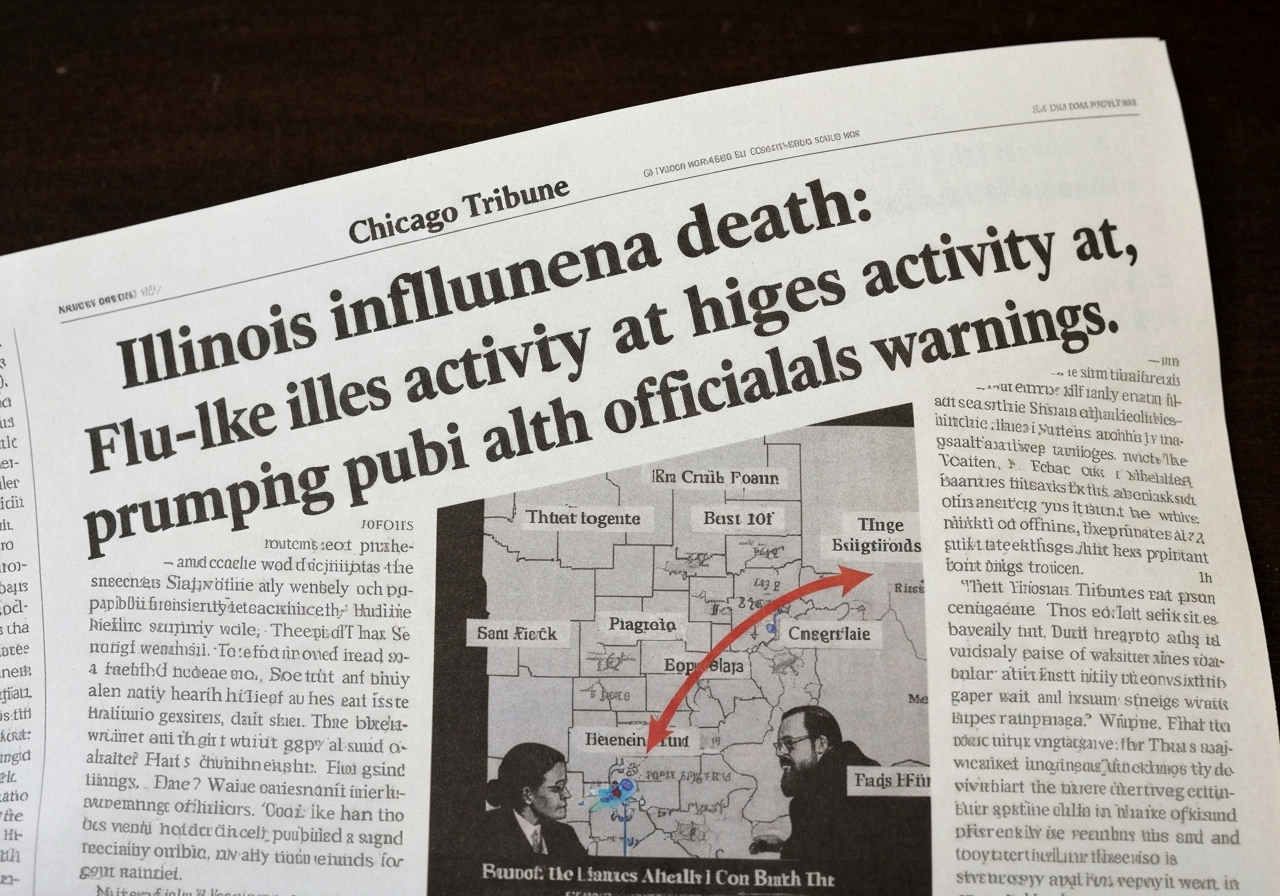
Illinois health officials announced the state’s first pediatric influenza death this season as flu activity in Illinois reached the CDC category of “Very High.” State and federal agencies say the current wave is driven primarily by a new H3N2 subclade dubbed “Subclade K,” and public-health leaders urged vaccination and basic precautions as emergency departments and intensive care units report sharp increases. IDPH and CDC data also show COVID-19 activity at “moderate” levels statewide while national flu indicators point to widespread illness and elevated hospitalizations.
Key Takeaways
- Illinois reported its first child death from influenza this season; state officials did not publish the child’s location or vaccination status.
- The CDC classifies Illinois flu activity as “Very High,” the top of five activity categories used to track respiratory illness.
- Across the U.S., CDC data show at least 11 million flu illnesses and roughly 5,000 deaths this season so far.
- Illinois health authorities say the state recorded 12 pediatric flu deaths during the 2024–2025 season, plus six pediatric RSV deaths and three pediatric COVID deaths.
- Cook County emergency-room visits for influenza have already passed last season’s peak, and ICU admissions for flu are roughly double last season’s counts.
- About 8% of outpatient visits were for flu-like illness (ILI), the highest proportion reported since 1997, per CDC weekly surveillance.
- Most sampled viruses this season are linked to H3N2 Subclade K, a strain that circulated overseas in summer and fueled spikes in Canada and the U.K.
- Public-health leaders say the current vaccine is less well-matched to Subclade K but still recommended because it reduces severe outcomes and deaths.
Background
Seasonal influenza surveillance uses multiple indicators—outpatient visits for flu-like illness, laboratory detections, hospitalizations and deaths—to gauge intensity and spread. The CDC’s five-category system ranges from minimal to very high; Illinois has moved into the highest designation for respiratory activity, signaling broad community transmission and pressure on clinical resources. The H3N2 subtype is often associated with more severe seasons, particularly among young children and older adults, and shifts within H3N2 lineages can change how well the annual vaccine matches circulating viruses.
Subclade K of H3N2 has been detected in several countries since the previous summer and has been identified by U.S. laboratories as a dominant driver of cases this season. Vaccine strain selection occurs months ahead of circulation, so late-emerging subclades can reduce match and vaccine effectiveness. Public-health stakeholders—hospitals, county health systems and state agencies—track real-time impacts such as emergency department volumes and ICU admissions to decide resource and messaging priorities during spikes.
Main Event
The Illinois Department of Public Health confirmed the first pediatric influenza death this season but did not disclose the child’s location or whether the child had received a flu vaccine. State officials publicly categorized statewide flu activity as “Very High,” while the CDC’s monitoring showed COVID-19 levels at “moderate” in Illinois. Healthcare providers across the state reported surging clinic and emergency-room volumes in recent weeks, with clinicians describing a busy holiday-period uptick that accelerated in mid-December.
Clinicians in suburban and Cook County systems said severe cases have appeared in both general wards and ICUs. Cook County Health reported that emergency-room visits for influenza exceeded last season’s peak and that flu-related ICU admissions are approximately double their previous-season counts. Those operational pressures have prompted renewed public advisories on vaccination, masking when ill, hand hygiene and staying home when symptomatic.
National surveillance released by the CDC indicates at least 11 million influenza illnesses and about 5,000 flu-associated deaths this season so far. The CDC also reported roughly 8% of outpatient visits met the ILI definition (fever plus cough and/or sore throat), the highest recorded proportion since the agency’s outpatient surveillance series began in 1997. Public-health officials linked much of the rise in cases to Subclade K within H3N2, which international experience suggests can drive rapid increases in transmission.
Analysis & Implications
The convergence of a late-emerging H3N2 subclade and increased social mixing over the holidays appears to have accelerated transmission in Illinois and nationwide. When a subclade differs antigenically from vaccine strains, measured vaccine effectiveness against infection can fall; however, historical evidence shows vaccines continue to reduce severe outcomes even with imperfect strain match. That distinction is crucial for messaging: individual protection against any infection is reduced, but population-level reductions in hospitalization and death remain an important benefit.
Pressure on emergency departments and ICUs matters beyond individual patient outcomes because surges can disrupt routine care for nonflu conditions. Cook County’s doubling of flu ICU admissions compared with last season indicates hospitals may need to reallocate staff and beds, delay elective procedures or expand surge capacity. Local public-health responses—temporary clinics, targeted vaccination campaigns, and messaging about staying home when ill—can blunt peak demand if implemented quickly.
Economically, widespread flu increases worker absenteeism and strains outpatient clinics; pediatric deaths add emotional and political weight to calls for enhanced mitigation. International experience—particularly in Canada and the U.K., where Subclade K contributed to earlier spikes—provides a preview for U.S. jurisdictions and underscores the need for rapid genomic surveillance and timely communication about vaccine effectiveness and clinical risk.
Comparison & Data
| Metric | This Season | Comparator |
|---|---|---|
| Estimated U.S. illnesses | ~11,000,000 | CDC seasonal estimate (current season) |
| Estimated U.S. deaths | ~5,000 | CDC seasonal estimate (current season) |
| Outpatient visits for ILI | ~8% of visits | Highest since 1997 |
| Illinois pediatric flu deaths | 12 (2024–2025 season reported by IDPH) | State health reporting |
| Cook County flu ICU admissions | ~2× last season | Local hospital reports |
These figures combine national CDC surveillance and state/local reports. The 8% ILI level is notable because it exceeds outpatient visit proportions recorded in CDC data since 1997; that historic comparison is an established benchmark used to identify unusually severe seasons. The Cook County doubling of ICU admissions is reported by local clinicians and reflects relative change rather than absolute counts published in national datasets.
Reactions & Quotes
“We’re seeing a lot of flu — more than I can recall in at least the last several years,”
Dr. Robert Citronberg, Advocate Health Care (executive medical director, infectious disease and prevention)
Citronberg emphasized clinics and emergency departments are busier than usual and cited observed severe illnesses and deaths linked to influenza this season.
“It probably started the middle part of December, and with holidays and kids back at school we’ve seen a sharp spike in the last two weeks,”
Dr. Trevor Lewis, Cook County Health (assistant chair, Emergency Medicine)
Lewis framed the recent surge as consistent with seasonal patterns but unusually large in magnitude, and he highlighted increased ICU admissions as a specific operational concern.
“Even though the flu shot may not be perfect this year, it still helps prevent severe illness and death,”
Illinois Department of Public Health (paraphrased advisory)
IDPH and clinical leaders reiterated that vaccination remains recommended to reduce the risk of hospitalization and death despite imperfect vaccine-virus matching.
Unconfirmed
- The exact location within Illinois of the child who died has not been released by state officials and remains unconfirmed.
- The child’s vaccination status—whether vaccinated against influenza this season—has not been disclosed publicly.
- The precise vaccine effectiveness percentage against Subclade K for the current season has not been fully quantified in publicly released CDC estimates at the time of reporting.
- Apparent numerical tensions between “nine pediatric deaths nationwide” and Illinois reporting of “12 pediatric flu deaths” reflect different reporting windows or categorizations and require clarification from IDPH/CDC.
Bottom Line
Illinois moving to “Very High” influenza activity, the state’s first pediatric flu death this season, and evidence of Subclade K driving cases together mark this season as unusually intense for many communities. Vaccination remains recommended because it lowers the risk of severe disease and death even when strain match is imperfect; other measures—hand hygiene, staying home when ill, and masking in high-risk settings—can reduce transmission and relieve pressure on hospitals.
Healthcare systems and public-health authorities should prepare for continued elevated demand in the weeks ahead, monitor genomic surveillance for further viral evolution, and communicate clearly about vaccine benefits and available clinical resources. Individuals should consult local health guidance and seek care promptly for severe respiratory symptoms, particularly in infants, older adults and people with chronic medical conditions.
Sources
- ABC7 Chicago / WLS-TV (local news report)
- Centers for Disease Control and Prevention (CDC) (national surveillance, official)
- Illinois Department of Public Health (IDPH) (state public health agency)
- Cook County Health (local health system)