
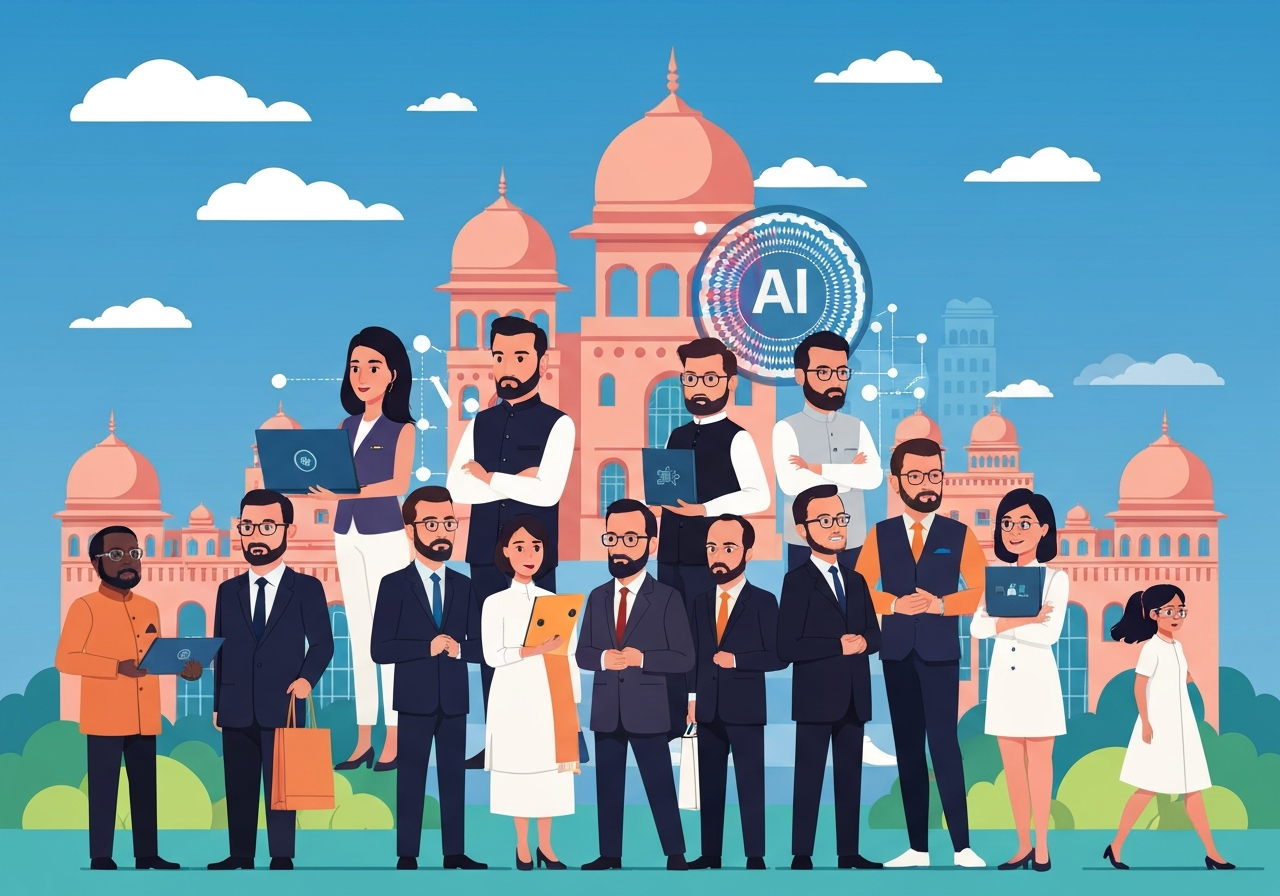
Lead: India opened a five-day artificial intelligence summit in New Delhi this week, convening 20 heads of state and government alongside senior technology executives to discuss the expanding global role of AI. The India AI Impact Summit—the first edition staged in the Global South—aims to balance questions of safety, economic opportunity and governance as AI reshapes industries from health care to defense. Prime Minister Narendra Modi is scheduled to speak on Thursday, while leaders including French President Emmanuel Macron and Brazilian President Luiz Inácio Lula da Silva are among the attendees. Organizers and Indian officials say the summit is intended to position India as a bridge between advanced economies and lower-income countries on AI deployment.
Key Takeaways
- The summit runs five days in New Delhi and brings together 20 heads of state and government, including Emmanuel Macron and Luiz Inácio Lula da Silva, with a range of technology CEOs present.
- High-profile industry attendees expected include Google CEO Sundar Pichai, Qualcomm CEO Cristiano Amon, OpenAI CEO Sam Altman, Microsoft President Brad Smith and AMI Labs Executive Chairman Yann LeCun.
- India presents the meeting as the first major AI summit hosted in the Global South, highlighting its large digital public infrastructure such as national digital identity and payment systems.
- Organizers expect the summit to culminate in a non-binding New Delhi declaration on AI goals rather than a legally binding treaty or accord.
- A panel of experts released an annual safety report ahead of the event assessing risks from advanced AI systems; the report and ongoing UN work reflect growing international governance efforts.
- Indian business leaders framed AI as key to India’s 2047 development ambition, with energy and manufacturing listed among priority sectors for scaled AI deployment.
- Concerns over job displacement persist; industry representatives emphasize reskilling programs as the primary mitigation strategy.
Background
The India AI Impact Summit follows earlier editions held in France, the U.K. and South Korea, and it marks a shift from small, safety-focused meetings toward broader gatherings that mix policy, industry and commercial showcases. The first summit in November 2023—hosted at a former code-breaking base north of London—included delegates from 28 countries and was tightly centered on reducing catastrophic AI risks. Since then, the forum has expanded in size and scope amid rapid commercial deployment of generative systems and specialized models across multiple sectors.
India’s government casts the New Delhi meeting as an opportunity for the Global South to influence norms and practices around a technology currently dominated by firms in richer countries. Officials emphasize India’s experience building large-scale digital public goods—digital identity (Aadhaar) and payments rails are frequently cited examples—as offering a template for cost-effective, inclusive AI applications. At the same time, stakeholders acknowledge the tension between fostering innovation and designing regulations that protect privacy, security and labor markets.
Main Event
The summit opened on Monday with plenaries, ministerial sessions and side events running through the week. Delegates will discuss themes ranging from AI safety and ethics to industrial adoption and climate modeling, while separate tracks focus on defense, health care and workforce transitions. India has invited a mix of government leaders, technology executives and academics, with Prime Minister Modi scheduled to address a high-level session on Thursday that organizers say will outline India’s strategic priorities.
Organizers expect the summit to conclude with a joint statement or non-binding declaration—referred to in planning materials as the New Delhi declaration—setting aspirational goals for AI development and deployment. Unlike treaty negotiations, this summit format favors consensus-oriented language and voluntary commitments, reflecting the diplomatic and political diversity of attendees. Panel reports released ahead of the summit include an annual safety assessment by a group led by Yoshua Bengio, which flagged misuse, malfunctions and systemic risks from the most capable AI systems.
Industry delegations emphasized economic opportunity and competitive positioning. Indian executives have highlighted AI’s potential to increase productivity in manufacturing, power grids and public services as part of a broader push toward achieving developed-nation metrics by 2047. Civil society groups and some researchers used the sidelines to press for stronger transparency, independent oversight and worker protections, underscoring the multi-stakeholder tensions present at the meeting.
Analysis & Implications
The New Delhi summit is geopolitically significant because it relocates a high-profile AI forum to the Global South, giving emerging economies greater visibility in shaping norms around technology that is largely produced in wealthier markets. If India can successfully marshal its digital public infrastructure as a model, it may influence how middle- and lower-income countries adopt AI at scale, prioritizing affordability and broad access. That shift would alter the terms of technical assistance and regulatory cooperation with advanced economies.
However, the summit’s likely non-binding outcome limits immediate regulatory impact. Non-binding declarations can set norms and spur national policies but lack enforcement mechanisms; much of the summit’s long-term effect will depend on follow-through by individual governments and multilateral bodies such as the United Nations. Ongoing UN work to create a global forum and an independent scientific panel suggests complementary tracks for institutionalizing governance beyond summit communiqués.
Economically, India hopes to attract investment and talent by projecting itself as an AI hub that couples scale with low-cost deployment. Success could accelerate digitalization across energy, manufacturing and public services, boosting productivity and new job creation. Yet labor-market disruption remains a realistic near-term risk: while reskilling programs may soften displacement, policy-makers must fund and coordinate education, certification and social protections to avoid widening inequality.
Comparison & Data
| Summit | Host | Year | Primary focus |
|---|---|---|---|
| First AI Summit | U.K. (former base north of London) | 2023 | AI safety, catastrophic risk |
| Paris AI Action Summit | France | 2024 | Industry-policy debates, regulatory pushback |
| India AI Impact Summit | India (New Delhi) | 2025 | Global South perspective, deployment & governance |
This table illustrates how the forum has broadened its agenda from concentrated safety concerns toward larger political and economic debates. The New Delhi meeting emphasizes inclusion of Global South priorities and practical deployment models rather than only theoretical risk assessments.
Reactions & Quotes
Government and industry voices framed the summit both as an opportunity and a balancing act between risk and growth.
“The goal is clear: AI should be used for shaping humanity, inclusive growth and a sustainable future.”
Ashwini Vaishnaw, India’s Minister for Electronics and Information Technology
Vaishnaw’s remarks were cited by officials to underline the government’s aim to pair AI adoption with social objectives.
“There is a lot of genuine concern around this theme … emphasis is on re-skilling programs as AI becomes mainstream.”
Sangeeta Gupta, Senior Vice President, Nasscom
Industry representatives reiterated that reskilling will be central to India’s strategy to manage workforce transitions while expanding AI use.
“It’s really important that the world will continue to have a strong independent scientific evaluation of the risks.”
Yoshua Bengio, lead author of the annual safety report
Bengio’s panel released an annual assessment ahead of the summit, aimed at building international consensus on AI risk science.
Unconfirmed
- Precise text and concrete commitments of the anticipated New Delhi declaration remain unconfirmed ahead of the summit’s close.
- Final attendance lists for some private sessions and bilateral meetings have not been publicly released and may change.
Bottom Line
The India AI Impact Summit represents a strategic effort by New Delhi to shape the narrative around global AI governance while showcasing domestic expertise in large-scale digital systems. Hosting 20 heads of state and top technology executives raises the summit’s diplomatic weight, but the expected non-binding outcome means tangible policy shifts will require follow-up through national laws and international fora.
Observers should watch for how the New Delhi declaration is worded, which countries endorse which commitments, and whether concrete financing or technical-assistance pledges toward Global South adoption of AI accompany aspirational language. Ultimately, the summit may matter less for immediate rules than for who gains influence in shaping the norms and tools that govern AI deployment worldwide.