
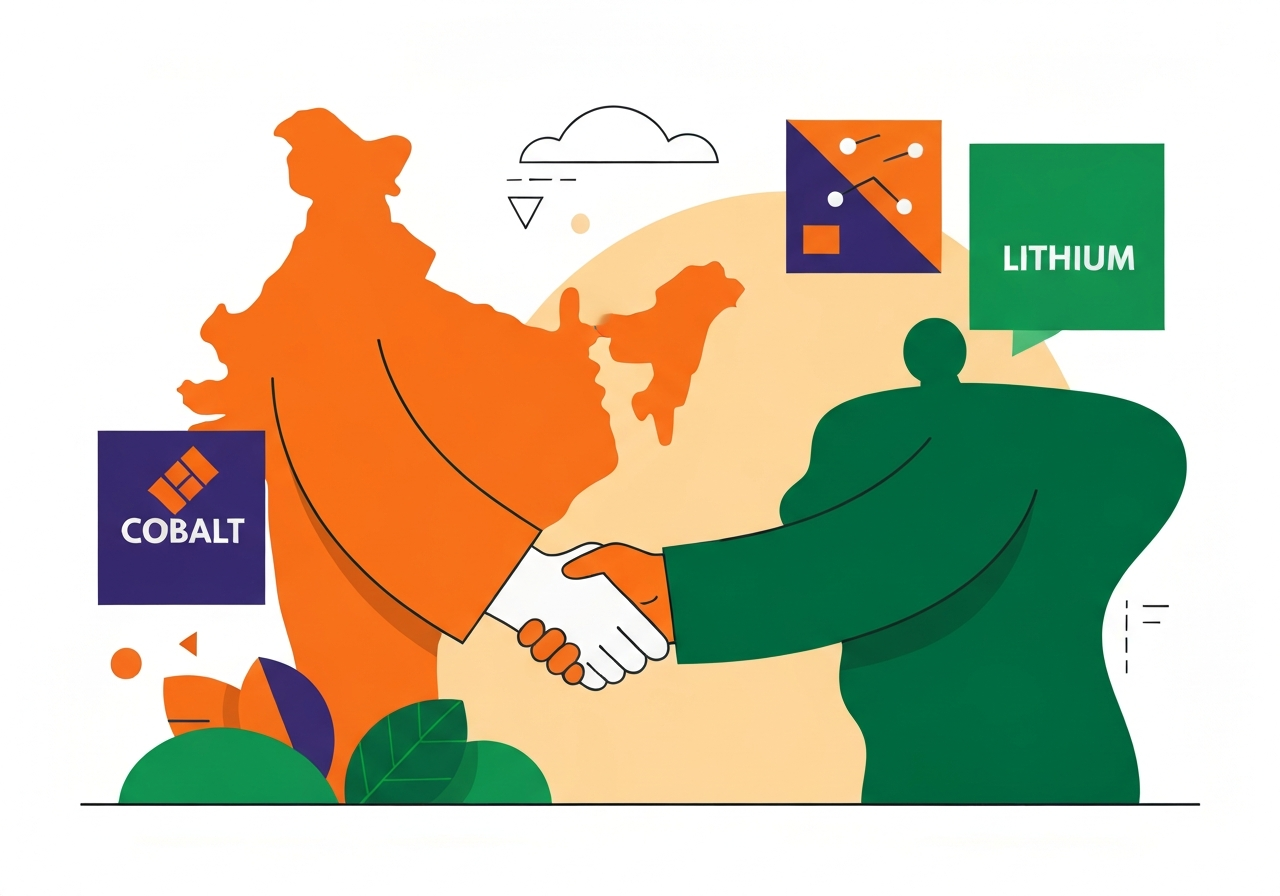
Lead: India and Brazil on 21 February 2026 finalized a cooperation agreement on critical minerals and rare earths during Brazilian President Luiz Inácio Lula da Silva’s visit to New Delhi. The deal, announced after a bilateral meeting with Prime Minister Narendra Modi at Hyderabad House, aims to broaden India’s supplier base and strengthen resilient supply chains. Officials framed the pact as part of a broader push to expand trade, investment and renewable-energy collaboration between the two Global South economies. Early statements suggest the move is intended to reduce India’s reliance on China for processed rare-earths and other strategic inputs.
Key Takeaways
- India and Brazil signed a memorandum on critical minerals and rare earths on 21 Feb 2026 following a summit between PM Narendra Modi and President Luiz Inácio Lula da Silva.
- Modi described the agreement as a “major step towards building resilient supply chains,” highlighting diversification from China’s dominance.
- Brazil is cited as the world’s second-largest holder of critical minerals; its resources feed industries such as EV batteries, solar panels and aerospace components.
- India and Brazil also inked nine additional pacts covering digital cooperation, health and trade promotion, with a bilateral trade target above $20 billion within five years.
- Trade figures from 2024 show Indian exports to Brazil at $7.23 billion and Brazilian exports to India at $5.38 billion, according to the Observatory of Economic Complexity.
- Analysts note the agreement follows India’s recent supply-chain engagements with the US, France and the EU as part of broader diversification efforts.
Background
China currently dominates the mining, refinement and global export infrastructure for many rare-earth elements and critical minerals, a position Beijing has consolidated over two decades of investment in processing capacity. That concentration has prompted consuming nations to seek alternative sources and partners to secure inputs for batteries, electronics and defence technologies. India, which has rapid infrastructure and industrial growth driving demand for steel and mineral inputs, has faced supply volatility and policy-driven export shifts from China in recent months.
Brazil sits on large deposits of minerals used across clean-energy and high-tech sectors and is a major global supplier of iron ore and other raw commodities. President Lula and his team have pushed to translate Brazil’s resource position into higher-value trade and inbound investment, particularly in renewables and processing facilities. For India, partnerships with resource-rich Global South countries represent both an economic and strategic avenue to lower import concentration risks and to develop onshore or partner-led processing capabilities.
Main Event
The agreement was announced publicly after Modi and Lula met at Hyderabad House in New Delhi on Saturday. Both leaders emphasized enhanced trade and investment links; Modi called Brazil India’s largest trading partner in Latin America and reiterated a shared ambition to push bilateral trade beyond $20 billion within five years. Officials said the critical-minerals memorandum covers cooperation on exploration data sharing, investment facilitation and early-stage value-chain collaboration, though full technical annexes were not released.
In his statement, Lula highlighted renewable-energy cooperation and described the pact as “pioneering,” signaling Brazil’s interest in attracting downstream processing projects and technology partnerships. India’s foreign ministry confirmed that the minerals deal was one of ten agreements signed during the visit, ranging from digital ties to health cooperation. Delegation-level meetings will now focus on technical working groups to define specific project pipelines and timelines.
Observers in New Delhi noted rising Indian demand for iron ore and other inputs amid rapid infrastructure projects; Brazil is the world’s second-largest producer and exporter of iron ore after Australia. Beyond iron ore, Indian industry is scouting supplies of nickel, cobalt and rare-earths vital for electric vehicles and renewable installations. The governments signalled intent to coordinate regulatory and investment frameworks to attract private capital into minerals processing and battery-chemicals projects.
While the public announcements were upbeat, officials on both sides acknowledged significant work remains to convert memoranda into concrete, high-value manufacturing and processing capacity. Negotiators plan follow-up technical meetings and investor roadshows in the coming months to map potential joint ventures and financing arrangements.
Analysis & Implications
The pact has three immediate strategic implications. First, it advances India’s diversification strategy by formally adding a large Global-South supplier to its resource portfolio, reducing the single-source exposure that has driven recent policy concern. Second, for Brazil the deal offers an avenue to capture more value domestically by attracting investment into processing and downstream industries rather than exporting raw ores alone. Third, the agreement signals a broader geopolitical realignment where South–South cooperation complements, rather than replaces, India’s engagements with Western partners.
Economically, securing upstream materials from Brazil could lower input-price volatility and give Indian manufacturers greater planning certainty for capital-intensive projects like EV supply chains and solar manufacturing. Achieving those benefits, however, depends on whether the two countries can progress from memoranda to binding investment and technology-transfer deals that build processing capacity. Without midstream processing, much of the strategic gain—reduced dependence on Chinese refinement—will be limited.
Politically, the pact is a message to markets and capitals that the Global South is organizing alternative commercial networks. Analysts caution that building resilient, trusted supply chains requires more than diplomatic declarations; it demands standards alignment, financing mechanisms, and long-term industrial policy alignment. The agreement may also spur competitive responses from other suppliers and consuming countries, influencing investment flows into minerals processing globally.
Comparison & Data
| Metric | Brazil (2024) | India (2024) |
|---|---|---|
| Exports to partner | $5.38bn | $7.23bn |
| Role in global minerals | Second-largest holder of critical minerals (by reserves) | Growing industrial demand; major importer |
The table uses 2024 trade values published by the Observatory of Economic Complexity to illustrate the current trade imbalance and the scope for expansion. Brazil’s status as a top minerals holder contrasts with India’s role as a rising industrial consumer; bridging that gap will require investments in shipping, refining and bilateral logistics. Analysts expect bilateral trade composition to shift if processing investments materialize, potentially increasing the value of Brazilian exports to India beyond raw commodities.
Reactions & Quotes
Officials and analysts gave measured responses, framing the agreement as strategically important but operationally nascent.
“This is a major step towards building resilient supply chains.”
Narendra Modi, Prime Minister of India (official statement)
Modi’s brief quote was released alongside the joint announcements and reflects New Delhi’s public messaging on supply-chain diversification.
“Increasing investments and cooperation in renewable energies and critical minerals is at the core of the pioneering agreement that we have signed today.”
Luiz Inácio Lula da Silva, President of Brazil (official statement)
Lula emphasized Brazil’s interest in turning resource wealth into broader economic cooperation and industrial opportunity.
“Global South alliances are critical for securing diversified, on-ground resource access and shaping emerging rules of global trade.”
Rishabh Jain, Council on Energy, Environment and Water (think tank)
Jain’s comment, provided to international media, interpreted the deal as part of a multi-directional diversification strategy that complements India’s Western partnerships.
Unconfirmed
- The precise volumes, timelines and financial terms for the minerals and processing investments were not published and remain under negotiation.
- Details on whether Brazil will build large-scale refining facilities for rare-earth processing for India, or if Indian firms will invest in Brazilian processing, are not confirmed.
- Any specific tariff, export-control adjustments or technology-transfer arrangements referenced in talks have not been made public.
Bottom Line
The India–Brazil critical minerals memorandum represents a strategic step toward supply-chain diversification but is, at present, a framework rather than a package of executed projects. Converting diplomatic momentum into industrial impact will require binding investment deals, financing, and technical cooperation to develop midstream processing capacity.
For markets and policymakers, the agreement signals that Global South partnerships are becoming an explicit element of national strategies to reduce single-country dependencies, especially on China’s processing dominance. The coming months of technical talks and investor engagement will determine whether the pact produces tangible supply-chain resilience or remains a political signal with limited operational effect.
Sources
- Al Jazeera (international news report)
- Council on Energy, Environment and Water (CEEW) (think tank commentary cited in reporting)
- Observatory of Economic Complexity (OEC) (trade data, 2024)