
Lead
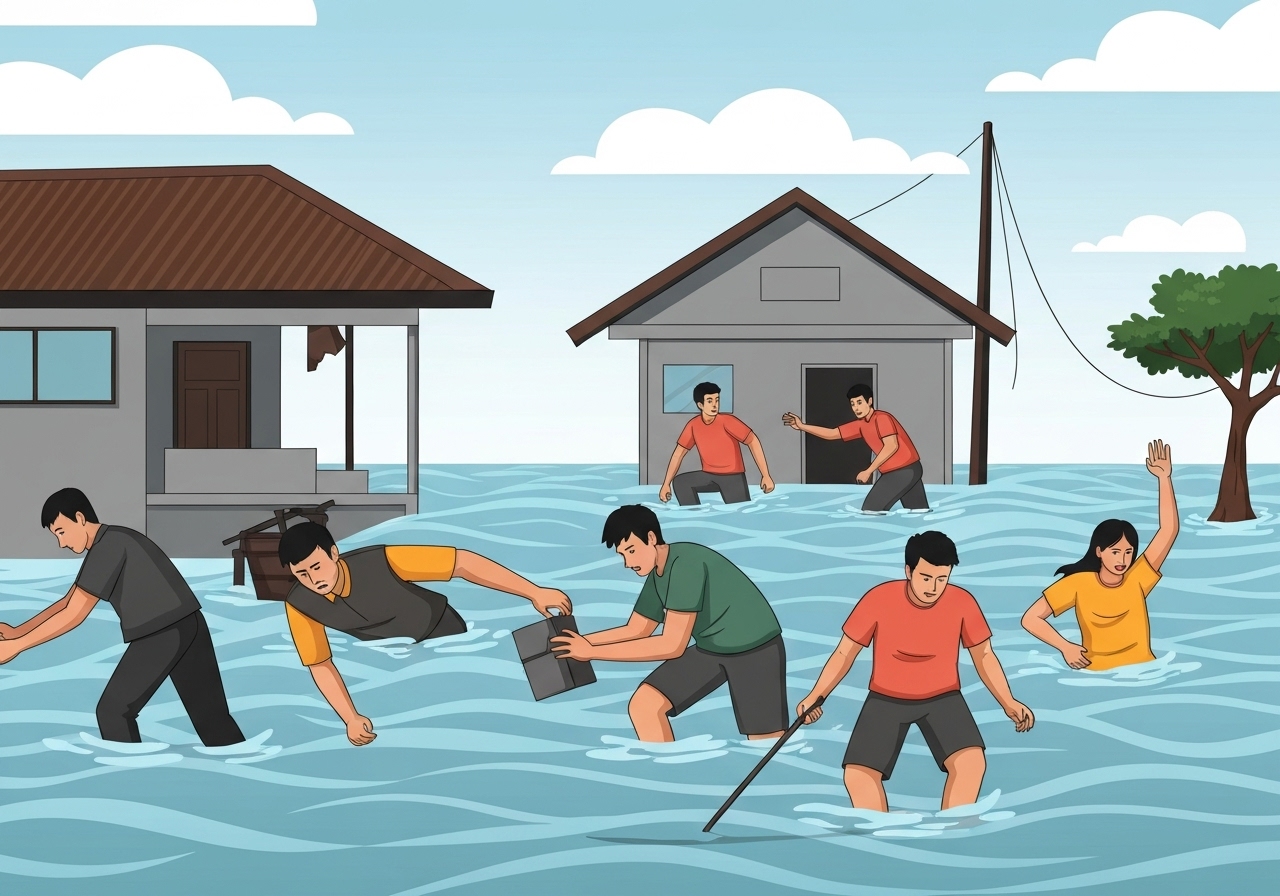
Last week in Aceh province, elderly residents and travellers were swept into life‑threatening floods as three tropical cyclones battered parts of Southeast Asia. Survivors in Langsa, Kuta Makmur and other towns described being carried from rising waters, sheltering for days in community centres and mosques, and losing nearly all household goods. The deluge has left swathes of Sumatra inaccessible, hampering rescue efforts and driving a mounting death toll. Authorities say at least 631 people have died in Indonesia so far as regional fatalities exceed 1,140.
Key takeaways
- More than 1,140 people have died across Indonesia, Sri Lanka, Thailand and Malaysia over the past week; at least 631 fatalities are confirmed in Indonesia.
- Flooding and flash landslides have buried parts of Sumatra and left many roads impassable, delaying search and rescue operations.
- In Langsa, 71‑year‑old Nurdin — a stroke survivor who uses a wheelchair — was carried from chest‑deep water and evacuated to a mosque, where he stayed four days.
- About 300 people sheltered in a community centre in Kuta Makmur; many reported only rice, instant noodles and eggs were available during those first days.
- Transport was disrupted: a group of passengers, including Nasir, were marooned on a bus for five days in Kuala Simpang before finding a boat and pickup to continue to Medan.
- Homes and appliances were extensively damaged — survivors describe mud half a metre deep, ruined fridges and wardrobes with doors torn off.
Background
A series of three tropical cyclones in late November and early December 2025 brought intense rainfall to parts of Southeast Asia, triggering flash floods and landslides across Sumatra and neighbouring countries. Low‑lying coastal and riverine communities in Aceh and North Sumatra were particularly hard hit, where drainage and road infrastructure struggled to cope with sudden, extreme runoff. Indonesia’s island topography and deforested slopes in some districts have exacerbated landslide risk, cutting off villages and complicating relief efforts.
Local governments, the national disaster agency and the military have mobilised to evacuate residents and deliver emergency supplies, but many areas remain hard to reach. Community centres and mosques have become temporary shelters; civilians, volunteers and neighbours played a major role in first rescues. International aid discussions are underway as neighbouring countries grapple with parallel impacts.
Main event
In Langsa, Nurdin, 71, who uses a wheelchair following a stroke, said he initially refused to leave his home as water rose early in the week. His wife persuaded him to accept help; neighbours reached the couple around 4am and carried them as waters climbed to chest height. A strong current knocked a neighbour from his feet and both men were plunged under, but they were later pulled to safety and moved to a nearby house.
When sustained rain rendered that house uninhabitable, the military evacuated Nurdin and his wife to a mosque using a table as an improvised stretcher. He had only a sarung to wear and remained at the mosque for four days before relocating to his brother’s home; when he later returned to his neighbourhood, he found nearly everything ruined and mud piled about half a metre high outside his house.
In northern Aceh’s Kuta Makmur, 70‑year‑old Nurkasyah lost household appliances and food stocks when water submerged her home. She spent five days with roughly 300 other displaced residents at a community centre and described acute shortages of food and basic items. Her son Nasir, travelling by road from Banda Aceh to Medan, was among passengers stranded on a bus in Kuala Simpang; after five days marooned on the vehicle roof, they secured a fishing boat and a pick‑up to continue their journey.
Analysis & implications
The immediate humanitarian priority is search and rescue, shelter, water, sanitation and medical care for displaced people — needs that escalate when roads are blocked and communications are limited. With many settlements still unreachable, official casualty figures are likely to rise as teams gain access to isolated communities. The destruction of household goods, agricultural stores and transport also signals a substantial short‑term economic shock for families and local markets.
Over the medium term, rebuilding will confront recurrent vulnerabilities: settlements in floodplains, weakened slope stability and strained local infrastructure. Community recovery will depend on coordinated cash assistance, debris removal and repairs to critical roads and bridges to restore supply lines. Authorities face trade‑offs between rapid reconstruction and investing in more resilient, longer‑term flood defences and early‑warning systems.
There are health risks in the aftermath: standing water and disrupted sanitation can increase diarrhoeal disease and vector‑borne infections, while crowded shelters heighten respiratory transmissible disease risk. Relief planners must balance immediate food and shelter distribution with public‑health interventions, waste removal and mosquito‑control measures to prevent secondary crises.
Comparison & data
| Date | Reported event/location |
|---|---|
| November 26, 2025 | Residents shelter in Kuta Makmur community centre (North Aceh) |
| November 27, 2025 | Passengers marooned on bus in Kuala Simpang, Aceh Tamiang |
| December 1, 2025 | Photographs show vehicle wreckage in Agam, West Sumatra |
This timeline highlights how incidents across the last week disrupted both coastal and inland transport routes and concentrated displacement in provincial hubs. The confirmed death toll (at least 631 in Indonesia and more than 1,140 regionally) provides a baseline that will be updated as teams access cut‑off areas.
Reactions & quotes
Survivors described panic, improvisation and neighbour‑to‑neighbour rescues during the peak flooding.
“I decided I would just die there, but my wife insisted we leave.”
Nurdin, 71, Langsa resident (flood survivor)
The strain on food and shelter was evident among displaced community members.
“We just ate rice, instant noodles and some eggs. There wasn’t enough food to go around.”
Nurkasyah, displaced resident, Kuta Makmur
Travellers stranded on transit routes described ad‑hoc evacuations when buses could not move.
“We managed to find a boat and then a pick‑up truck to get out of there.”
Nasir, passenger, marooned on bus in Kuala Simpang
Unconfirmed
- A Langsa resident reported seeing bodies rising from a cemetery and floating in floodwaters; this claim has not been independently verified.
- The full count of missing people across isolated Sumatran districts remains unclear until search teams reach cut‑off villages.
Bottom line
The floods have produced a large and rapidly evolving humanitarian emergency across Sumatra, with immediate needs for access, shelter, food and medical care. The true scale of loss and casualties will become clearer only as rescue teams reach remote areas and complete assessments.
Policymakers and relief agencies must prioritise restoring access routes and providing basic services while planning for resilient reconstruction. For readers, the critical indicators to watch are updated casualty and displacement figures, official access reports from affected regencies, and announcements on international or national aid commitments.
Sources
- Al Jazeera — international news outlet reporting survivor accounts and regional toll (original reporting)
- Badan Nasional Penanggulangan Bencana (BNPB) — Indonesian national disaster management agency (official source for national response and casualty figures)