
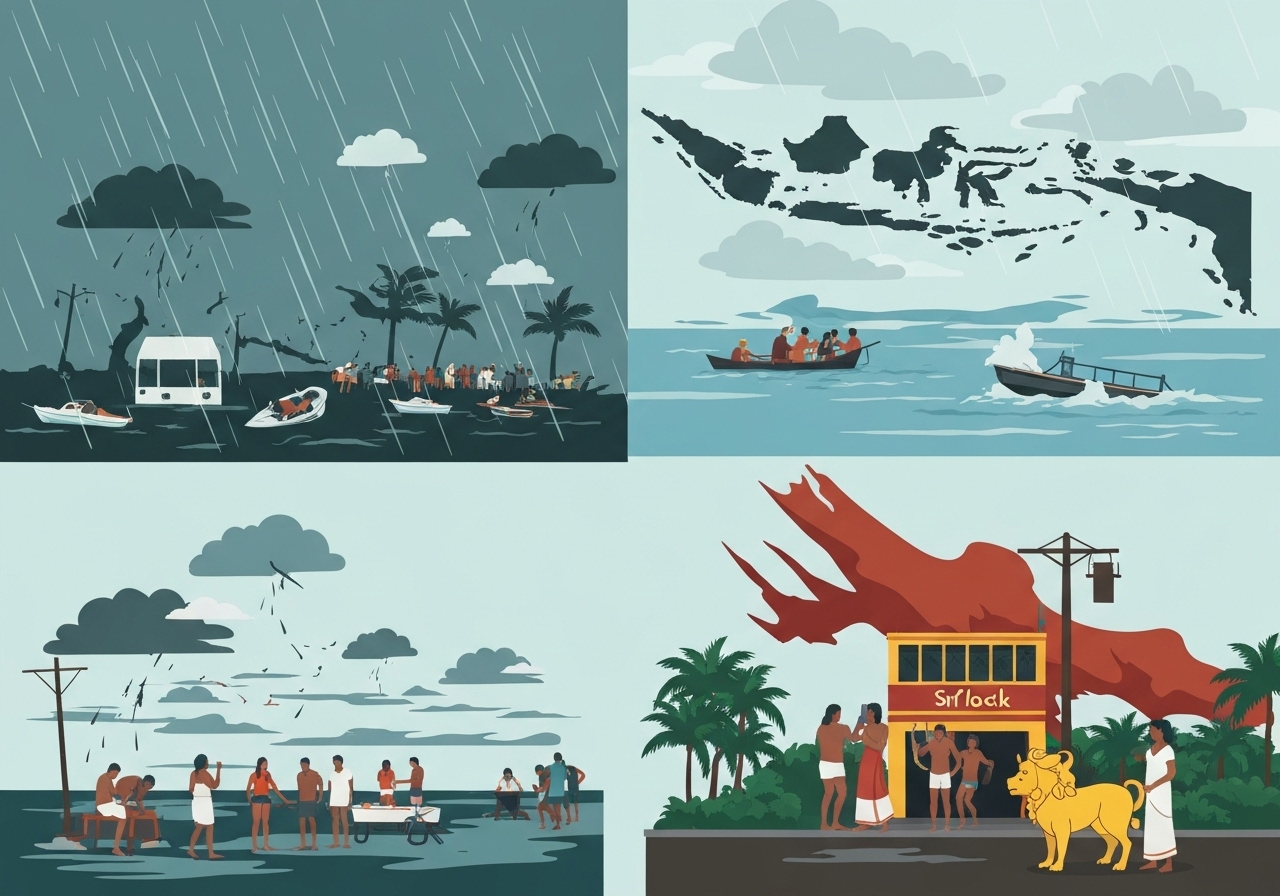
Heavy monsoon rains and tropical cyclones across South and Southeast Asia this week have produced catastrophic flooding and landslides. At least 90 people have died in Indonesia’s Sumatra region, while Sri Lanka reports 56 dead and 21 missing after floods and landslides linked to Cyclone Ditwah. Authorities in Sri Lanka and Indonesia have mobilised military and emergency assets for large-scale evacuations, and regional hospitals are strained by rising casualty numbers. Rescue teams continue to search cut-off communities as more severe weather remains possible.
Key takeaways
- Indonesia: At least 90 confirmed dead across Aceh, North Sumatra and West Sumatra after flash floods and landslides; dozens remain missing.
- Sri Lanka: 56 confirmed dead and 21 missing after floods and landslides; Kala Wewa reservoir overflowed and airlifts evacuated stranded residents.
- Extraordinary rainfall totals: parts of Sumatra saw 160 mm on 23 November and 226 mm on 24 November, with up to 800 mm over four days in Central Tapanuli and Sibolga.
- Thailand: Southern provinces face record floods; the city of Hat Yai recorded 335 mm in a single day and local morgues have reached capacity.
- Response: Indonesia’s President Prabowo Subianto ordered emergency supplies including 150 tents, 64 inflatable boats and around 100 communication units to affected provinces.
- Unusual meteorology: Researchers at BRIN say Cyclone Senyar is an exceptional occurrence near the equator, where cyclones seldom form.
- Logistics: Power cuts, damaged roads and ongoing rain have hampered search-and-rescue operations across affected zones.
Background
Seasonal monsoon flows typically bring heavy rain to South and Southeast Asia, but this week’s events have been intensified by unusual cyclone activity near the equator and concentrated downpours. Indonesia’s Sumatra island—particularly Aceh, North Sumatra and West Sumatra—was struck by sudden, intense rainfall that caused rivers to break banks and triggered landslides in steep terrain. In Sri Lanka, a combination of heavy rains and the passage of Cyclone Ditwah along the eastern coast produced widespread inundation and slope failures in the central highlands.
Although tropical cyclones are common in the wider Indian Ocean and Bay of Bengal, formation so close to the equator is rare because the Coriolis force that spins storms is weak at low latitudes. Indonesian researchers at the National Research and Innovation Agency (BRIN) have pointed to the exceptional daily totals recorded on 23–24 November and multi-day accumulations up to 800 mm in some districts as drivers of the rapid flooding. Regional emergency agencies and militaries have long-standing roles in flood rescue and relief, but the scale of displacement this week has stretched those systems.
Main event
In Indonesia, rivers on Sumatra’s west coast rose quickly after concentrated downpours. Local authorities reported multiple landslides and collapsed roads that impeded rescue convoys. Dramatic footage circulating from affected towns shows streets chest-deep in brown floodwater and houses partially submerged. Provincial police described accelerated search efforts despite blocked access and unstable slopes.
Sri Lankan forces were mobilised to carry out air and sea evacuations as reservoirs, notably the Kala Wewa complex near Aukana in Anuradhapura, overflowed. The Sri Lanka Air Force conducted airlifts that rescued individuals stranded on rooftops and a man who sheltered overnight atop a coconut tree. In Badulla district, a landslide overnight destroyed several homes, killing 21 people, according to the Disaster Management Centre.
Thailand’s southern provinces have also reported severe flooding over the past week. Hospital officials in Songkhla province said a morgue exceeded capacity and refrigerated trucks were brought in to store bodies, while Hat Yai recorded its heaviest single-day rainfall on record. Cross-border transport and supply chains in the region have been disrupted by inundated roads and cancelled rail services.
Analysis & implications
From an operational standpoint, the events highlight how concentrated extreme rainfall can overwhelm local infrastructure faster than agencies can respond. In mountainous or heavily populated floodplains, a single day of multiple-hundred-millimetre totals can trigger cascading failures: roads wash out, power and communications fail, and rescue teams require airlift or waterborne access. Indonesia’s reported 64 inflatable boats and 150 tents show early logistics priorities—shelter, mobility and restoring communications.
Scientifically, researchers caution against attributing any single event solely to long-term climate change, though warming increases the atmosphere’s moisture capacity and therefore the potential intensity of extreme precipitation. BRIN researchers described Cyclone Senyar as an exceptional formation near the equator, underscoring both unusual meteorology and the need to reassess coastal and island storm-risk models. Policy-makers will face pressure to update early-warning systems and to prioritise hardening of critical infrastructure.
Humanitarian implications are immediate and medium-term. Tens of thousands have been displaced, and with power and water supplies compromised there is an elevated risk of waterborne disease, interruptions to schooling and lost livelihoods in agriculture and fisheries. Economically, damage to transport arteries and market towns will slow recovery and will likely require national and international assistance if rains continue.
Comparison & data
| Location | Peak reported daily rainfall | Confirmed deaths |
|---|---|---|
| North / West Sumatra (Indonesia) | 226 mm (24 Nov); up to 800 mm over 4 days | 90+ |
| Sri Lanka (central & north) | multiple heavy falls; reservoir overflows | 56 confirmed; 21 missing |
| Hat Yai (Thailand) | 335 mm in one day | reported dozens (see unconfirmed) |
These figures show the intensity and rapid accumulation of rainfall that led to flood peaks. Indonesia’s multi-day totals in some districts were several times a single-month average; Sri Lanka’s reservoir overflows amplified downstream impacts by increasing river stages. Thailand’s single-day record in Hat Yai illustrates how urban drainage can be overwhelmed by very short-duration extremes.
Reactions & quotes
“What’s important is that all aid reaches the deepest and most detailed locations,”
Teddy Indra Wijaya, Cabinet Secretary (Indonesia, official statement)
The Cabinet Secretary described initial stockpiles sent to Sumatra—tents, boats and communication devices—and emphasised routing supplies into cut-off communities.
“If rainfall exceeds 100 mm in a day, it is already considered extreme—let alone reaching 200 mm,”
Erma Yulihastin, Climate researcher, BRIN (research institute)
BRIN researchers framed the rainfall totals as far beyond local climatic norms and noted the rarity of cyclone formation so near the equator, which complicated forecasts and preparedness.
“The morgue has exceeded its capacity, so we need more,”
Charn, morgue official, Songkhla Hospital (hospital official, Thailand)
Thai hospital staff reported that refrigerated lorries were parked outside to hold bodies as local facilities reached capacity, illustrating pressure on health and mortuary systems.
Unconfirmed
- Some casualty counts for Thailand vary across local and national sources; reports range from 37 to 55 dead and remain being reconciled by authorities.
- Final missing-person totals in remote parts of Sumatra are not yet consolidated; local reports indicate multiple uncounted communities.
- While atmospheric trends increase extreme-rain likelihood, direct attribution of these specific events to anthropogenic climate change is still under review by climate scientists.
Bottom line
The immediate priority across the region is search, evacuation and life-saving relief as rivers remain high and landslide risk persists. Military and civilian agencies have started large-scale operations, but damaged communications and infrastructure constrain response speed and coverage. Tracking and repairing transport and power links, restoring clean water and preventing disease outbreaks will determine short-term humanitarian outcomes.
Medium-term, the events will add urgency to investments in flood-resilient infrastructure, updated early-warning systems and land-use planning that reduces exposure in high-risk valleys and coastal zones. For now, communities across Sumatra, Sri Lanka and southern Thailand face a difficult window of rescue and recovery while agencies compile final casualty and damage assessments.
Sources
- BBC (live coverage and regional reporting) — news organisation
- BRIN (National Research and Innovation Agency) — research institute statement on rainfall and cyclones
- AFP (Agence France-Presse) — reporting on Thai hospital and morgue capacity
- Sri Lanka Air Force — official rescue operations and airlift footage