
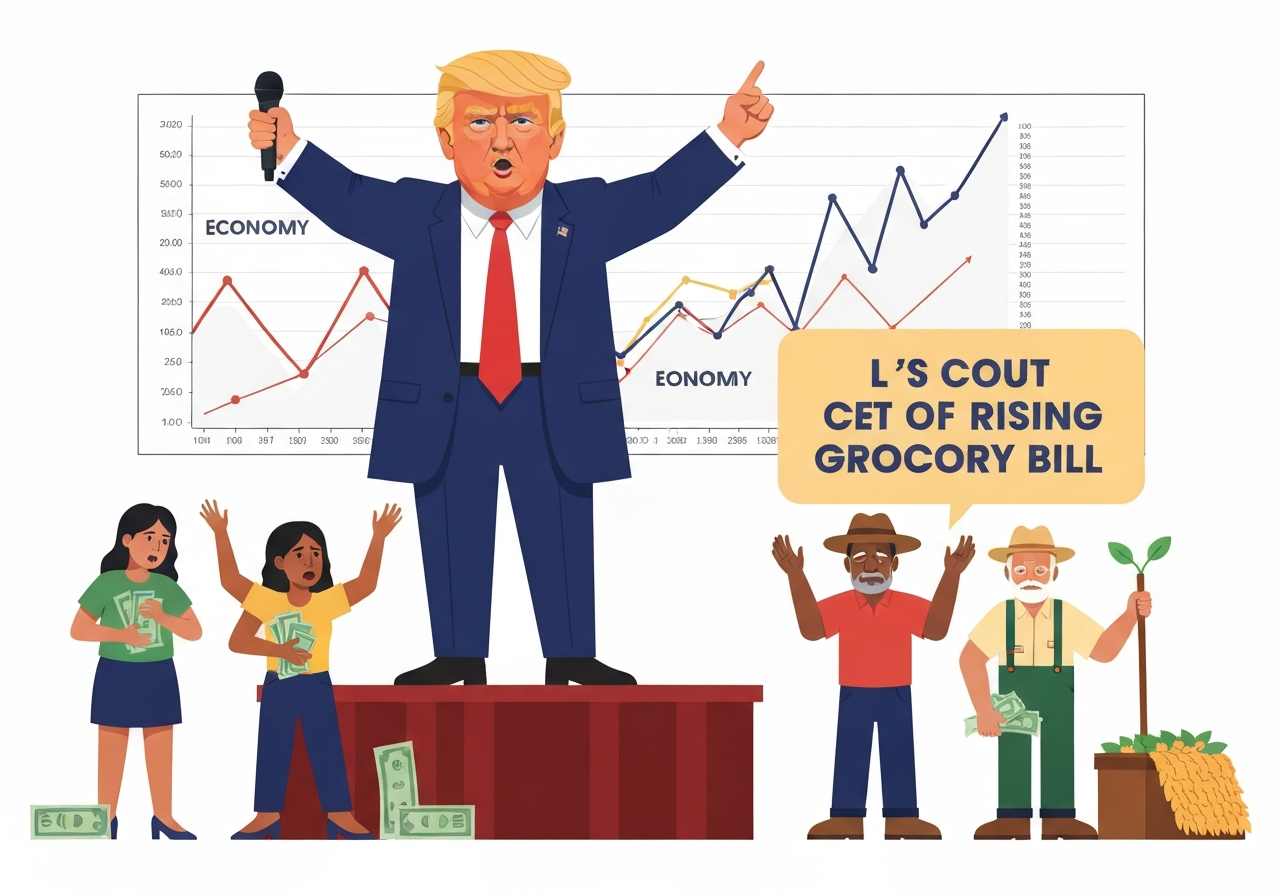
Lead: President Trump has asserted that inflation has been reduced, a point he is expected to highlight in his upcoming State of the Union address on Tuesday, Feb. 24, 2026. Yet ordinary Americans from Charlotte to New York say their household budgets still feel strained by high housing, health care and grocery costs. Workers such as 66-year-old Maribel McBeath, who has cleaned airplane cabins in Charlotte for 13 years and earns $16.50 an hour, report little relief and no ability to stop working. The divergence between headline indicators and daily experience frames a growing political and economic debate about who benefits from recent gains.
Key Takeaways
- President Trump will point to slower inflation and low unemployment in his Feb. 24, 2026 State of the Union as evidence of economic progress.
- Many households report persistent affordability problems for essentials such as housing, health care and child care despite those macroeconomic trends.
- Maribel McBeath, 66, earns $16.50 per hour after 13 years cleaning aircraft cabins in Charlotte, N.C., and still cannot cover medical bills or save for retirement.
- Kristin Errico, 43, a managing editor in New York, says prices rose roughly 20 percent across many items while her salary did not keep pace.
- About 8.6 million Americans held multiple jobs in January 2026, a sign some workers must take extra work to make ends meet (Bureau of Labor Statistics).
- Stock-market gains have lifted wealth measures but have not translated into higher take-home pay for many working households.
Background
Over the past two years, headline inflation rates have trended down from the peaks seen during 2021–2022, and unemployment has remained comparatively low. These macroeconomic indicators are often cited by federal officials and the White House to argue that the economy is on firmer footing. Yet the distributional effects of that recovery have been uneven: asset holders and wealthier households have seen larger gains than many wage-dependent families. Structural cost drivers—especially in housing, health care and childcare—have continued to push monthly household budgets higher even as headline inflation cools.
Policy debates have shifted toward whether fiscal and regulatory moves by the federal government can meaningfully reduce the burden of recurring costs for working families. Labor-market metrics such as multiple-jobholding and underemployment provide complementary views of strain not captured by the unemployment rate alone. Advocates for expanded social supports argue that targeted subsidies or price controls are necessary to restore affordability, while opponents warn of inflationary or fiscal side effects. The tension between political messaging about macroeconomic success and people’s lived expenses is central to current public discussions.
Main Event
In the run-up to the State of the Union, President Trump has framed the economy as improved, pointing to slower inflation and a stronger stock market. Administration officials have highlighted monthly reports showing inflation moderation and steady job growth as evidence their policies are working. Yet profile interviews with workers in diverse regions reveal a different picture: many households say wages and benefits have not caught up with costs for basic needs.
In Charlotte, Maribel McBeath described how half her pay goes to rent, leaving little for emergencies or retirement saving despite 13 years on the job. She said outstanding medical bills and the absence of a financial cushion keep her working past the age at which she had hoped to retire. Similarly, in New York, Kristin Errico criticized the President’s rhetoric and asked for concrete plans to lower the cost of groceries, housing and child care. These personal accounts illustrate a gap between aggregate statistics and household-level affordability.
Economists note that headline inflation figures aggregate price movements across a broad basket of goods and services, which can obscure high increases in specific necessities. The rising stock market compounds the political contrast: wealth indicators improve for investors without altering wages for nonfinancial workers. Policymakers face pressure to reconcile these divergences ahead of budget decisions and midterm political contests.
Analysis & Implications
First, the contrast between falling headline inflation and persistent household strain suggests a distributional problem: price declines have not been uniform. Sectors such as housing and health care, which compose large shares of many household budgets, have been slower to relieve cost pressure. That means median or lower-income families may see little difference on their grocery bills or rent payments even if the overall CPI decelerates.
Second, labor-market measures that look beyond the unemployment rate—like the count of multiple-jobholders—paint a picture of workers who must stretch across shifts and gigs to cover essentials. The 8.6 million people holding more than one job in January 2026 underscores the prevalence of supplemental work. Persistent underemployment and stagnant wage growth for large swaths of workers reduce the transmission of macro gains into everyday financial stability.
Third, politically, the split between positive headline indicators and people’s pocketbooks creates vulnerabilities for incumbents and talking points for opponents. If presidential rhetoric emphasizes inflation control without accompanying policy steps to lower housing, health care or child-care costs, voters experiencing sticker shock may judge the recovery incomplete. Policy solutions will need to address both cyclical inflation risks and structural cost drivers to be seen as effective by broad constituencies.
Comparison & Data
| Measure | Value / Note |
|---|---|
| Maribel McBeath: hourly wage | $16.50 (Charlotte, N.C.) |
| Years on job | 13 years (aircraft cabin cleaner) |
| Multiple jobholders (Jan 2026) | 8.6 million (Bureau of Labor Statistics) |
The table highlights a mix of individual and official data used in this story. While macro statistics show moderation in headline inflation, the household snapshot and labor-market figures demonstrate persistent pressures that official aggregates do not fully capture.
Reactions & Quotes
Below are representative reactions from people and institutions that frame the debate in different terms.
“I have to keep working.”
Maribel McBeath, aircraft cabin cleaner, Charlotte, N.C.
McBeath’s brief statement, made during an interview, underscores how medical bills and rent obligations force continued labor participation at an age when she had hoped to cut back.
“Everything is up 20 percent in cost except my salary.”
Kristin Errico, managing editor, New York
Errico’s remark reflects frustration from workers who say nominal incomes have not tracked price rises for essentials; she urged the president to move beyond general claims and outline concrete affordability measures in his address.
“Headline inflation has eased, but distributional effects matter for policy.”
Independent economist (analysis)
Economists caution that aggregate easing does not negate the need for targeted policies aimed at sectors where price pressure remains acute.
Unconfirmed
- Whether the President’s policies were the primary driver of the recent slowdown in headline inflation remains contested among economists and has not been definitively established.
- Claims that stock-market gains have materially improved living standards for the majority of households lack direct evidence and depend on household asset ownership patterns.
Bottom Line
The economy presents a mixed picture: official indicators such as slower headline inflation and low unemployment point to recovery, but many Americans continue to face sharp affordability challenges for essentials. Individual stories—like that of Maribel McBeath and middle-income workers in urban centers—illustrate how costs for housing, health care and child care can outpace wage gains and savings opportunities.
For policymakers, the priority is twofold: sustain macroeconomic stability while deploying targeted measures to reduce recurring household costs and strengthen wage growth where it has lagged. How the White House and Congress respond in the coming months will shape whether the public perceives the recovery as broad-based or limited to financial markets and upper-income groups.
Sources
- The New York Times (news)
- Bureau of Labor Statistics (government data)
- The White House (official statements)