
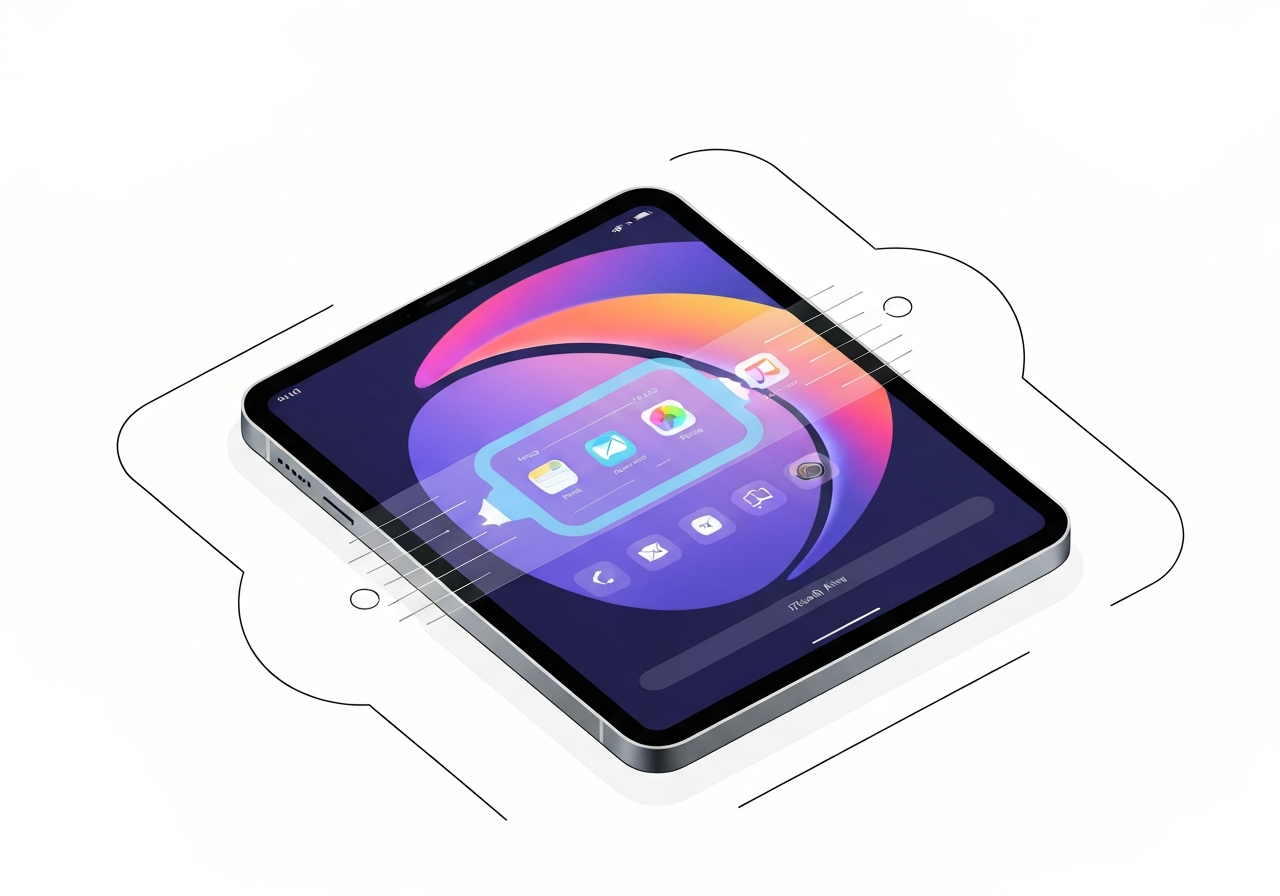
Lead: Apple’s 2026 iPad Air receives a focused hardware refresh: three upgraded silicon elements—the M4 processor, a C1X cellular modem, and an N1 connectivity chip—arrive without major design changes. Priced from $599 with a 128GB base tier and a 60Hz display, the new Air delivers measurable performance gains but few headline features. In real-world use the M4 speeds up CPU- and GPU-bound tasks modestly, while the C1X can noticeably improve cellular throughput in weak-signal areas. For most buyers the Air remains the best-value, mid-tier iPad in Apple’s lineup.
Key takeaways
- The 2026 iPad Air upgrades three chips: M4 CPU, C1X cellular modem, and N1 connectivity chip supporting Wi‑Fi 7, Bluetooth 6, and Thread.
- List price starts at $599 with a 128GB base configuration; the display is a 60Hz LED panel (no Face ID).
- Benchmarks show the M4 is roughly 20–25% faster than the M3 on CPU workloads and about 10–15% faster on GPU tasks.
- Against older A14-based iPads, the M4 posts roughly 80–250% CPU gains and more than 3× GPU improvements; users upgrading from those devices will notice the difference.
- C1X cellular performance is a standout in testing, sometimes outperforming recent phones and other tablets in low-signal conditions.
- The N1 brings Wi‑Fi 7 and Thread support but delivers minimal immediate advantages for typical users without compatible routers or smart‑home setups.
- If you own last year’s M3 or an M2 Air, there’s little reason to upgrade now; for buyers choosing a new iPad, the Air is the most balanced option.
Background
Apple’s iPad lineup is deliberately tiered: the iPad Pro is the performance flagship and a testbed for leading-edge displays and silicon, the iPad Air typically inherits that technology later, and the base iPad aims for the lowest price. Over several generations the Air has acted as the middle ground—accepting some tradeoffs from the Pro while delivering much of its performance at a lower cost. That strategy lets Apple scale components and manage margins while offering a compelling product for a wide audience.
Historically, Apple staggers flagship features—high-refresh OLED displays, advanced Face ID systems, or the newest GPU cores—so the Air often arrives with proven but slightly older configurations. The 2026 Air follows that pattern: it borrows Apple’s M4 silicon family but omits the Pro’s 120Hz OLED panel and Face ID hardware. For many consumers that yields a favorable price-to-performance balance; for power users, the Pro remains the only route to the top-tier experience.
Main event
The new iPad Air’s headline is plainly technical: an M4 system-on-chip replaces last year’s M3, a C1X modem replaces the prior cellular component, and an N1 communications chip adds Wi‑Fi 7, Bluetooth 6, and Thread. Externally the tablet is unchanged—same chassis, the same accessories compatibility, and the same form factors (with the 11‑inch model being the most versatile for most users). Apple’s public messaging framed the device as an iterative but meaningful step in performance.
In benchmark testing the M4 Air posts a CPU uplift of about 20–25% over the M3 and a GPU improvement near 10–15%. Those figures translate into snappier search and some background workloads; in day‑to‑day app launches and gaming the difference is often subtle. Curiously, synthetic scores place the M4 Air slightly above the M4 iPad Pro on some CPU runs and a hair below on GPU tests despite the same nominal chip—differences likely down to thermal headroom and power tuning.
Battery life remains in line with previous Air models: the device delivers solid all‑day runtime under mixed workloads and retains the Air’s suitability as a mobile hotspot thanks to a large battery. The C1X modem stood out in cellular tests, frequently delivering noticeably higher throughput than recent flagship phones and other tablets when signal conditions were poor—an advantage for travelers and users in fringe-coverage areas.
The N1’s additions—Wi‑Fi 7, Bluetooth 6, and Thread—are forward looking but of limited immediate benefit for most buyers. Wi‑Fi 7 requires a compatible router to realize meaningful gains, Bluetooth improvements are incremental in many accessories, and Thread is primarily valuable for smart‑home ecosystems that have adopted that mesh standard. As a result, the new connectivity suite is a future-proofing move more than a present-day revolution.
Analysis & implications
From a product-strategy perspective, the 2026 Air illustrates Apple’s cadence: reuse and refine proven flagship technologies at a more accessible price point. That allows Apple to stretch the lifecycle of expensive components while offering tangible upgrades for users on much older devices. The practical outcome is a tablet that will feel distinctly faster to owners of four‑ to six‑year‑old iPads, even if owners of last year’s Air barely notice the difference.
For buyers weighing storage and display tradeoffs, the Air’s $599 starting price with 128GB remains the chief gripe. Many competing devices and several Apple models now ship with larger base capacities, and some users will feel constrained by the 128GB tier. Likewise, a 60Hz screen is a notable compromise given that some iPhones and the Pro line now offer high‑refresh displays; the lack of Face ID is another omission for users who have grown accustomed to that convenience.
Economically, incremental silicon upgrades can lengthen device lifecycles: if a tablet is expected to perform well for five years, the M4’s headroom against older chips (A14 and earlier) justifies buying an Air today for longevity. That dynamic also pressures Apple’s entry-level iPad: without a meaningful refresh, the base model looks less competitive, potentially nudging buyers toward the Air.
Comparison & data
| Comparison | CPU uplift | GPU uplift |
|---|---|---|
| M4 vs M3 (Air) | ~20–25% | ~10–15% |
| M4 vs A14 (older iPads) | ~80–250% | >3× |
| M4 Air vs M4 iPad Pro | Air slightly above on some CPU runs | Air slightly below on some GPU runs |
The table summarizes public benchmark behavior: the M4 is a clear but not radical step up from the M3, and a transformative upgrade compared with A14-era hardware. The Air’s CPU and GPU improvements are meaningful for users migrating from older iPads; for owners of M3 or M2 devices, the day-to-day benefits are limited. Variability between Air and Pro M4 scores likely reflects thermal and power-provision tradeoffs rather than fundamental differences in core architecture.
Reactions & quotes
Apple framed the Air as a refinement rather than a reinvention; reviewers and users echoed that view, praising performance gains while noting conservative tradeoffs. Two representative short remarks:
“It’s where Apple’s top-line tech goes after it’s retired from the iPad Pro,”
David Pierce / The Verge (review)
This captures the Air’s role in the product family: a vehicle for proven Pro technologies scaled for broader customers. Review observations emphasized that the Air’s improvements are real but not disruptive—useful, incremental enhancements.
“M4 brings notable performance headroom across everyday tasks and creative apps,”
Apple (official product page)
Apple’s messaging highlights performance and versatility; independent testing confirms those claims for many workflows, particularly when compared to older silicon generations. Public reaction has been split between buyers seeking value and power users who still prefer the Pro’s superior display and features.
Unconfirmed
- Whether Apple will raise base storage on the Air in the near term remains unknown; no official announcement has been made.
- The precise causes of the small CPU/GPU score differences between the M4 Air and M4 Pro (thermal tuning versus binning) have not been disclosed by Apple.
- Real-world Wi‑Fi 7 benefits for the average consumer depend on router adoption timelines and have not been broadly demonstrated in independent field tests.
Bottom line
The 2026 iPad Air is a textbook chip bump: meaningful silicon upgrades that improve performance and cellular responsiveness without altering the core product. For buyers of older A14-era iPads, the M4 represents a substantial and noticeable leap in speed and graphics capability. For owners of M3 or recent M2 Airs, the incentives to upgrade are weak; the Air’s value proposition is strongest for new buyers choosing a balanced, long‑lived tablet.
If you need the smoothest display, Face ID, or the absolute highest sustained GPU performance, the iPad Pro remains the only choice. For most users who want a fast, capable tablet at a reasonable price, the Air is the sensible pick—especially if you prioritize cellular speed and longer future-proofing over a 120Hz OLED and larger base storage.
Sources
- The Verge review by David Pierce — (media review)
- Apple iPad Air official page — (official product page)