
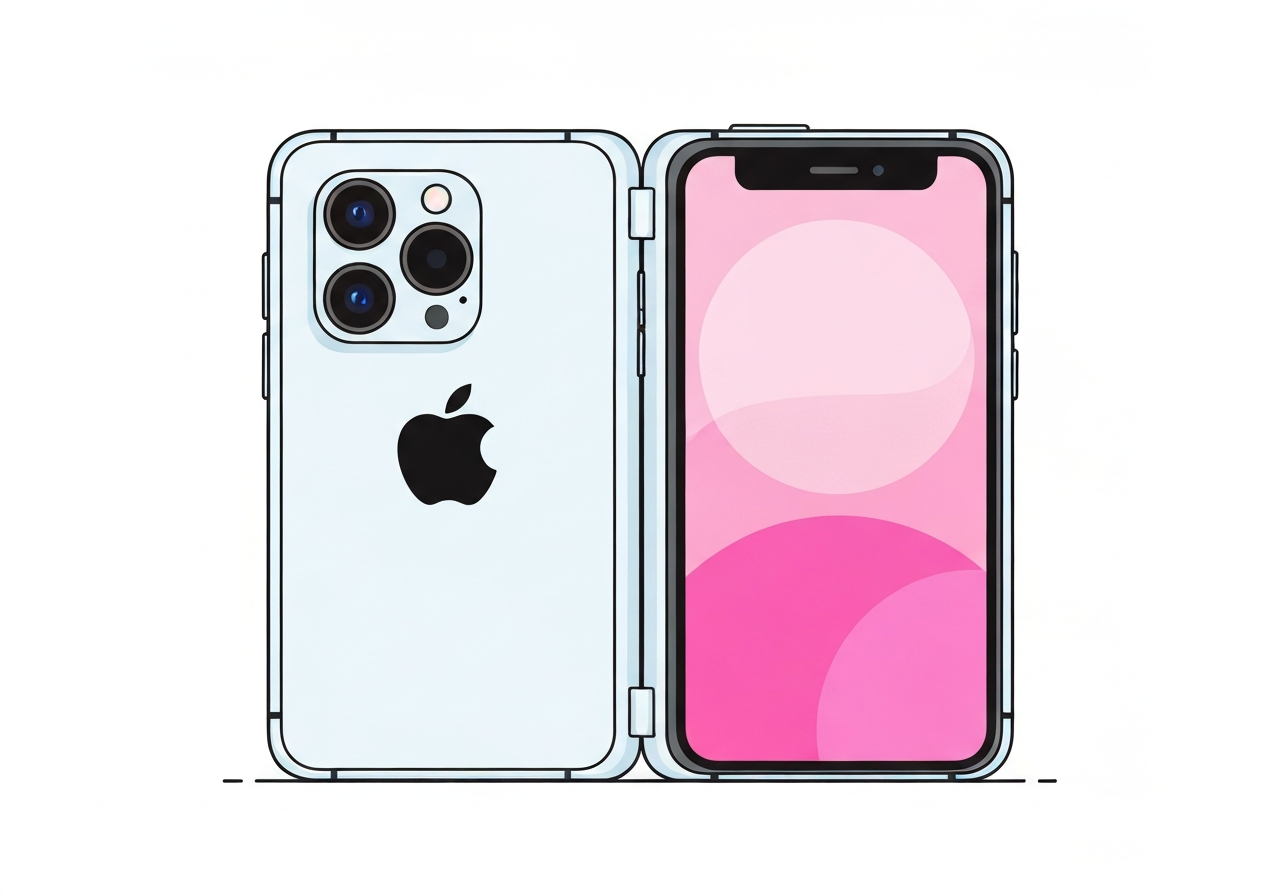
— Two fresh leaks surfaced today outlining several design and hardware choices for Apple’s anticipated iPhone Fold, including button placement, camera layout and a hole‑punch front camera. The details come from a Weibo post by leaker Instant Digital and were summarized by 9to5Mac; they follow an earlier report that the Fold may house Apple’s largest-ever iPhone battery. If accurate, the combination of an unusual internal layout and revised input placements could reshape how users hold and use Apple’s first mainstream foldable.
Key Takeaways
- The leak claims volume buttons are relocated to the device’s top-right edge rather than the left side, a move that would change one-handed ergonomics.
- The power button will retain Touch ID and an additional AI/camera button remains on the right side, with most physical controls consolidated to the right edge.
- Sources say the main logic board sits on the right, enabling a largely button-free left edge and permitting a much larger internal battery than prior iPhones.
- The inner front camera is reported as a single punch‑hole design, consistent with a device that relies on Touch ID rather than Face ID.
- The rear cameras are said to be arranged horizontally on the right side, with the camera module base described as fully black, possibly contrasting with the body color.
- Only a white finish is confirmed in the leak; a second (likely black) color is expected but not verified.
- Leakers describe an internal stacking approach that prioritizes battery and screen structure, reportedly blending iPad mini and iPhone Air design cues.
Background
Foldable smartphones have moved from niche experiments to mainstream competition, led by multiple generations of Samsung Galaxy Fold and similar devices from other manufacturers. Apple has historically prioritized tight integration of hardware and software, and any foldable iPhone will require new internal engineering choices to preserve battery life, screen reliability and iOS feature parity.
Apple’s recent product decisions—such as the Dynamic Island, the reintroduction of Touch ID in side buttons, and the compact iPad mini layout—offer design precedents that the Fold may borrow from. Suppliers and component layouts for foldables differ from slab phones because of hinge mechanisms, stacked batteries and signal routing; those constraints often force compromises in button placement, camera layout and internal board location.
Main Event
The Weibo post from leaker Instant Digital, relayed by 9to5Mac on February 2, 2026, provides a translated list of hardware choices. Chief among them is moving the volume rocker from the left side to a top-right position—an unconventional change for iPhone users accustomed to left‑side controls. The leaker explained this as a consequence of placing the main board on the right to avoid routing flexible cables across the folding display.
According to the leak, the power button on the right will continue to include an integrated Touch ID sensor, and an additional AI or camera-dedicated button will remain on that same edge. The left edge, freed of physical controls, would be allocated primarily to the screen structure and a larger battery pack—described in the post as Apple’s biggest iPhone battery yet, a claim earlier echoed by another leaker.
Camera details in the post include a single punch‑hole front camera—presented as a smaller, cleaner active‑area cutout—rather than a Dynamic Island-style housing. Rear imaging reportedly uses a horizontal dual‑camera array plus microphone and flash on the right side; the camera plateau is said to have an all‑black base that may not match the chassis color.
The post also suggests the Fold’s overall silhouette will mix cues from the iPhone Air (sleek edges) and iPad mini (control and button layout), producing what the leaker calls an “extreme but reasonable” internal stacking that could surprise competitors.
Analysis & Implications
Relocating the volume controls to the top‑right will require a behavioral shift for long‑time iPhone owners. For right‑handed users the change may be less disruptive, but left‑handed users and accessory makers (cases, mounts) will need to adapt. Apple has historically accepted short-term friction for long-term gains—if the change meaningfully increases battery capacity and display integrity, the tradeoff could be defensible.
Putting the motherboard on one side to avoid flex‑cable crossings is a common engineering response in foldables. That layout can reduce stress on the foldable panel and simplify assembly, at the cost of asymmetry in weight distribution and control placement. Larger battery capacity is a strong selling point for foldables, where two active displays increase power draw; however, the exact capacity figure remains unannounced and will determine how meaningful this improvement is.
The choice of a punch‑hole front camera and reliance on Touch ID suggests Apple may prioritize thin bezels and internal layout efficiency over face‑scanning hardware in this model. That decision has software implications: Apple would need to ensure consistent app and security behavior without Face ID on a primary iPhone model, and developers may have to account for different biometric APIs or UX flows on the Fold.
Comparison & Data
| Feature (rumored) | iPhone Fold (leak) | Recent iPhone models |
|---|---|---|
| Volume buttons | Top-right edge | Left edge (typical) |
| Power/Biometrics | Right edge with Touch ID | Side button with Face ID on some models; Touch ID on others |
| Front camera | Single punch‑hole | Dynamic Island punchout or notch |
| Rear cameras | Horizontal dual array on right | Vertical/diagonal modules |
| Battery | Reportedly largest iPhone battery yet (unverified) | Smaller than reported Fold capacity |
The table highlights how the Fold, if these reports hold, departs from established iPhone design patterns. Those departures will affect ergonomics, accessory ecosystems and manufacturing processes; until Apple confirms specifications and capacity, the practical benefits remain estimates rather than confirmed improvements.
Reactions & Quotes
“The motherboard is on the right side, and they didn’t want to run wires across the screen to the left side for the buttons.”
Instant Digital (Weibo leaker, translated)
The leaker framed the layout as an engineering decision to protect display integrity and enable a larger battery, an explanation echoed by supply‑chain analysts who have tracked foldable production tradeoffs.
“It’s been a busy day for iPhone Fold leaks,”
9to5Mac (news outlet)
9to5Mac aggregated the translation and contextualized it alongside earlier battery claims, calling attention to the number of independent hints about Apple’s foldable strategy.
Unconfirmed
- The exact battery capacity and whether it will indeed be the largest ever in an iPhone remain unverified by Apple or suppliers.
- Official color lineup beyond a reported white option has not been confirmed; a black finish is speculated but unproven.
- Button placements and the complete internal board layout are based on a single leaker translation and lack corroboration from Apple or multiple supply‑chain sources.
- Whether the Fold will ship without Face ID in all markets or offer region‑specific biometric configurations is not confirmed.
Bottom Line
Today’s leaks sketch a bold engineering approach for Apple’s first widely anticipated foldable: asymmetric internal stacking to maximize battery and a button layout that departs from long‑standing iPhone norms. If true, those choices prioritize battery life and display integrity but create an ergonomic shift that users and accessory makers must adapt to.
These reports remain unconfirmed and should be treated as informed rumoring until Apple provides official specifications. Key items to watch are Apple’s announced battery capacity, confirmed biometric setup, and whether Apple keeps the reported right‑side control scheme at launch.
Sources
- 9to5Mac — news outlet summarizing the Weibo leak and earlier reports (news)
- Instant Digital (Weibo leaker) — original leaker post (social post; translation cited)