
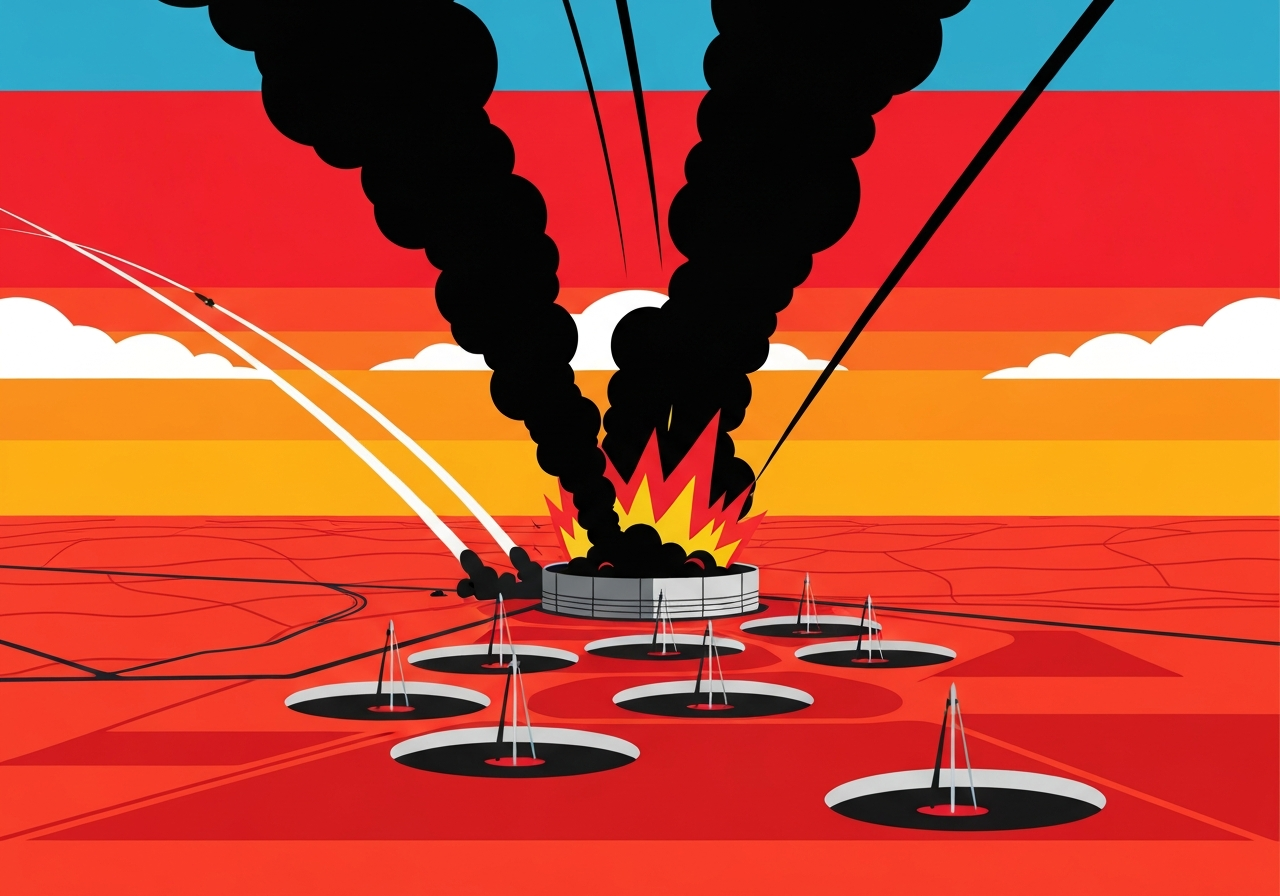
The attack on Iran’s Pars gas field on March 18, 2026, sparked a sharp rise in global energy prices and heightened financial market volatility. Brent crude climbed roughly 5%, pushing prices above $108–$110 a barrel, while U.S. gasoline averages rose toward $3.86 per gallon. U.S. equity benchmarks fell, with the Dow and S&P 500 sliding to their lowest levels since November and Treasury yields climbed as investors reassessed inflation risks. Iranian officials vowed retaliatory strikes on Gulf energy infrastructure, intensifying concerns about supply disruptions.
Key Takeaways
- Attack location and timing: The Pars natural gas field in Iran was struck on March 18, 2026, damaging tanks and refinery components and prompting worker evacuations, according to Iranian state media.
- Oil reaction: Benchmark Brent crude jumped about 5%, moving above $108–$110 per barrel after reports of the strike and pledged Iranian retaliation.
- Fuel costs: U.S. national average gasoline reached roughly $3.86 per gallon, with some price trackers showing month-over-month increases near $1.00 in parts of the country.
- Market moves: The Dow fell about 1.6%, the S&P 500 about 1.4%, and the Nasdaq roughly 1.5%, as investors sold equities amid uncertainty.
- Fixed income: The 10-year U.S. Treasury yield rose nearly 6 basis points to around 4.26%, reflecting bond selling and inflation concerns.
- Geopolitical escalation: Tehran announced plans to target oil and gas infrastructure across the Gulf; Qatar and the UAE condemned the strike and reported damage to energy facilities.
- Responsibility disputed: Israeli media widely reported Israeli involvement with alleged U.S. consent; U.S. officials denied participation and Israel declined comment.
Background
The Pars field sits within the shared South Pars/North Field hydrocarbon complex, the world’s largest concentrated natural gas deposit, split between Iran and Qatar. That infrastructure is critical to regional and global energy flows; any damage or blockade can ripple through crude and refined fuel markets that already operate with limited spare capacity. Since the outbreak of high-intensity hostilities this month, shipping through the Strait of Hormuz—an outlet for roughly 20% of global oil—has been intermittently disrupted, prompting insurers and shippers to reroute or suspend operations.
Political tensions have deepened after a sequence of strikes across the region, including reported attacks on Iranian military and nuclear-linked sites earlier in March. Tehran’s public statements framed the Pars attack as a significant escalation and vowed reciprocal strikes on Gulf energy targets, raising the prospect of prolonged infrastructure damage. Regional U.S. allies, such as Qatar and the UAE, quickly condemned the strike and warned of broader implications for global energy security.
Main Event
On March 18, state and local emergency services in Iran reported fires at tanks and refinery sections in the Pars complex; workers were evacuated and crews worked to control blazes, which state media later said were largely contained. International wire services and Israeli outlets reported that the strike was attributed to Israeli forces; U.S. officials told reporters the United States was aware but denied direct involvement. The Israeli military did not provide an immediate response to media requests.
Market responses were swift: Brent crude surged roughly 5% intraday and U.S. gasoline price trackers reported renewed upward pressure on pump prices. Traders cited both the physical risk to production infrastructure and the broader risk of escalation that could close shipping lanes and force longer-term supply adjustments. Equity markets reacted negatively as investors re-priced growth and inflation prospects under a more volatile supply backdrop.
U.S. policymakers moved to mitigate near-term disruptions: the administration announced a 60-day Jones Act waiver to ease domestic shipping constraints for energy and essential commodities, while defense and diplomatic briefings emphasized contingency planning for maritime security. Regional air defenses in Saudi Arabia and elsewhere reportedly intercepted missiles and drones in the hours after the Pars strike, underscoring the kinetic intensity now affecting multiple Gulf states.
Analysis & Implications
Immediate economic effects center on energy markets: a sustained hit to Pars or retaliatory strikes on Gulf infrastructure would tighten global supply and likely extend the rally in Brent and other benchmarks. That price impulse feeds directly into inflation expectations; the Federal Reserve has already flagged energy-driven uncertainty as a factor complicating its policy outlook. If consumers and businesses expect higher future inflation, spending behavior can change in ways that reinforce price pressures.
Financial markets are balancing two risks: higher inflation that would argue for tighter monetary policy, and slower growth caused by elevated energy costs and trade disruptions that typically argue for looser policy. For now the Fed left rates unchanged, but officials signaled vigilance about upside inflation risks tied to the conflict. Higher Treasury yields imply rising borrowing costs across the economy and can reduce equity valuations when sustained.
Geopolitically, the attack raises the specter of a protracted campaign targeting energy chokepoints and facilities, which would have outsized effects on emerging-market and energy-importing countries. Reopening the Strait of Hormuz and securing Gulf production will require coordinated naval and diplomatic action; regional partners and European nations face increasing pressure to contribute resources and risk-sharing. In parallel, insurance premiums for shipments and energy project financing costs are likely to rise if the security outlook remains unsettled.
Comparison & Data
| Indicator | Prior (approx.) | After strike |
|---|---|---|
| Brent crude | $102–$106 / barrel | $108–$110 / barrel |
| U.S. gasoline (national avg) | $3.86 / gallon | ~$3.86–$3.88 / gallon |
| S&P 500 | -0.6% (pre-market) | -1.4% (session low) |
| 10-year Treasury yield | ~4.20% | ~4.26% (up ~6 bps) |
The table shows intraday moves consistent with a risk-off market reaction and a near-term energy shock. While some indicators may retrace if tensions ease, sustained infrastructure damage or repeated strikes would amplify the higher-price scenario. Economists will watch shipping volumes, refinery utilization, and futures curve shifts for signs of persistent tightening.
Reactions & Quotes
“The implications of developments in the Middle East for the U.S. economy are uncertain,”
Federal Reserve (policy statement)
The Fed’s language underlines how geopolitical shocks complicate the central bank’s inflation-growth tradeoff. Officials reiterated their decision to hold rates steady while noting upside risks from energy markets.
“This was a dangerous and irresponsible escalation that puts global energy security at risk,”
Qatari foreign ministry (statement)
QatarEnergy reported extensive damage at the Ras Laffan hub earlier in the day and called for restraint; Doha hosts significant shared infrastructure with Iran and houses major energy export facilities.
“We were aware of the attack but did not participate,”
White House official (on U.S. role)
U.S. spokespeople denied direct involvement while referring questions about operational responsibility to regional militaries; Israeli media continued to report possible Israeli action with alleged U.S. knowledge.
Unconfirmed
- Attribution: Multiple Israeli media reports attributed the Pars strike to Israeli forces with alleged U.S. consent; neither Israel nor the U.S. has publicly claimed responsibility.
- Extent of damage: Initial state reports cited tank and refinery damage and an extinguished fire, but independent verification of long-term production loss is not yet available.
- Wider targeting plan: Tehran’s stated intent to hit Gulf oil and gas targets has been declared, but the precise timing, scale, and operational execution of such actions remain unverified.
Bottom Line
The strike on the Pars gas field transformed a regional military episode into a material energy-market shock, briefly lifting Brent to levels that intensify inflation risks and complicate central-bank policymaking. Markets reacted with equity sell-offs and higher Treasury yields as investors priced the likelihood of sustained supply risk and higher core inflation expectations.
Policy responses—both diplomatic and logistical—will determine whether the shock is transitory or persistent. Watch for: confirmation of production damage at Pars; any follow-on strikes on Gulf export infrastructure; NATO, U.S., and regional naval moves to secure shipping lanes; and shifts in futures and refinery utilization data that would signal longer-term tightening.
Sources
- USA TODAY — live updates (media)
- Reuters — reporting on Pars strike and regional reactions (news agency)
- GasBuddy — national gasoline price tracker (market data)
- Federal Reserve — policy statement and press materials (official)
- International Atomic Energy Agency — statements on nuclear facility safety (international organization)