
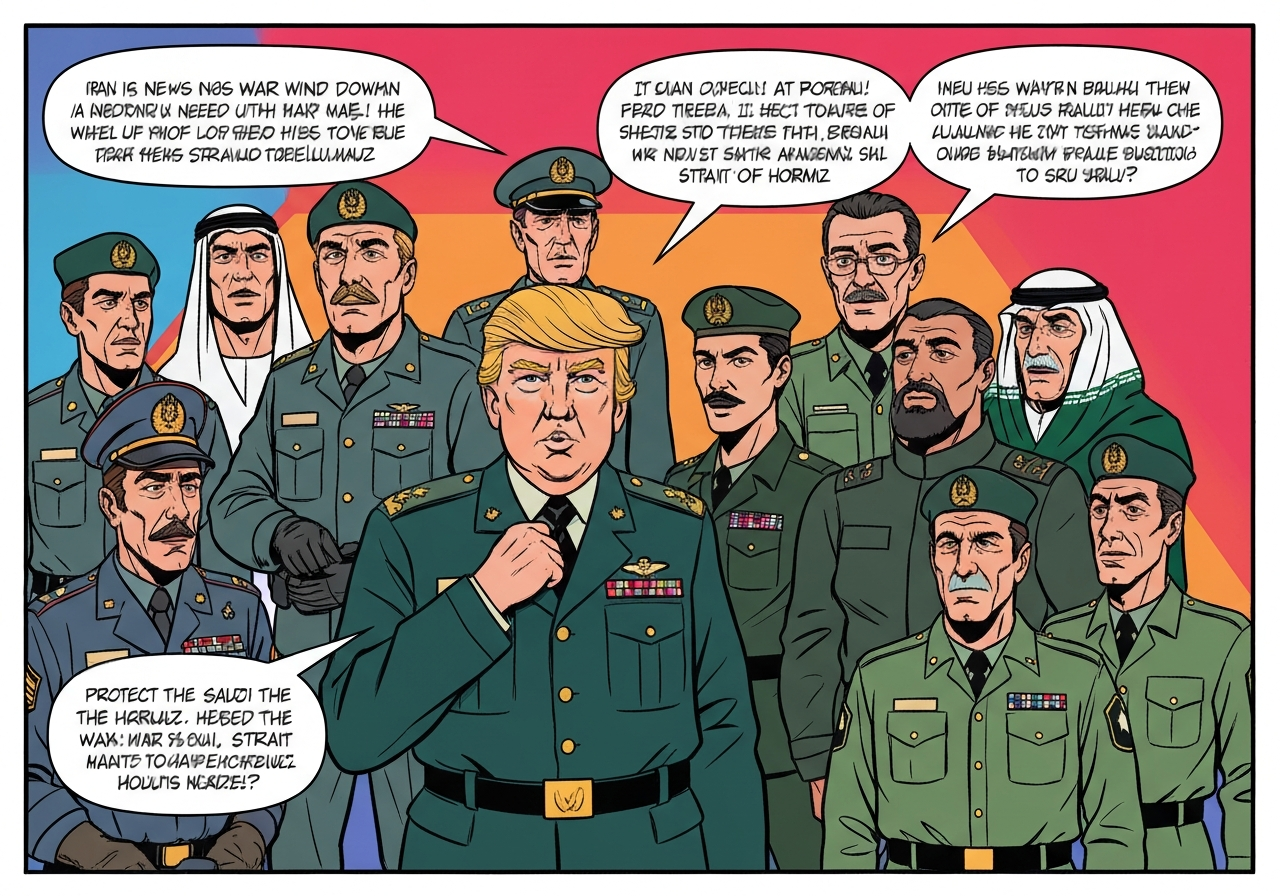
Lead: On 20 March, amid widening strikes and regional alerts, missile fragments fell near the Old City of East Jerusalem, close to al-Aqsa, the Western Wall and the Church of the Holy Sepulchre. President Donald Trump posted that the US is “considering winding down” military operations related to the Iran conflict while urging other nations that rely on the Strait of Hormuz to take responsibility for its security. The developments come as US reinforcements are being dispatched to the region, Gulf states report further drone and missile activity, and several countries pledge support to keep Hormuz open to commercial shipping.
Key Takeaways
- Missile fragments were reported on 20 March near the Old City in occupied East Jerusalem, roughly 300 metres from al-Aqsa mosque, the Western Wall and the Church of the Holy Sepulchre.
- President Trump posted that the US is “considering winding down” military efforts in the Middle East and said the Strait of Hormuz must be guarded by other nations that use it.
- US reinforcements: an initial group of Marines already left Japan and should arrive in about 5–7 days; ~2,500 Marines from the US west coast are expected to take at least 30 days; a separate ~400-strong unit at sea is projected to arrive in about 20 days (estimates per a retired US colonel advising CSIS).
- Gulf tension: Iran threatened strikes on the UAE city of Ras Al Khaimah over a long-running island dispute; the UAE, Dubai and Kuwait reported missile or drone attacks on 20 March.
- Bahrain joined a multi-nation statement with the UK, France, Germany, Italy, the Netherlands, Japan, Canada and others pledging to support safe passage through the Strait of Hormuz.
- Markets reacted: Brent crude near $112 a barrel (up ~3% on the day and ~53% year-on-year); US markets closed lower — Dow down ~1%, S&P 500 down ~1.5%, Nasdaq down ~2% — marking a fourth straight week of losses.
- Israeli authorities closed several holy sites in Jerusalem’s Old City citing security concerns; Israeli military also ordered evacuations in parts of southern Beirut amid intensified strikes focused on Hezbollah infrastructure.
Background
The clash between Iran and a US-led coalition of partners has escalated across multiple fronts since the start of the wider confrontation earlier this year. The Strait of Hormuz — a chokepoint for a significant fraction of global oil flows — has been a repeated flashpoint: Iran has issued threats and reportedly used mines, drones and missiles in ways that alarm Gulf producers and maritime traders. Many countries that rely on the strait for energy shipments have urged collective steps to keep it open.
Diplomatic alignments have shifted: some US partners have moved from defensive postures to permitting US basing or use of facilities for operations tied to threats in the region. The UK recently authorised US use of RAF Fairford and Diego Garcia for strikes against Iranian targets said to endanger shipping and allied personnel, a decision that has provoked debate in British politics and criticism from Iranian officials.
At the same time, regional actors such as Bahrain and a set of NATO and non-NATO countries have publicly pledged support for safeguarding commercial passage through Hormuz. Iran, for its part, has stressed island territorial claims in the Gulf and threatened retaliatory strikes against targets it says are linked to perceived aggression.
Main Event
On 20 March, local and social-media footage showed fragments striking the pavement and railing in Jerusalem’s Jewish Quarter; BBC verification matched the video imagery with satellite maps and said the footage had not appeared online previously. Local authorities closed some of the Old City’s holy sites for security reasons, disrupting religious observance on the first day of Eid for many worshippers.
Meanwhile, President Trump used Truth Social to set out a list of US military objectives and signalled that Washington is near its goals and may begin winding down operations related to Iran. He added that the Strait of Hormuz would have to be “policed by other Nations who use it” and said the US might assist if asked, but would not take primary responsibility. The remarks were delivered as the president travelled with Secretary of State Marco Rubio and prompted immediate diplomatic and allied reaction.
US force posture is being increased but staggered. Retired Colonel Mark Cancian, a senior adviser at the Center for Strategic and International Studies, told the BBC that an initial contingent of Marines that departed from Japan should reach the Middle East in about five to seven days; ~400 Marines at sea are expected in roughly 20 days; and a larger 2,500-strong reinforcement from the US west coast will take at least 30 days after departure.
Across the Gulf on 20 March, the United Arab Emirates, Dubai and Kuwait reported intercepting inbound missiles and drones. Saudi defences said they destroyed six drones over the kingdom’s eastern region. Iran’s state outlets broadcast a warning from its armed forces that any “further aggression” over Abu Musa and Greater Tunb — islands long occupied by Iran but claimed by the UAE — would prompt strikes on Ras Al Khaimah, though Iran did not specify an immediate provocation linked to the warning.
Analysis & Implications
Trump’s public comments about “winding down” may reflect a political decision to signal de-escalation to domestic audiences while pressuring allies to shoulder more of the operational burden for maritime security. If implemented, such a posture shift could reduce the US footprint in direct escort missions but risk creating coordination gaps among the many navies that transit Hormuz. Operationally, multinational escort operations require integrated command-and-control, shared rules of engagement and logistics — capabilities that can take weeks to assemble.
Practically, the phased arrival of US reinforcements means the next month will remain volatile. The first groups arriving within days can provide a deterrent effect, but the larger 2,500-person deployment will not be fully in place for at least a month. That timing matters because Iran and its proxies have demonstrated capacity for irregular attacks on shipping and regional targets that can rapidly alter risk assessments for insurers and traders.
Economically, sustained disruption or the prospect of prolonged insecurity around Hormuz would keep upward pressure on oil prices and compound market volatility. Brent near $112 and sharp weekly index losses already reflect investor concerns; a further escalation could tighten global energy markets and raise inflationary risks for energy-importing economies, notably in Europe and Asia.
Politically, calls from Washington for other user states to “police” Hormuz put countries such as Japan, South Korea, China and Gulf states in a delicate position: they must balance protecting shipping interests against the dangers and diplomatic costs of more direct naval involvement. NATO partners face similar dilemmas; some European states have indicated support for safe passage but have stopped short of committing to offensive options.
Comparison & Data
| Reinforcement Group | Approx. Size | Departure/Status | Estimated Arrival |
|---|---|---|---|
| Group from Japan | Initial Marines | Departed ~1 week earlier | ~5–7 days |
| At-sea unit | ~400 Marines | At sea now | ~20 days |
| West coast reinforcement | ~2,500 Marines | Announced 17–20 March | ≥30 days |
Context: the staggered arrival schedule means a partial US presence in the near term but a full reinforcement picture only after several weeks. This pacing influences deterrence credibility and the options commanders can employ without broader allied participation.
| Market | Move (20 March) |
|---|---|
| Brent crude | ~$112/bbl (+3% day; +53% year) |
| Dow Jones | ~-1% (closed) |
| S&P 500 | ~-1.5% (closed) |
| Nasdaq | ~-2% (closed) |
These market snapshots highlight how security shocks transmit quickly into oil and equity markets.
Reactions & Quotes
Officials and analysts offered mixed responses, reflecting diplomatic friction and security concern.
“We are getting very close to meeting our objectives as we consider winding down our great Military efforts in the Middle East,”
President Donald Trump (Truth Social post, 20 March)
Context: the tweet-like post was circulated from Air Force One and emphasised a US preference to seek allied responsibility for Hormuz security while keeping the option to assist. Allies reacted cautiously, noting operational and legal complexities in multinational maritime security.
“For a hostage or wrongfully detained citizen abroad, their biggest fear is to be forgotten,”
Siamak Namazi (former detainee, CBS interview)
Context: Namazi, released in 2023 after eight years in Iranian detention, warned that heightened tensions increase risks for Americans still held in Iran. US officials say at least four Americans remain detained, two considered wrongfully held.
“We condemn in the strongest terms recent attacks by Iran on unarmed commercial vessels,”
Bahrain and partner states (joint statement)
Context: Bahrain joined multiple countries in calling for immediate cessation of any attempts to block the Strait and expressed readiness to contribute to measures ensuring safe passage; precise operational commitments were not detailed in the statement.
Unconfirmed
- Attribution of the Jerusalem debris to a specific Iranian missile system remains unverified by an official forensic analysis; reports cite fragments and verified video but do not name munition type.
- Reports of strikes in Tehran on 20 March were reported by two sources and Iranian outlets; independent confirmation of target sets and damage assessments was not available at time of reporting.
- Iran’s announced threat to strike Ras Al Khaimah referenced “further aggression” over Abu Musa and Greater Tunb but did not specify an immediate precipitating action that triggered the warning.
Bottom Line
The situation on 20 March combined kinetic incidents close to sacred sites, public US statements hinting at a potential drawdown and ongoing regional threats — a mix that keeps both diplomatic and military risks high. Even if Washington reduces a leading role in escorting shipping, collective security for the Strait of Hormuz will demand rapid coordination, shared rules and clear burden-sharing among nations that rely on the waterway.
Operational timelines matter: partial US reinforcements will arrive in days or weeks, but a fuller posture will take longer to establish. Markets and regional capitals will watch whether allied states step forward with concrete naval or logistical commitments, because any gap in capability or coordination could quickly raise the economic and humanitarian stakes.
Sources
- BBC Live updates — (UK public broadcaster; live news feed, 20 March)
- Center for Strategic and International Studies (CSIS) — (think tank; expert commentary including Mark Cancian)
- CBS News / Face the Nation — (US broadcaster; interview reporting on Siamak Namazi)
- Bahrain News Agency — (state news agency; joint statement reporting)
- UAE Ministry of Defence / official releases — (official government statements on intercepts)