
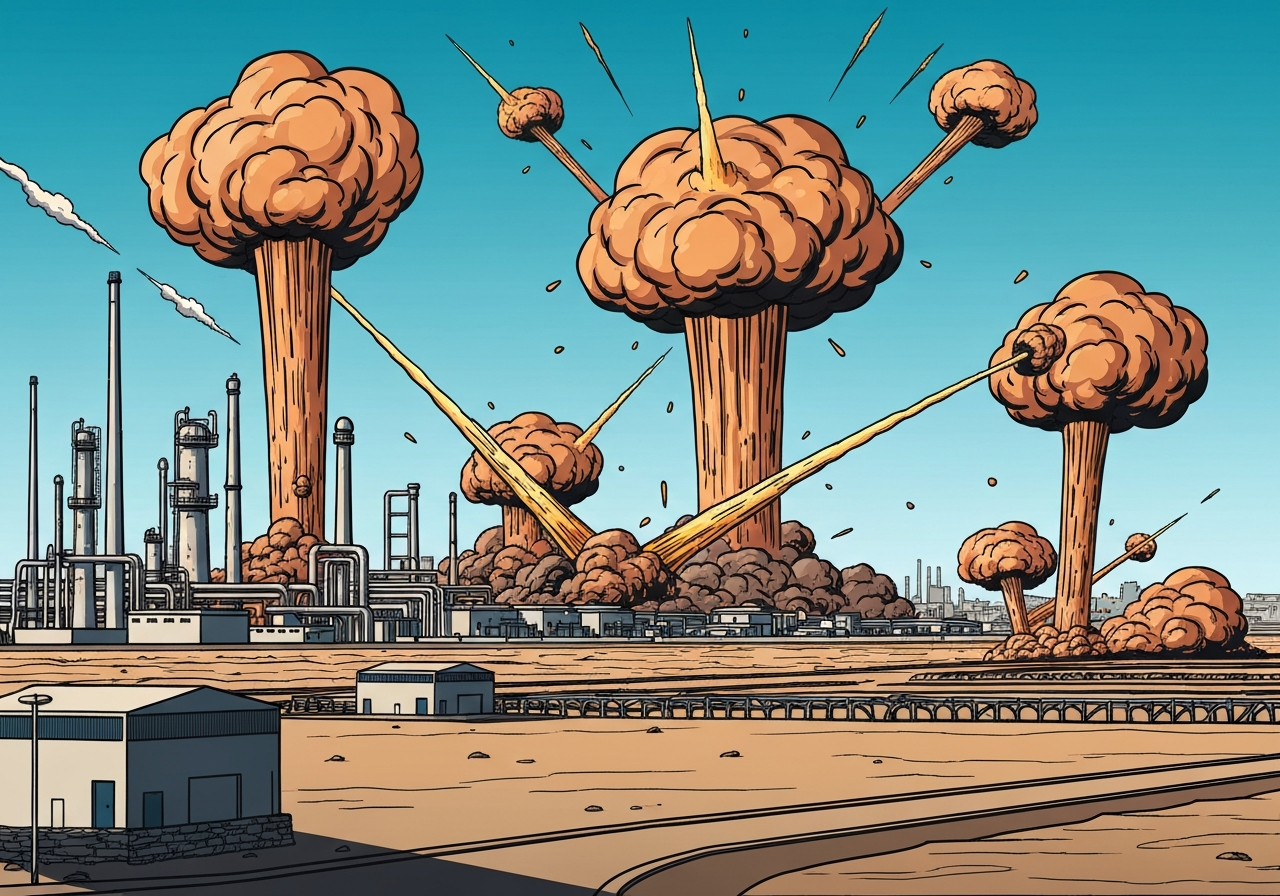
— Iran carried out strikes that damaged a major Kuwaiti oil refinery and set off explosions over Tehran on Friday, officials and media said, in a dramatic escalation nearly three weeks after the conflict began on Feb. 28. The attacks came as Iranians observed Nowruz and regional air defenses intercepted incoming fire over Gulf cities, while Israel and the United States continued a campaign that has targeted Tehran’s leadership and energy infrastructure. The incidents disrupted oil facilities and shipping routes that help supply Asia and Europe, contributing to sharp rises in global fuel prices.
Key Takeaways
- Two waves of Iranian drones struck the Mina Al‑Ahmadi refinery in Kuwait early Friday, sparking fires at a complex that can process about 730,000 barrels per day.
- Explosions were reported over Tehran and Dubai on Friday; Dubai’s air defenses engaged incoming threats during Eid al‑Fitr and Nowruz observances.
- More than 1,300 people have been killed in Iran since the fighting began; Lebanon reports over 1 million displaced and more than 1,000 dead in cross‑border fighting.
- Israel says it has killed more than 500 Hezbollah fighters; Iran‑launched missiles have killed at least 15 people in Israel and 4 in the occupied West Bank.
- At least 13 U.S. service members have died in the campaign so far, and Brent crude was trading near $107, up roughly 47% since Feb. 28, reflecting mounting energy‑market strain.
- Iran’s government announced continued missile production amid the war; Tehran’s paramilitary sources reported the deaths of several senior commanders in recent strikes.
Background
The conflict began on Feb. 28 with sustained U.S. and Israeli strikes against Iranian military, energy and leadership targets, according to official statements, with the declared aims ranging from eliminating nuclear and missile capabilities to destabilizing Iran’s command structures. Over the following weeks, both sides widened targeting: Israel has hit Iran‑linked positions in Lebanon and Syria, while Iran has struck at Israeli territory and energy infrastructure across the Gulf. High‑level deaths have been reported on both sides — Tehran has lost senior figures, and Israel says it has inflicted heavy losses on allied militias in Lebanon.
Iran’s leadership changed rapidly after early attacks: Ayatollah Ali Khamenei, reported killed on the first day, was succeeded by his son Mojtaba Khamenei, who has made public calls to remove the security of Iran’s adversaries. Iran’s Revolutionary Guard and other security organs have been central actors, both defending domestic targets and directing strikes abroad. The conflict has tapped long‑running regional tensions over Iran’s nuclear and missile programs, the role of proxy groups such as Hezbollah, and access to strategic waterways like the Strait of Hormuz.
Main Event
Early Friday, Kuwaiti authorities and regional statements said two waves of drones struck the Mina Al‑Ahmadi refinery, one of the Middle East’s largest facilities with roughly 730,000 barrels per day capacity, igniting fires that emergency crews later worked to contain. Kuwait had reported damage earlier in the week from related strikes, and officials described Friday’s impact as further disruption to refining operations that underpin local and regional fuel supplies.
At roughly the same time, air defenses in Dubai intercepted incoming projectiles, and loud detonations rattled parts of the city as many residents observed Eid al‑Fitr. In Tehran, explosions were heard and state media reported incoming strikes; first responders in Jerusalem also treated two elderly people with light injuries after warning of incoming Iranian missiles. Saudi authorities said they intercepted multiple drones aimed at the Eastern Province, and Bahrain reported a fire after shrapnel from an intercepted projectile hit a warehouse.
Israel continued its campaign inside Iran and beyond. The Israeli military reported that Esmail Ahmadi, head of intelligence for the Basij internal security force, was killed in a strike earlier in the week along with other Basij leaders. Prime Minister Benjamin Netanyahu said Israeli strikes had severely degraded aspects of Iran’s navy, air force and ballistic missile production — claims Tehran’s military disputed.
Iranian officials responded with both threats and confirmation of resilience. Gen. Abolfazl Shekarchi warned that parks, recreational areas and tourist sites worldwide would not be safe for Iran’s enemies. Separately, Gen. Ali Mohammad Naeini was quoted by state outlets saying Iran continued missile production even under wartime conditions; state television later reported Naeini was killed in an airstrike.
Analysis & Implications
The strikes on Gulf energy infrastructure and the risk to shipping through the Strait of Hormuz raise the prospect of sustained global supply shocks. Brent crude’s move to about $107 per barrel — roughly 47% above levels before the conflict — shows markets are pricing in higher risk premiums and potential supply disruptions, particularly to Asia, which receives much of the oil transiting the strait.
Beyond crude, the fighting is interrupting flows of critical raw materials such as helium and sulfur, with knock‑on risks for semiconductor production and fertilizer supply. Those constraints could push up costs across manufacturing and food production chains, intensifying inflationary pressure that policymakers in many countries were already grappling with.
Politically, threats to strike tourist and recreational sites signal a potential broadening of tactics that could internationalize the conflict and complicate efforts by third‑party states to mediate. Attacks outside the Middle East would risk drawing additional states into defensive or retaliatory measures, and they would raise severe legal and humanitarian concerns if civilian locations are targeted.
On the military front, the apparent deaths of senior Iranian commanders suggest that precision strikes have degraded operational leadership, but Iran’s public claims of ongoing missile production and the ability to strike distant targets indicate a capacity for sustained asymmetric retaliation. The lack of visible signs of a domestic uprising in Iran contrasts with hopes expressed by some external actors that regime change might follow intense pressure.
| Metric | Reported figure |
|---|---|
| Iran deaths (reported) | More than 1,300 |
| Lebanon displaced | Over 1,000,000 |
| Hezbollah reported killed (Israel claim) | More than 500 |
| Israeli civilian deaths from Iranian missiles | 15 |
| Brent crude (morning trading) | About $107/bbl (+47% since Feb. 28) |
The table above summarizes major human and economic impacts reported by governments and markets. Figures are based on official tallies and market quotes cited by regional authorities and news agencies; some numbers remain provisional and may be revised as reporting improves. The oil‑price spike reflects immediate market anxiety; however, medium‑term prices will depend on facility repairs, shipping security and diplomatic developments.
Reactions & Quotes
Officials and analysts offered sharply divergent framings, from threat warnings to claims of operational resilience.
“Parks, recreational areas and tourist destinations across the world will not be safe for those who attack Iran,”
Gen. Abolfazl Shekarchi (Iranian military spokesman)
The statement underscored Tehran’s willingness to threaten broad, symbolic targets outside traditional military lists — a shift that regional security analysts say could aim to raise the political and economic costs for adversaries.
“We have hit leadership targets and key capabilities, including strikes on missile production sites,”
Israeli Prime Minister Benjamin Netanyahu (statement)
Netanyahu framed the operations as effort to dismantle Iran’s war‑making capacity; Israeli officials have repeatedly highlighted high‑value strikes as evidence of operational success, even as independent verification is limited for some claims.
“We are producing missiles even during war conditions…there is no particular problem in stockpiling,”
Gen. Ali Mohammad Naeini (quoted in state press)
Iran’s public assertions of continuing arms production are intended to signal resilience to both domestic audiences and international rivals; subsequent reports saying Naeini was killed illustrate how fluid and violent the operational environment remains.
Unconfirmed
- Extent of damage to Iran’s nuclear facilities is not independently verified; public claims vary and assessments remain provisional.
- Precise operational state of Iran’s navy and air force after recent strikes is disputed between Israeli claims and Iranian denials.
- Attribution of some explosions and specific strike details (timing, weapon type) has not been fully corroborated by independent sources.
Bottom Line
This week’s attacks — including strikes on the Mina Al‑Ahmadi refinery and explosions over multiple Gulf cities — have shifted the conflict from localized strikes to actions that threaten global energy flows and civilian infrastructure. Markets have already priced in higher risk through a near 50% jump in Brent crude, while disruptions to raw materials could ripple through manufacturing and food systems worldwide.
Near term, attention should focus on repair and containment at Gulf energy sites, protection of shipping through the Strait of Hormuz, and diplomatic efforts to prevent further escalation or outward expansion of strikes to civilian tourism sites. The human toll and displacement in Lebanon and Iran underline the broader humanitarian stakes, even as the prospect of a sudden political collapse inside Iran appears unlikely based on current reporting.
Sources
- Associated Press (international news agency) — main reporting and timeline.
- Israel Defense Forces (official) — statements on strikes and militant casualties.
- IRAN (newspaper) (state media) — quoted on missile production and Gen. Naeini remarks.
- Kuwait Oil Company (official/industry) — background on Mina Al‑Ahmadi refinery capacity and impact.
- Reuters Commodities (news agency/market data) — Brent crude pricing and market context.