
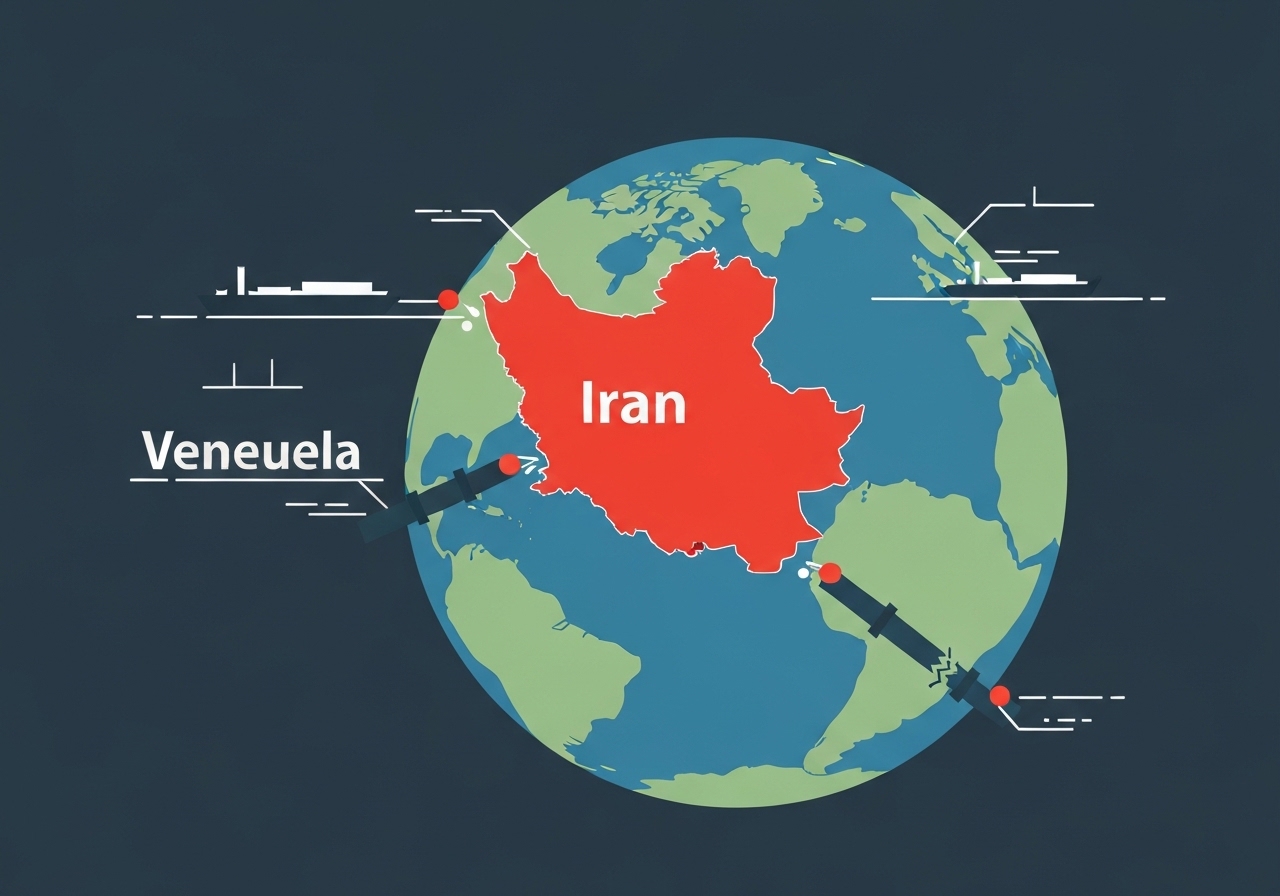
Lead: Developments in Iran carry outsized consequences for global oil and financial markets because Tehran supplies substantially more crude and sits at the heart of Gulf transit routes. Energy experts warn that a severe disruption in Iran — whether from internal upheaval, new sanctions, or regional escalation — would reverberate far more widely than comparable turmoil in Venezuela. The risk stems from Iran’s larger production and exports, dense regional infrastructure, and the role of the Strait of Hormuz in global flows. Markets would likely see sharp short‑term price spikes and broader geopolitical spillovers if Iranian output or transit were curtailed.
Key Takeaways
- Iran currently produces roughly 4 million barrels per day (bpd) — about four times Venezuela’s output — covering roughly 4% of global oil demand.
- Iran is estimated to export about 2 million bpd; Venezuela’s exports are around 350,000 bpd, limiting the latter’s immediate market impact.
- About 25% of the world’s traded oil passes through the Strait of Hormuz; a blockade there could push prices toward estimates as high as $120 a barrel.
- Both countries face sanctions that hinder technology access and investment; Iran additionally relies on a sizeable “shadow fleet” to move oil to buyers like China.
- Iran’s production has shown resilience since the 1980s, recovering from 2 million bpd to roughly 4 million, though it never returned to the pre‑1979 peak near 6 million bpd.
- Heavy crude and remote deposits make Venezuela’s 303 billion‑barrel reserves harder to monetize quickly compared with Iran’s exportable volumes.
- If oil workers in Iran joined sustained strikes, historical precedent suggests this could threaten regime stability and produce acute supply shocks.
Background
Iran is a major OPEC producer whose crude and transit geography make it central to global energy security. Historically the country produced near 6 million bpd before 1979; output then fell to about 2 million bpd in the 1980s and later stabilized near 4 million bpd. That recovery reflects operational resilience but also chronic underinvestment due to sanctions, limits on foreign technology and parts, and discounted sales to secure buyers.
Venezuela holds very large proved reserves — OPEC cites about 303 billion barrels — but much of that oil is heavy, located in the Orinoco Belt and costly to process. Those features, plus domestic mismanagement and sanctions, have shrunk Venezuela’s marketable output to roughly 350,000 bpd, reducing the immediate systemic risk its instability poses to world markets.
Main Event
Energy analysts say the contrast between Iran and Venezuela is primarily quantitative and geographic. Andreas Goldthau of the Willy Brandt School notes Iran’s share of production and exports gives it much greater leverage over prices than Venezuela. Since Iran still moves millions of barrels a day and sits beside chokepoints and dense regional infrastructure, any sizable disruption would have rapid price and trade effects.
Sanctions have driven Iran to develop alternative logistics, including a large tanker fleet used as floating storage and intermediary transfer platforms. Those practices — transfers at sea and reflagging vessels — have enabled Iran to maintain flows to key buyers, notably China, which takes the bulk of Iranian crude. The shadow‑fleet dynamic complicates both enforcement and market forecasting.
Political unrest raises an added layer of risk. Observers caution that if refinery or field workers join broad protests, production stoppages could become prolonged. Reports remain mixed about whether key oil provinces like Khuzestan have seen meaningful output declines; some outlets report no confirmed drop in exports so far.
Analysis & Implications
In the near term, a sudden loss of Iranian exports would tighten global supply and likely prompt a marked price spike. Investment banks and market analysts have modeled scenarios in which a significant Gulf disruption pushes Brent toward levels near $120 a barrel. Such moves would be driven not only by physical deficits but also by risk premia tied to transit security and insurance costs.
However, markets can adjust over time: other producers may increase output, and strategic petroleum reserves managed by entities such as the IEA could be released to stabilize prices. The scale and duration of any shock would determine how quickly replacements can close the gap, and logistical constraints often slow that process.
A more dangerous prospect is regional contagion. A blockade or attacks on Gulf export and midstream facilities could damage neighboring states’ infrastructure, deepen supply interruptions, and raise LNG and gas prices in markets like Europe, where about 20% of global LNG passes through the Strait of Hormuz.
Longer term, sustained sanctions, discounting and deferred maintenance erode government revenues and investment, perpetuating a cycle of weaker output and economic strain. That fiscal pressure feeds social unrest, creating feedback between domestic politics and energy markets that can persist for years.
Comparison & Data
| Country | Production (bpd) | Estimated exports (bpd) | Share of global demand | Proved reserves (billion barrels) |
|---|---|---|---|---|
| Iran | ~4,000,000 | ~2,000,000 | ~4% | — |
| Venezuela | ~350,000 | ~350,000 | ~1% | 303 |
The table highlights why market participants treat Iran’s position differently: Iran’s daily export volumes are several times those of Venezuela, amplifying the impact of supply interruptions. Venezuela’s vast reserves are predominantly heavy crude in remote fields, which constrains the speed and feasibility of turning reserves into marketable barrels.
Reactions & Quotes
Officials, analysts and investors have voiced concern about the potential market effects of Iranian instability. Below are succinct remarks placed in context.
“Iran’s production and export scale mean disruptions would be felt much more sharply in global markets.”
Andreas Goldthau, Willy Brandt School (academic)
This comment underlines the quantitative case: Iran’s higher flows and export links to major buyers make it a more consequential supply node than Venezuela.
“A collapse or prolonged internal conflict would change regional power balances and carry heavy economic costs.”
Mark Mobius, investor in emerging markets (finance)
Mobius’ observation frames the political stakes: regime outcomes in Tehran could reshape geopolitics and investment climates across the Middle East.
“A blockade of the Strait of Hormuz could send prices sharply higher — sizable enough to affect global inflation and trade.”
JPMorgan (investment bank, market analysis)
Financial estimates from investment banks emphasize the chain reaction from a transit disruption to commodity markets and downstream economic indicators.
Unconfirmed
- Whether oil exports from Khuzestan province have fallen significantly remains unverified; some reporting finds no confirmed drop in national exports.
- The full size and current location of Iran’s offshore floating storage is not publicly confirmed and varies across estimations.
- There is no definitive evidence yet that oil sector workers have mounted nationwide strikes sufficient to halt production.
Bottom Line
Iran’s fate matters to global oil markets more than Venezuela’s because of higher production and exports, strategic geography near the Strait of Hormuz, and integrated supply‑chain risks. Disruptions in Iran would therefore trigger sharper immediate price moves and carry larger geopolitical consequences than similar turmoil in Venezuela.
Markets may absorb a temporary shortfall through alternative supplies and releases from strategic reserves, but the overall costs — higher energy prices, insurance and shipping premiums, and potential regional escalation — could persist. Policymakers, traders and consumers should monitor political developments in Iran closely, as the economic and security stakes are substantial and intertwined.