
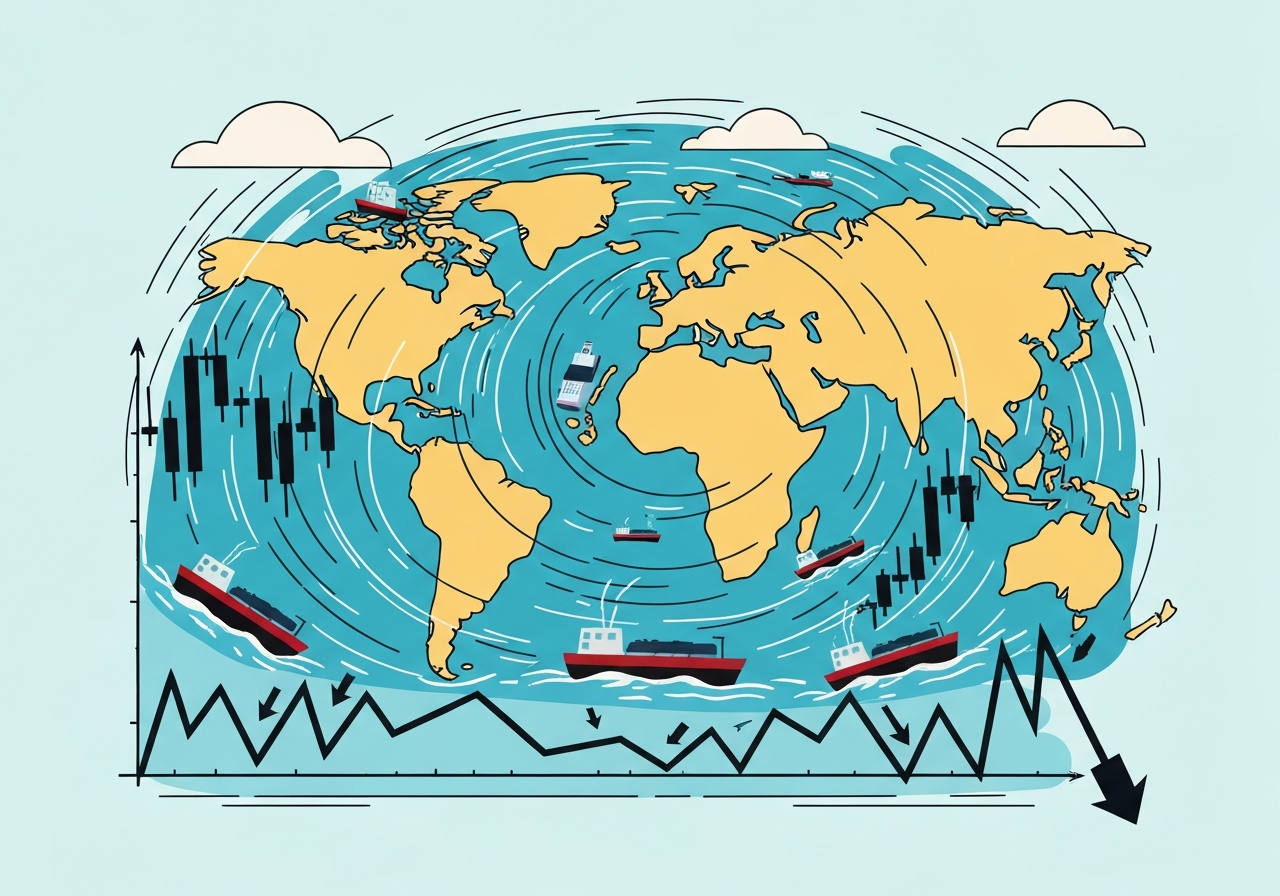
Global markets plunged and oil prices spiked on Monday after renewed airstrikes across Iran and attacks on energy infrastructure raised fears of prolonged disruption to shipments through the Strait of Hormuz. Finance ministers from G7 countries, including UK Chancellor Rachel Reeves, convened an emergency meeting to assess economic fallout as Brent crude briefly approached $119.50 a barrel and the FTSE 100 fell about 1.5%. Traders reacted to reports of halted traffic through the narrow shipping lane and to weekend strikes that hit oil depots in Iran and energy targets across the Gulf. Policymakers are considering coordinated measures, including a possible IEA-coordinated release from petroleum reserves, to calm markets.
Key takeaways
- Brent crude spiked to as high as $119.50 on Monday morning before retreating to roughly $107; US WTI traded around $104 per barrel.
- About one fifth of the world’s oil transits the Strait of Hormuz; traffic has largely stopped since the war intensified more than a week ago.
- The FTSE 100 fell about 1.5%, Germany’s Dax and France’s Cac 40 each dropped roughly 2.5%, while Japan’s Nikkei fell 5.2% and South Korea’s Kospi declined about 6%.
- G7 finance ministers met Monday to discuss market responses; the Financial Times reported they will consider an IEA-coordinated release from strategic reserves—the first such move since 2022.
- UK month-ahead gas jumped to 171p per therm at open before easing to about 156p; US average gasoline prices rose 11% last week to $3.32 a gallon (AAA).
- Saudi Arabia reported intercepting two waves of drones overnight aimed at a major oilfield, while Iran named Mojtaba Khamenei as successor to Supreme Leader Ali Khamenei amid continuing hardliner control.
Background
The spike in energy prices and market volatility follows a sharp escalation in hostilities between the US, Israel and Iran that began more than a week ago. Airstrikes across Iran at the weekend reportedly struck multiple targets, including oil depots, and Iran in turn has targeted energy infrastructure in neighbouring Gulf states. The Strait of Hormuz, a narrow but vital chokepoint through which around 20% of global oil normally flows, has been a particular focus because any prolonged disruption there quickly tightens global supply.
Policy responses now link geopolitics with macroeconomics: higher oil and gas prices feed inflation, which in turn can alter central bank paths on interest rates. In 2022 coordinated releases from strategic petroleum reserves were used after Russia’s full-scale invasion of Ukraine; officials are again weighing similar steps. Major market indexes are sensitive to energy risk—energy producers can benefit from higher prices while most other sectors face cost pressure and investor flight to safe assets.
Main event
Over the weekend the US and Israel carried out additional airstrikes inside Iran, reportedly damaging oil depots and other infrastructure. Concurrently Iran asserted strikes on energy facilities in neighbouring countries, and Saudi forces said they intercepted drone waves bound for a key oilfield. The clashes prompted immediate risk-off moves in Asia, Europe and the US trading sessions, with wide sectoral losses and notable drops in equity benchmarks.
On Monday morning Brent crude jumped more than 25% from recent levels to a session high near $119.50 before settling back to around $107; WTI showed comparable volatility and traded near $104. UK month-ahead gas initially rose about 25% to 171p per therm then eased to 156p as trading continued. The abrupt moves triggered circuit-breaker mechanisms in some markets: South Korea’s Kospi halted trading for 20 minutes amid a roughly 6% decline.
Governments and international agencies scrambled to respond. G7 finance ministers convened an emergency session—reporting indicates a focus on coordinated reserve releases through the International Energy Agency (IEA) and on measures to stabilize markets and consumer prices. Officials emphasized they were monitoring both immediate supply disruptions and the potential for a longer, structural impact on energy logistics in the Gulf.
Analysis & implications
Immediate market impacts are clear: higher crude and gas prices raise input costs for businesses and increase living expenses for consumers, feeding into headline inflation. Central banks that had signalled potential rate cuts could delay or scale back easing if energy-driven inflation proves persistent, slowing a prospective respite for economies that expected lower rates later this year.
Financial stability is also at stake. Rapid price moves and deep share declines can trigger forced selling, margin calls and liquidity stress in vulnerable markets. Emerging-market economies that import oil or hold significant foreign-currency debt could suffer outsized strain if commodity-driven balance-of-payments shocks widen. Investors often seek safe-haven assets—government bonds and the dollar—compounding pressure on equity markets.
Policy tools are limited in the short term. Strategic reserve releases can moderate price spikes but do not solve shipping-route insecurity or repair damaged infrastructure. Coordinated diplomatic pressure and military de-escalation would be required to restore steady flows through Hormuz; absent that, markets may price in a prolonged premium for physical security risks in the Gulf.
Comparison & data
| Metric | Recent peak | Level after retreat |
|---|---|---|
| Brent crude | $119.50/b | ~$107/b |
| WTI crude | — | ~$104/b |
| FTSE 100 | — | -1.5% |
| Nikkei 225 | — | -5.2% |
| Kospi | — | -6% (trading halted 20 mins) |
The table highlights acute intra-day swings: crude prices surged then eased, while equity markets recorded steep single-day losses in Asia and Europe. The asymmetry matters—energy firms often gain on higher oil, but industrials, transportation and consumer-exposed sectors face immediate margin compression. Historical precedent from 2022 shows reserve releases can blunt spikes but are not a substitute for restored supply certainty.
Reactions & quotes
Officials, analysts and political leaders responded quickly to the market shock, framing both the scale of the disruption and the limits of policy options.
“People are realising that this won’t end quickly,”
Adnan Mazarei, Peterson Institute for International Economics
Mazarei’s comment followed observations that Gulf production has been halted in several locations and that the conflict shows signs of prolonged engagement. He warned markets should prepare for sustained higher prices unless security and production are restored.
“Israel, not the US, was targeting Iran’s energy infrastructure,”
Chris Wright, US Energy Secretary (broadcaster remarks)
Wright’s statement aimed to clarify the chain of responsibility for recent strikes amid domestic concern about fuel costs. The comment feeds into debates about escalation risk and how allied actions affect regional energy assets.
“Short term oil prices… are a very small price to pay for U.S.A., and World, Safety and Peace,”
Donald Trump, US President (social media post)
The president framed temporary price increases as acceptable in pursuit of broader security objectives; critics say this understates near-term economic pain for consumers and firms. Market participants nonetheless weigh political resolve against the economic cost of a protracted disruption.
Unconfirmed
- Whether G7 ministers will formally agree to and immediately trigger an IEA-led coordinated release of strategic petroleum reserves remains unconfirmed; reports indicate it is under discussion.
- Precise damage assessments and the full operational impact on Gulf oil production and export capacity are incomplete; official tallies of lost barrels have not been disclosed publicly.
- Attribution of all recent strikes and counterstrikes is still being clarified; some claims of responsibility and target lists remain subject to verification.
Bottom line
The market reaction underscores how quickly regional military escalation translates into global economic stress: oil and gas prices climbed sharply, equity markets fell, and policymakers rushed to consider coordinated interventions. Short-term measures such as releasing strategic stocks can reduce acute price spikes but offer limited protection if shipping through Hormuz remains insecure.
Investors and policymakers should prepare for a period of elevated volatility. If disruption persists, central banks could delay easing, consumer prices may stay higher for longer, and supply-chain pressures could spread across energy-intensive sectors. Restoring maritime security and repairing damaged infrastructure are the durable solutions; until then, markets will likely price a geopolitical risk premium into energy and broader asset valuations.
Sources
- BBC News — news report summarising developments and market moves (primary news source).
- Financial Times — news outlet referenced for reporting on G7 discussions (news).
- Peterson Institute for International Economics — think-tank commentary from an economist cited in market analysis (academic/think tank).
- International Energy Agency (IEA) — international energy authority referenced for reserve-coordination mechanisms (official/agency).
- AAA — motorists group data on US gasoline price moves (consumer group).