
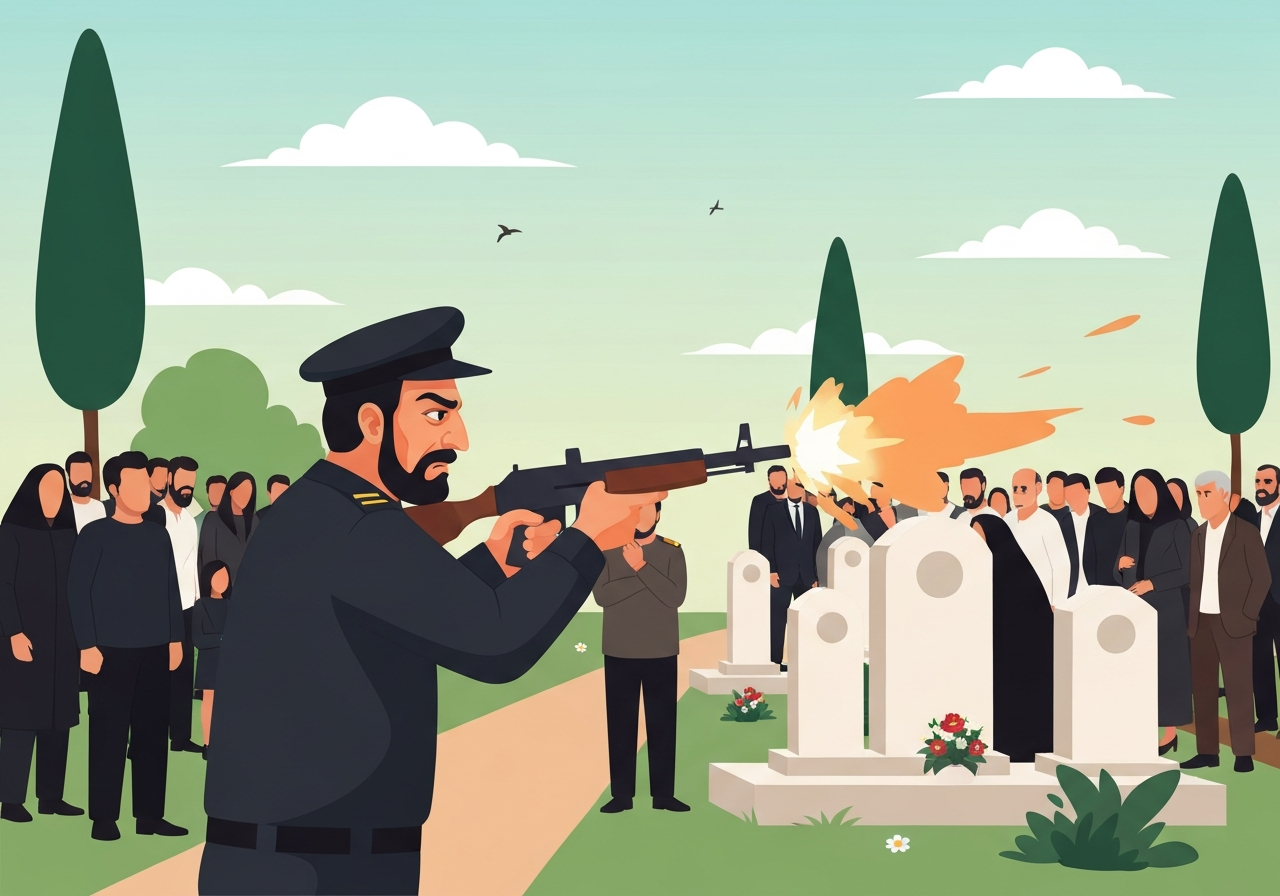
Lead: Verified footage shows a uniformed security official firing at a crowd of mourners in Abdanan, western Iran, on Tuesday during 40th-day commemorations for victims of last month’s deadly crackdown. Witnesses and video show people running and smoke after two shots; state media denied reports of casualties. The incident coincided with commemorations across several cities after the bloodiest nights of protest on 8 and 9 January.
Key takeaways
- Video verified by BBC Verify and BBC Persian shows a uniformed figure firing from or near an armoured vehicle at a cemetery in Abdanan on Tuesday during a commemoration.
- The shots in the footage number at least two; visible puffs of smoke and people fleeing are captured on multiple clips.
- The event took place during traditional 40th-day mourning ceremonies held nationwide after the deadly 8–9 January crackdown that reportedly killed thousands.
- State-run IRIB News described the Abdanan gathering as peaceful and said reports of injuries or deaths were not true.
- Footage from Tehran, Mashhad and Abdanan includes chants of “death to Khamenei” in verified clips; state-organised broadcasts showed officials leading chants of “death to America.”
- A billboard visible in one clip displays Alireza Seydi, a teenager from Abdanan believed to have been killed during protests and memorialised at the ceremony.
- BBC reporting notes the unrest spread to more than 68 towns and cities during the protests that began in late December and escalated in January.
Background
The unrest began in late December over economic grievances and social issues, and escalated sharply after events on 8 and 9 January following a call for nationwide demonstrations by Reza Pahlavi, the exiled son of the late shah. Authorities launched a severe crackdown in which thousands are reported to have been killed; Iran’s supreme leader later acknowledged the large death toll and blamed foreign influence for the unrest. Across the country, families have held 40th-day memorials for those killed—a cultural practice that has in several cities turned into further demonstrations.
Commemorative gatherings became focal points for renewed anti-government expression, with both spontaneous memorials and state-organised events taking place. State media have aired ceremonies attended by senior officials and military figures, where organisers directed pro-regime chants. Parallel independent and citizen-filmed footage documented anti-government chants and confrontations in multiple cities.
Main event
On Tuesday in Abdanan, video verified by BBC teams shows an armoured vehicle moving past a crowd at a cemetery as mourners chanted and gathered around memorials. In one clip a person who appears to be wearing a uniform lifts a firearm; a first shot is fired with the weapon initially pointed away from the camera, then a second shot is audible after the barrel appears directed toward the crowd. People are seen screaming and running from the area as smoke is visible near the weapon.
Another verified clip from the same cemetery shows smoke on the horizon and multiple gunshots while people scatter. A roadside billboard in one video features a photograph of Alireza Seydi, identified in reporting as a teenager from Abdanan who was believed to have died in protests in Tehran and was being commemorated that day.
In other cities—Tehran and Mashhad among them—verified footage captured mourners shouting anti-government slogans during 40th-day events. State television simultaneously broadcast official memorial ceremonies attended by senior figures, where participants were led in chants directed at the United States. The two streams—state events and independent footage—highlight sharply different narratives offered to domestic and international audiences.
Analysis & implications
The apparent use of lethal force at a cemetery during a mourning ritual marks an escalation in the dynamic between security forces and civilians: memorials that traditionally serve as private or communal grieving can become flashpoints for broader political expression. If security personnel use force in such settings, it risks deepening public anger and could inflame further street-level confrontations rather than contain them.
For the Iranian government, managing both the optics and the reality of these events is politically sensitive. State broadcasters emphasise orderly, state-led ceremonies; independent footage circulating online undermines that narrative by showing spontaneous dissent and, in this case, the apparent use of firearms. Internationally, images and videos of violence at memorials may increase scrutiny from rights groups and foreign governments already critical of the January crackdown.
Practically, accountability will hinge on verifiable, transparent investigations—something critics argue is unlikely given the current environment. Absent credible inquiries and independent access, disputed claims about casualties and responsibility will persist, complicating efforts by outside actors to respond or mediate. The interplay between citizen video verification and official denials will be central to how the story develops and how public opinion evolves domestically.
Comparison & data
| Item | Reported/Observed |
|---|---|
| Key protest dates | 8–9 January (peak crackdown) |
| Towns/cities affected | Reported spread to more than 68 locations |
| Shots captured on verified video | At least two in Abdanan clip |
These figures—dates, scope and the number of shots audible on available footage—are drawn from verified video and BBC reporting. They do not substitute for official counts of casualties or a formal investigation; rather, they provide a factual baseline for what can be observed in open-source material to date.
Reactions & quotes
State broadcaster IRIB denied that the Abdanan ceremony resulted in injuries or deaths, presenting the gathering as orderly and peaceful.
“The event was peaceful and reports of people injured or killed were not true.”
IRIB News (state broadcaster)
Independent verification teams documented anti-regime chants at multiple commemorations, including language directly targeting Iran’s supreme leader.
“Death to Khamenei”
Verified video — BBC Verify / BBC Persian
Iran’s supreme leader has publicly conceded the heavy toll from the January crackdown, framing the casualties in geopolitical terms.
“Thousands had been killed”
Statement by Ayatollah Ali Khamenei (reported)
Unconfirmed
- Precise casualty figures from the Abdanan incident remain unverified; state media deny injuries or deaths, and independent counts have not been confirmed by a neutral body.
- The identity, rank and official affiliation of the person who fired in the video are not independently confirmed.
- The intent behind the shots—whether warning, aimed at specific individuals, or otherwise—has not been established from the footage alone.
Bottom line
The verified footage from Abdanan adds to a mounting body of open-source evidence showing confrontations between security forces and civilians during a period of sustained unrest in Iran. Whether this incident becomes a catalyst for renewed street-level protest or is contained by a combination of state media messaging and security measures will depend on subsequent domestic responses and any independent verification of casualties.
For observers and policymakers, the incident underscores the importance of transparent, independent investigations and continued scrutiny of both state narratives and citizen-sourced evidence. In the short term, expect more memorial events to become contested spaces and for the competing narratives—state-organised commemorations versus grassroots mourning and dissent—to shape both domestic sentiment and international reaction.
Sources
- BBC News — Verified reporting on Abdanan incident (national broadcaster / investigative reporting)
- BBC Verify (verification unit)
- BBC Persian (Persian-language reporting / media)
- IRIB News (state broadcaster — official statements)