
Lead
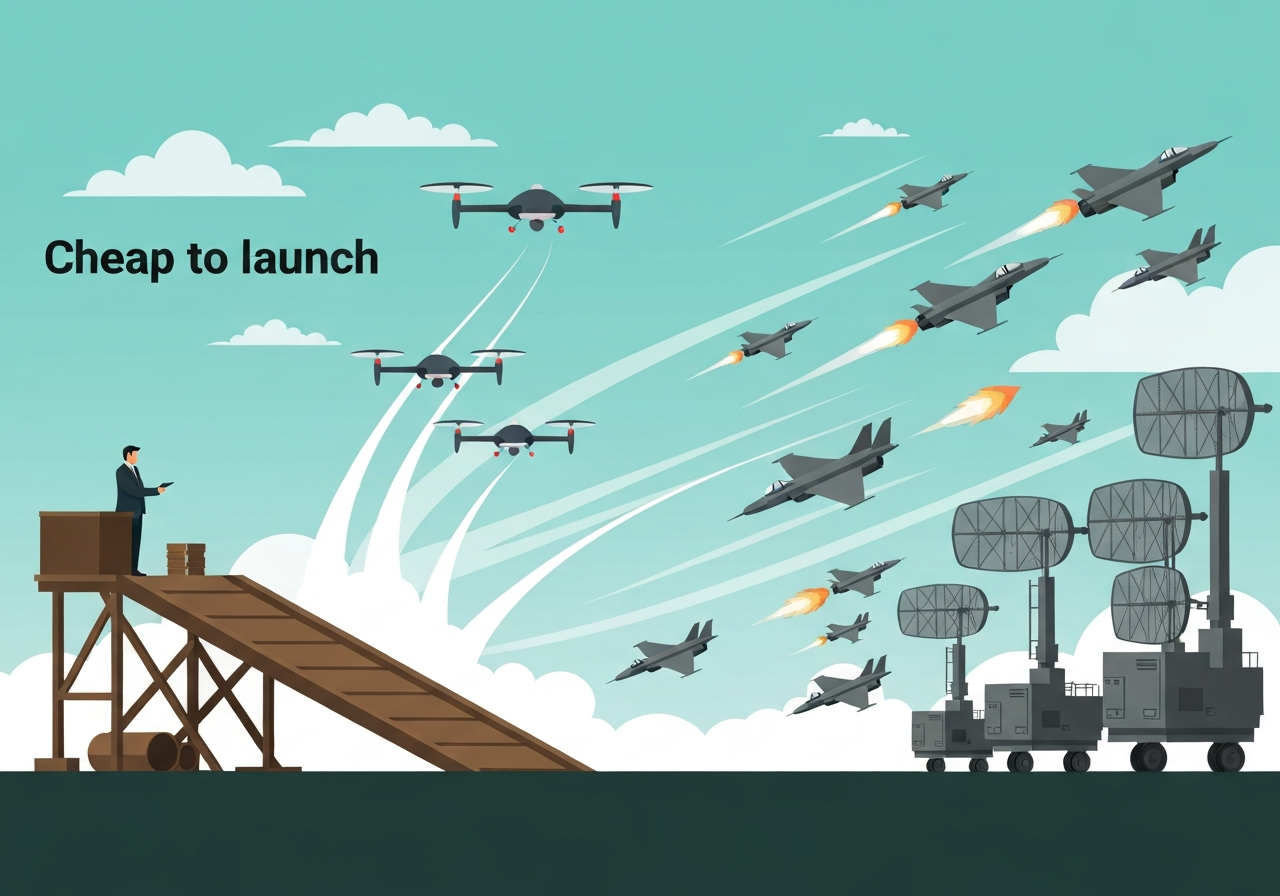
Since early March 2026, waves of Iranian Shahed loitering drones have posed a growing challenge across the Middle East, prompting expensive missile and radar responses from the United States and its partners. More than 2,000 one-way drones have been launched in recent exchanges, and some have reached targets despite layered, billion-dollar air defenses. Analysts say each Shahed can cost roughly $20,000 to $50,000 to build while the interceptors and systems used against them run into vastly higher per-engagement expenses. The result is a widening asymmetry: cheap offensive drones versus costly defensive responses.
Key Takeaways
- Iran has deployed thousands of Shahed-series loitering munitions; open-source reporting cites more than 2,000 one-way drones fired since a spike in strikes in early March 2026.
- Shahed 136 long-range variants can travel about 1,200 miles, enabling strikes across the Middle East from mobile launch sites.
- Manufacturing cost per Shahed is estimated at $20,000–$50,000, built largely from commercial off-the-shelf electronics.
- Interception cost ratios favor attackers: industry estimates put the cost-to-intercept multiplier at a minimum of 10:1 and possibly as high as 60–70:1 in dollar terms per engagement.
- U.S. and allied air defenses can stop a majority of ballistic missiles and drones but face sustainability and capacity strains when engagements are frequent.
- Shaheds’ small size and truck-launch mobility make detection and preemption difficult for layered air-defense networks.
- Proliferation and mass production — including licensed or copied variants used in other conflicts — amplify the long-term difficulty of defensive containment.
Background
Loitering munitions, sometimes called suicide drones, have become a central feature of modern asymmetric warfare because they combine low cost with precise, hard-to-defeat delivery. Iran began developing and exporting Shahed variants over the last decade; the design’s simplicity allows mass production using commercial components. In recent years the type has been used in regional conflicts and copied or adapted by other state and nonstate actors, increasing availability and tactical familiarity.
On March 4, 2026, reporting highlighted renewed strikes and counterstrikes that put Shahed variants at the center of a cost-exchange problem for defenders. U.S. and allied systems — from ship- and ground-based interceptors to integrated radar and command networks — are capable and battle-tested but are also built and procured on a different economic scale than relatively cheap drones. That divergence introduces both immediate logistical burdens and longer-term budgetary implications if high-rate drone launches continue.
Main Event
In the recent exchange of attacks, Iranian forces launched massed waves of Shahed drones. Their triangular, jet-powered frames, roughly 11 feet long, carry explosive payloads in the nose and produce a distinctive roaring sound in flight. Operators can conceal and move launchers on trucks, complicating pre-launch targeting for defenders who rely on fixed radar coverage or satellite cues.
U.S. and allied air defenses engaged many incoming drones, shooting down large numbers with interceptors from layered systems. Officials and industry experts note intercept success is high for many launches but not perfect: some drones penetrated defenses and struck targets. The physical destruction of incoming drones consumes interceptors and munitions that are orders of magnitude more expensive than the weapons they counter.
Industry voices framed the contest in stark financial terms. Arthur Erickson, chief executive of a Texas drone firm, summarized the mismatch as a “money game,” saying it is generally much more expensive to defeat a single drone than to build and launch one. Independent analysts at U.S. think tanks add that the ratio varies by engagement profile and system used but creates a persistent economic pressure on defenders.
Analysis & Implications
The core implication is fiscal and operational: if attackers can sustain high sortie rates of low-cost loitering munitions, defenders may exhaust interceptors, strain logistics, and face rising procurement costs for replacement missiles and sensors. Over months or years, recurring engagements could require major budget reallocations or accelerated procurement of new counter-drone technologies.
Second, doctrine and deployment will likely shift. Defenders may prioritize layered, lower-cost countermeasures—electronic warfare, directed-energy research, and area denial solutions—that can be used repeatedly at lower marginal cost than single-use interceptors. Investment in detection, attribution, and preemptive strike capabilities may rise to reduce reliance on post-launch intercepts.
Third, proliferation matters. Variants of the Shahed are being mass-produced beyond Iran, and combat use in other theaters (notably by Russia in Ukraine) has improved operational knowledge among potential users. As production scales, states and proxies gain access to cost-effective precision-strike options, making regional escalation more affordable and potentially more frequent.
Comparison & Data
| Item | Typical Value |
|---|---|
| Shahed manufacture cost | $20,000–$50,000 per unit |
| Shahed 136 range | ~1,200 miles |
| Estimated cost-exchange ratio | ~10:1 to 60–70:1 (interceptor cost : drone cost) |
The table highlights the asymmetric economics: even conservative estimates place a large multiplier on defender spending per successful interception. That multiplier is not a fixed constant — it varies by system, theater, and whether lower-cost countermeasures are available — but it frames why repeated drone salvos can be strategically effective even when many are shot down.
Reactions & Quotes
“It is definitely more expensive to shoot down a drone than to put a drone in the sky.”
Arthur Erickson, CEO, Hylio (industry)
Erickson’s comment underscores the industry view that current cost asymmetries favor attackers who can mass-produce simple loitering munitions.
“Long-range variants like the 136 expand reach and complicate defenses, allowing strikes from farther and more concealed launch points.”
Stacie Pettyjohn, Senior Fellow and Director, Defense Program, CNAS (think tank)
Pettyjohn’s assessment highlights how extended range and mobility change tactical calculations for defenders across the region.
Unconfirmed
- Exact production totals for Iran’s Shahed-series drones remain unclear; claims of “thousands” are reported but not independently verified to a unit-by-unit accounting.
- Precise, event-level cost accounting for every interception (which interceptor, support logistics, platform amortization) varies by incident and is currently estimated rather than publicly tabulated.
- Attribution of all recent launches to specific Iranian units or external proxies has reports and signals intelligence elements that have not been publicly released.
Bottom Line
The recent exchanges underscore a strategic dilemma: when attackers can field reliable, low-cost loitering munitions at scale, defenders face an expensive, ongoing burden to stop them. Short-term operational success in shooting down many drones does not remove the longer-term fiscal and capacity stresses on air-defense forces.
Policymakers will need to balance procurement of high-end interceptors with investment in scalable, lower-cost countermeasures (electronic warfare, directed energy, enhanced detection) and strategies to reduce launch-capable stockpiles. Monitoring proliferation, improving attribution, and international cooperation on export controls will also be key to limiting the broader diffusion of these capabilities.
Sources
- The New York Times — news reporting on Shahed drone launches and U.S. defense responses (media).
- Center for a New American Security (CNAS) — think-tank analysis and expert commentary including assessments by Stacie Pettyjohn (think tank).
- Hylio — drone manufacturer comments and industry perspective from company leadership (industry).