
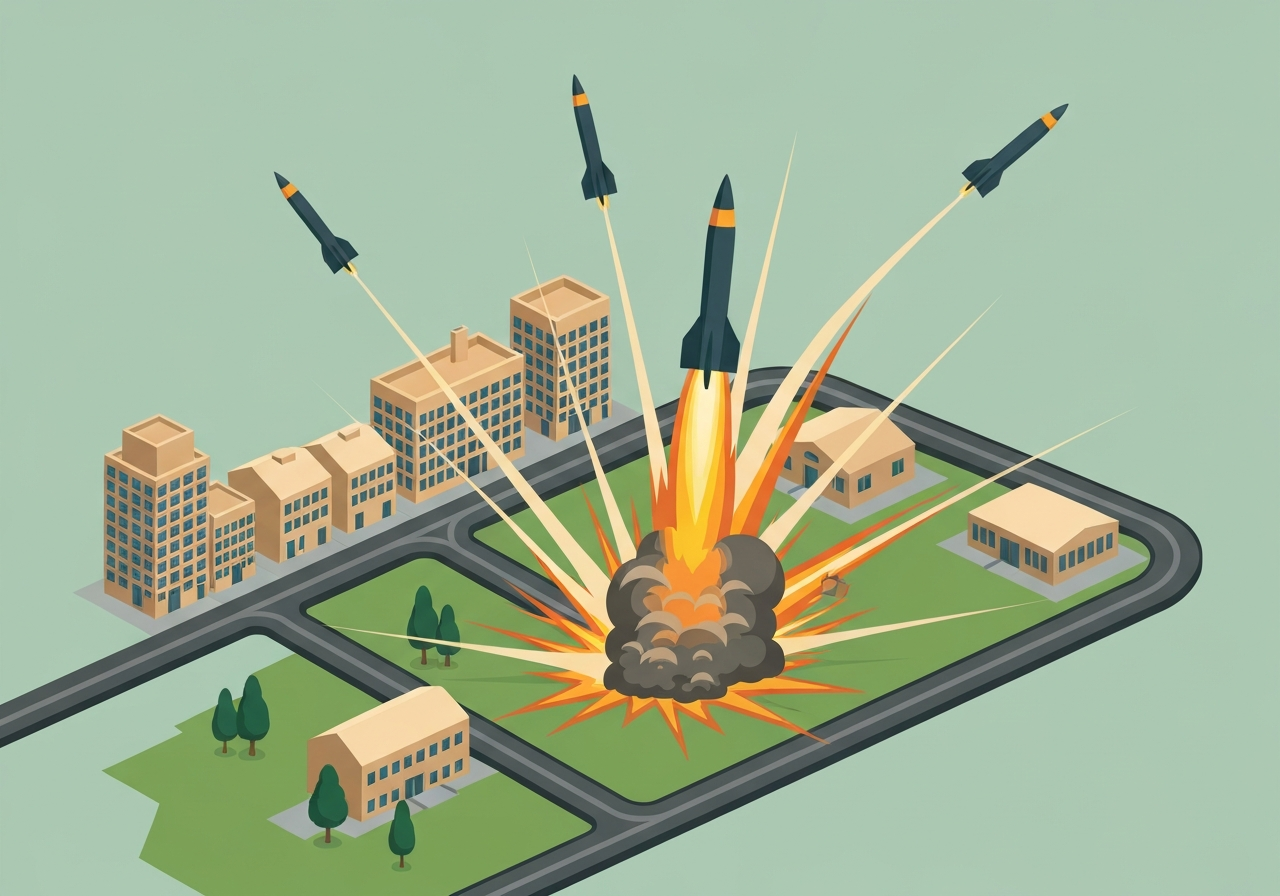
On March 22, 2026, Iranian missile strikes struck the southern Israeli towns of Arad and Dimona, communities near Israel’s primary nuclear research center, injuring more than 100 people. Israeli emergency services reported at least 64 injured in Arad—seven seriously, 15 moderately and 42 lightly—and about 40 injured in Dimona. The attacks came hours after an airstrike hit Iran’s Natanz enrichment facility, an incident for which Israel denied responsibility; the International Atomic Energy Agency (IAEA) said it had not detected abnormal radiation. Israeli leaders called the strikes reckless and vowed continued military action as emergency teams searched damaged buildings and debris for additional casualties.
Key takeaways
- More than 100 people were reported injured across two towns on March 22, 2026, with at least 64 in Arad and about 40 in Dimona, according to Magen David Adom.
- The Arad strike caused heavy structural damage across at least 10 apartment buildings; three were assessed as badly damaged and at risk of collapse.
- This was the first time Israel’s main nuclear research center area was directly targeted in the three-week-old war, marking an escalation in target selection.
- The strikes occurred hours after an airstrike damaged Iran’s Natanz enrichment site; Israel has denied responsibility and the IAEA reported no off-site radiation increase.
- Iran’s parliamentary speaker framed the inability to intercept missiles as a new operational phase, while Israeli leaders called for broader international action against Iran.
- U.S. officials have discussed options regarding Iran’s nuclear materials; sources say no final decision by the Trump administration had been announced as of March 22.
Background
The current confrontation traces to a war that began about three weeks before March 22, 2026, and has already included strikes on nuclear-related facilities on both sides. Israel, widely understood to possess nuclear weapons though it maintains deliberate ambiguity, has seen attacks both domestically and on Iranian facilities during the past year, including a 12-day exchange in June 2025. Iran’s nuclear infrastructure—sites such as Natanz and Isfahan—has been the focus of previous strikes and countermeasures; the IAEA has tried to monitor damage and radiation levels amid repeated incidents.
Dimona and Arad lie in Israel’s Negev desert near the country’s main nuclear research center, a location that until this weekend had not been directly struck in the latest conflict. Emergency responders and local authorities have been primary actors in immediate casualty care and damage assessment, while national leaders have used the incidents to frame wider diplomatic and military objectives. Regional actors and the United States have been drawn into contingency planning, including discussions on how to secure or remove nuclear materials if escalation continues.
Main event
Early on March 22, Iranian missiles struck Dimona and, hours later, Arad. Magen David Adom reported 64 injuries in Arad, with seven hospitalized in serious condition; teams continued to search rubble for more victims. Rescue footage showed a large crater near residential blocks in Arad and apartment exteriors sheared away, consistent with a strike that hit both open areas and nearby structures.
In Dimona, authorities reported about 40 injured; officials said air defenses had not intercepted the missiles that reached the towns near the nuclear research center. Local mayors and emergency coordinators described large-scale damage to housing stock and stressed search-and-rescue priorities as aftershocks of secondary hazards such as fires and unstable buildings.
Prime Minister Benjamin Netanyahu visited the scene at Arad and told reporters that the absence of fatalities was “due to luck,” urging additional international support and aligning Israel and the United States in response efforts. Israeli military spokespeople reiterated that strikes on civilian areas appeared deliberate on Iran’s part and framed the attacks as evidence of Iran’s disregard for civilian life.
Analysis & implications
The direct strikes near Israel’s primary nuclear research center represent a notable escalation in target selection and risk. If strikes persist against areas adjacent to nuclear infrastructure, the probability of unintended damage to sensitive sites or of miscalculated responses rises, increasing the risk of wider regional spillover. Military planners on both sides must now weigh the tactical advantage of striking symbolic or strategic targets against the strategic costs of international condemnation and potential escalation.
For Israel, the inability to intercept some incoming missiles near a heavily protected area raises questions about air-defense coverage and future deployment of assets. Iranian officials framed the events as evidence of new operational phases, which could signal changes in missile types, ranges or launch patterns intended to overwhelm defenses. International actors, including the United States, face difficult choices between deeper involvement, stepped-up logistics and intelligence support, or pursuing diplomatic channels to de-escalate.
Economically and politically, risks include disruption to regional energy markets, increased military spending, and a hardening of domestic politics in both Iran and Israel. Civilian trauma and infrastructure damage in towns such as Arad and Dimona will require reconstruction funds and social support, and persistent strikes may shift public tolerance for broader military action. Finally, repeated strikes on nuclear-related sites complicate non-proliferation monitoring and technical assessments by agencies like the IAEA.
Comparison & data
| Event | Date | Reported injured | Notes |
|---|---|---|---|
| Arad strike | March 22, 2026 | 64 (7 serious, 15 moderate, 42 mild) | Large crater; 10+ apartment buildings damaged |
| Dimona strike | March 22, 2026 | ~40 | Near nuclear research center; interception reportedly failed |
| Natanz airstrike | March 22, 2026 (hours earlier) | — | IAEA reported no off-site radiation increase; Israel denied responsibility |
| June 2025 strikes | June 2025 | Variable | Multiple strikes on Iranian nuclear sites during a 12-day exchange |
The table summarizes reported casualties and key notes for the March 22 events and recent precedents. While casualty counts are from national emergency services and media reports, structural damage assessments remain preliminary pending engineering surveys. The IAEA continues to provide technical monitoring of nuclear sites; its public statements are a crucial data point when assessing radiological risk after strikes near nuclear facilities.
Reactions & quotes
Israeli political and military leaders used the strikes to press international partners for stronger measures against Iran and to explain operational choices at home and abroad. Local authorities emphasized the scale of the humanitarian response and the ongoing search for survivors.
“If you want proof that Iran endangers the entire world, the last 48 hours have given it,”
Benjamin Netanyahu, Prime Minister of Israel
Netanyahu visited Arad and characterized the lack of fatalities as “luck,” urging global leaders to join Israel and the United States in confronting Iran. His remarks framed the strikes as evidence of what he described as Iran’s willingness to target civilian areas.
“It is becoming increasingly clear that the Iranian regime is resorting to reckless attacks that only further expose its instability and disregard for human life,”
Lt. Col. Nadav Shosh, Israel Defense Forces spokesperson
The IDF spokesperson used social channels to describe the strikes as strategically aimed at civilians and to justify continuing military operations across multiple fronts. Military briefings following the strikes emphasized damage assessments and search-and-rescue priorities.
“If the Israeli regime is unable to intercept missiles in the heavily protected Dimona area, it is, operationally, a sign of entering a new phase of the battle,”
Mohammad Bagher Ghalibaf, Iran Parliament Speaker
An Iranian official framed the incidents as evidence of changing operational dynamics; Iranian state outlets also reported the Natanz facility was not leaking radiation following an earlier strike. Tehran’s official commentary positioned the events as both a strategic message and a critique of Israeli defenses.
Unconfirmed
- Attribution for the Natanz airstrike remains officially unconfirmed; Israel has denied responsibility and investigations are ongoing.
- Reports of additional casualties beyond the numbers released by emergency teams remain possible as rubble searches continue.
- The exact types and launch points of the missiles fired at Arad and Dimona have not been publicly confirmed by independent analysts.
Bottom line
The March 22 strikes on Arad and Dimona represent a significant intensification by bringing towns near Israel’s primary nuclear research center into the line of fire. While no deaths were reported at the time of the latest public tallies, the human toll—more than 100 injured and extensive housing damage—will have lasting local and political consequences.
For regional stability, the incidents raise the stakes for both military planners and diplomats: the risk of accidental damage to sensitive nuclear infrastructure, the prospect of further escalation, and mounting pressure on international actors to choose between containment, deeper military involvement, or urgent diplomacy. Monitoring by agencies such as the IAEA and transparent casualty and damage reporting will be essential to assess evolving risks.
Sources
- CBS News (media report; original article summarizing strikes and casualty figures)
- International Atomic Energy Agency (IAEA) (UN nuclear watchdog; technical monitoring and public statements)
- Magen David Adom (official Israeli emergency medical service; casualty reports)
- Mizan (Mizan Online) (Iranian judiciary-affiliated news outlet; statements on Natanz)
- The Associated Press (wire service reporting on regional developments)