
Lead
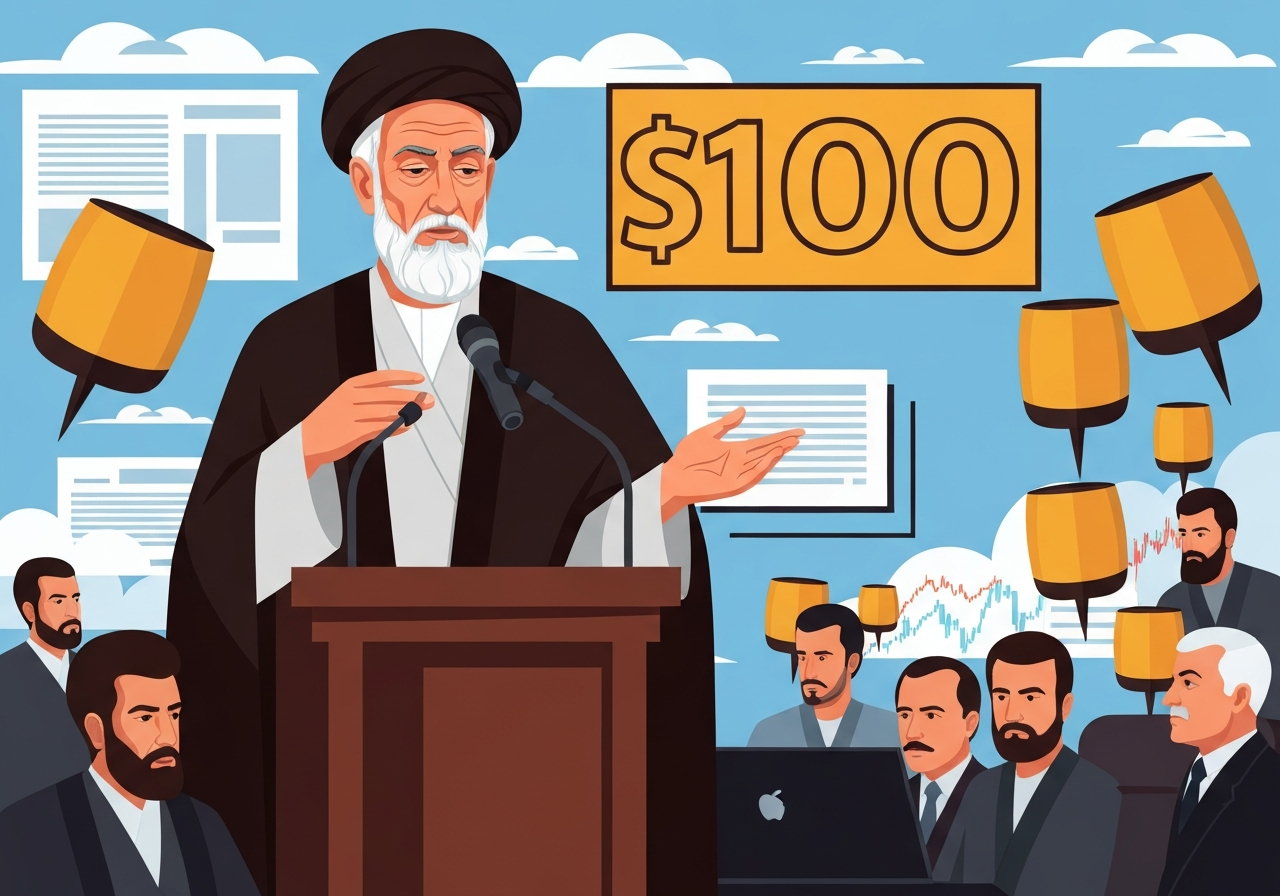
Iran’s newly appointed Supreme Leader, Mojtaba Khamenei, delivered his first public remarks on March 12, 2026, as global oil prices climbed above $100 a barrel and financial markets moved lower. The statement, broadcast by state television and read by a presenter rather than shown live, reiterated Tehran’s intention to keep pressure on U.S. bases and to leverage control over the Strait of Hormuz. The comments came amid fresh attacks on commercial tankers in the northern Persian Gulf, widespread evacuations in southern Lebanon and mounting humanitarian displacement inside Iran. Markets reacted to the combination of military escalation and supply concerns despite coordinated releases from strategic petroleum reserves.
Key Takeaways
- Iran’s Supreme Leader Mojtaba Khamenei gave his first public remarks on March 12, 2026, urging continued pressure on U.S. bases and invoking retaliation for recent deaths.
- Brent crude and other benchmarks climbed above $100 per barrel on March 12, reversing temporary relief after strategic reserve releases; global benchmarks rose roughly 5–6% in recent trading.
- The International Energy Agency announced a 400 million-barrel coordinated release while the U.S. moved 172 million barrels from its Strategic Petroleum Reserve to calm markets.
- Israel issued new evacuation orders for residents south of the Zahrani River in Lebanon; more than 800,000 people in Lebanon have been displaced in the past 10 days.
- UNHCR estimates up to 3.2 million people have been internally displaced inside Iran, a figure the agency says may rise as the conflict continues.
- Multiple tanker attacks were reported in Iraqi waters and the northern Gulf, including an attack on the Safesea Vishnu that left at least one sailor dead and others evacuated.
- The Israeli military said it conducted extensive strikes against Iranian targets and claimed significant degradation of Iran’s air defenses and command elements, a claim Tehran disputes.
Background
The current round of hostilities escalated after a U.S.-Israeli campaign against Iran’s military infrastructure and follow-on Iranian strikes on regional bases, commercial shipping and energy infrastructure. The Strait of Hormuz, a chokepoint linking Persian Gulf producers to world markets, has been intermittently targeted, cutting supply flows and heightening risk premia in oil markets. International institutions have responded with emergency measures: the U.S. and the International Energy Agency announced coordinated releases from strategic stockpiles to stabilize supply.
Lebanon has emerged as an expanding theater as Iran-backed Hezbollah exchanges fire with Israel, prompting hundreds of thousands to flee northern and southern districts; Israel’s recent evacuation order pushed the main relocation line north to the Zahrani River, about 35 miles from the Israeli border at midpoint. Meanwhile, Iran denies seeking nuclear weapons even as Israel says it has struck program-related sites. Humanitarian agencies warn that displacement inside Iran and across neighboring countries is growing amid continued military activity.
Main Event
On March 12, 2026, state television broadcast remarks attributed to Mojtaba Khamenei, the new Supreme Leader. The address, presented by a reader rather than a live appearance, stated that Tehran had thwarted attempts to divide the nation and would continue actions against U.S. bases it deems complicit in attacks. He demanded closure of U.S. bases in the region and framed the closure of the Strait of Hormuz as leverage, promising avenging those killed in recent strikes.
In the same 24-hour cycle, Iran’s Revolutionary Guard and affiliated media released video they said showed a missile strike on the U.S.-owned tanker Safesea Vishnu off Iraq’s coast; the British maritime authority reported two tankers struck by unknown projectiles in the same area and crews evacuated. Iraq’s port authority identified the other vessel as the Malta-flagged Zefyros; one Indian crew member was reported killed in the attacks and dozens were rescued.
Israel responded with a broadened military posture, announcing a new wave of strikes against targets across Iran and warning Lebanon’s government it may seize territory if local authorities cannot curb Hezbollah. Israeli officials claimed more than 4,200 strikes had been carried out, that 80% of some Iranian air defenses were neutralized and that about 1,900 Iranian commanders and personnel had been killed — figures the Iranian government disputes.
Markets and transport chains felt immediate effects: oil rallied above $100 per barrel and equity futures opened lower, even as the IEA and the U.S. released combined volumes of strategic crude. Airlines and logistics firms signaled higher costs, with carriers such as Cathay Pacific announcing fuel surcharge increases reflecting elevated bunker and insurance costs for Gulf routing.
Analysis & Implications
The immediate market reaction reflects the concentration of supply and transit risk in the Persian Gulf. With the Strait of Hormuz accounting for a large share of seaborne crude exports from the Gulf, repeated attacks on tankers or continued closure risk force traders to price in prolonged disruption. The IEA and U.S. reserve releases are sizeable but primarily tactical: they supply crude into markets but cannot replace persistent production or logistical stoppages if maritime transit remains unsafe.
Regionally, the conflict risks widening through proxy escalation. Israel’s broader strikes inside Iran and threats to expand operations in Lebanon increase the chance of spillover into neighboring states. Countries such as Qatar, Saudi Arabia and the United Arab Emirates have reported intercepted missiles or drones, stretching regional air defenses and elevating insurance and rerouting costs for shipping companies.
Humanitarian and economic strains are mounting: UNHCR’s preliminary assessment of up to 3.2 million internally displaced people inside Iran and 800,000 displaced in Lebanon point to sizable shelter, healthcare and logistics needs. For governments in the region and donor nations, the crisis will demand emergency assistance while simultaneously complicating diplomacy because military objectives, domestic politics and public sentiment constrain flexible responses.
On a geopolitical level, sustained pressure on oil and finance could shift third-party states’ behaviors, incentivizing diplomatic interventions or arms resupplies. Financial markets may see bouts of volatility in commodity and equity prices until actors can credibly secure shipping lanes or reach a de-escalation. Persistently higher oil prices would also feed through to inflation and central-bank calculations in many economies, complicating macro policy decisions.
Comparison & Data
| Metric | Recent value / claim |
|---|---|
| Brent crude | Above $100 per barrel (March 12, 2026) |
| IEA coordinated release | 400 million barrels |
| U.S. SPR release | 172 million barrels |
| Estimated displaced in Iran | Up to 3.2 million (UNHCR) |
| Displaced in Lebanon (last 10 days) | Over 800,000 |
| IDF strikes reported | Over 4,200 strikes; 1,900 regime personnel killed (IDF claim) |
The table summarizes key numbers shaping market and humanitarian responses. Reserve releases are large by historical standards but are finite and intended to smooth short-term supply shocks rather than substitute for lost production. Displacement figures from UNHCR and Lebanese health authorities signal growing humanitarian needs; independent verification on some battlefield casualty claims remains limited.
Reactions & Quotes
Iranian leadership framed recent operations as justified retaliation and moral duty to avenge the dead, a posture intended to consolidate domestic support and deter further strikes.
“I assure everyone that we will not refrain from avenging the blood of your martyrs,”
Mojtaba Khamenei (reported by state media)
Market analysts characterized Iran’s maritime campaign as a deliberate effort to raise economic costs for adversaries by threatening chokepoints and commercial shipping.
“Iran’s strategy of sowing economic chaos in the Gulf is working,”
Adam Crisafulli, Vital Knowledge
U.S. officials sought to temper the most extreme market forecasts while emphasizing operational steps to protect shipping and restore confidence.
“I would say unlikely” that oil reaches $200 per barrel,
U.S. Energy Secretary Christopher Wright (to CNN)
Unconfirmed
- The precise battlefield tolls claimed by the Israeli military, including the figure of over 1,900 Iranian regime commanders and soldiers killed, are Iranian state and independent verification pending.
- The full attribution and forensic confirmation of the video showing the strike on the Safesea Vishnu remain subject to third-party verification and maritime incident investigation.
- Reports that specific Iranian islands would be targeted or that an island seizure (for example Kharg) is imminent are unconfirmed and cited in commentary rather than official operational orders.
- Details on the exact causes of shipboard fires reported near Basra — whether drone, missile or explosive-laden boats — remain under investigation.
Bottom Line
The combination of Iran’s public hardline messaging, continued attacks on vessels in the northern Gulf, and Israel’s campaign of strikes has pushed energy markets higher and financial markets lower despite unprecedented coordinated reserve releases. Those releases are significant but not a substitute for secured shipping and restored production flows; if maritime risks persist, price volatility and economic ripple effects will likely continue.
Humanitarian and strategic consequences will unfold in parallel: mass displacement inside Iran and Lebanon will stress regional relief capacity, while the risk of wider escalation will keep policymakers balancing military, diplomatic and economic levers. Investors, shippers and governments should plan for extended disruption scenarios while monitoring verification of battlefield claims and diplomatic signals that could alter the trajectory of both markets and conflict.
Sources
- CBS News live updates — news agency live reporting and compilation
- UNHCR — UN refugee agency preliminary displacement assessment
- International Energy Agency (IEA) — international energy agency, strategic release announcement
- UKMTO — U.K. Maritime Trade Operations reports on incidents
- Institute for Science and International Security — independent analysis of satellite imagery and facility damage
- Reuters and The Associated Press — international news agencies reporting on strikes, casualties and official statements