
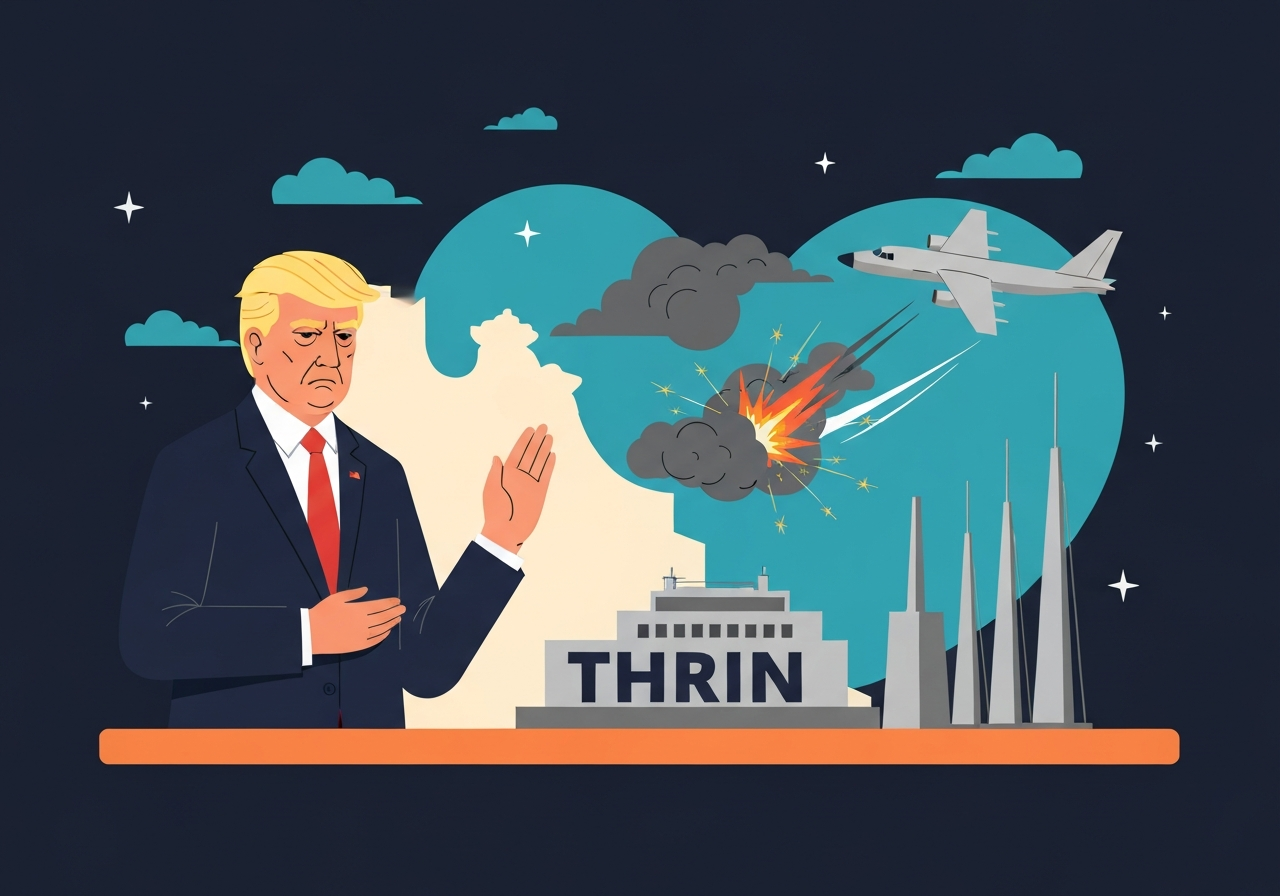
Lead: On 8 March 2026, US President Donald Trump said he would not negotiate with Iran, asserting the conflict could reach a point where Tehran had no leadership left to capitulate. Overnight, Israel carried out a fresh series of air strikes on Tehran targeting oil facilities and other infrastructure, producing large explosions and a skyline lit by flames. The attacks coincided with strikes in Lebanon that the health ministry says killed 12 people, and reports from Kuwait that two border guards were killed amid missile and drone barrages. US officials are also reported to be discussing the possibility of securing Iran’s highly enriched uranium at a later phase of the campaign.
Key Takeaways
- President Trump told reporters on Air Force One he was not interested in negotiating with Iran and warned the conflict could remove Iranian leadership able to surrender; his remark was delivered on 8 March 2026.
- Israeli forces confirmed a new wave of strikes on Iran, including assaults on Tehran oil refineries; residents reported loud explosions and refinery fires that turned the sky orange.
- Lebanese authorities reported 12 fatalities in fresh Israeli strikes on southern Lebanon and Beirut suburbs early on 8 March 2026.
- Kuwait said two border guards—Lt. Col. Abdullah Imad Al-Sharrah and Capt. Fahd Abdulaziz Al-Majmoud—were killed as missile and drone activity damaged civilian infrastructure.
- Axios, citing four anonymous sources, reported US and Israeli discussions about sending special forces into Iran later to secure highly enriched uranium stockpiles; that planning is described but not officially confirmed.
- Between 5,000 and 6,000 people protested in London on 7–8 March 2026 against US and Israeli strikes, chanting for an immediate halt to bombing, according to the Metropolitan Police estimates.
- Satellite imagery shows major damage to Tehran’s Mehrabad airport after the reported strikes, providing independent visual evidence of infrastructure impact.
- Sporting and commercial events are at risk: Formula 1 stands to lose an estimated £54m if the Bahrain and Saudi rounds scheduled for April are cancelled amid regional insecurity.
Background
The current confrontation escalated after the US-led and Israeli military responses to a series of Iranian attacks across the Gulf and against allied interests, with the wider conflict tracing back to the outbreak of hostilities on 28 February 2026. Tehran’s role has included missile and drone strikes that hit regional targets including Bahrain, Saudi Arabia and Kuwait, prompting defensive and retaliatory measures from multiple states. Israel has framed recent strikes as targeting Iranian command-and-control nodes and critical infrastructure, including oil facilities that can have both military and economic significance.
Washington has publicly backed Israel’s campaign while signalling a desire to degrade Iran’s military capabilities; privately, US officials have discussed options for preventing Tehran from retaining or reconstituting a nuclear-usable stockpile. Regional states—Kuwait, Lebanon and others—have faced spillover effects, including missile debris and damaged civilian sites. International responses range from large street protests in Western capitals to discreet high-level consultations among US, Israeli and Gulf security planners.
Main Event
On 8 March 2026 Israeli forces launched what they described as another wave of attacks across Iran, including strikes on oil refineries in and around Tehran. Local witnesses reported waking to loud explosions and seeing refinery fires that bathed the sky in orange, while satellite imagery later showed substantial damage at Mehrabad airport. Israeli military statements said the operations targeted Iran’s infrastructure and commanders linked to regional proxy operations.
President Trump, speaking to reporters aboard Air Force One, rejected proposals to negotiate with Tehran and warned the war could reach a stage where there was “nobody left to say ‘We surrender'”—a remark framed by the White House as support for strong military pressure on Iran. Separately, Axios reported discussions in Washington and Jerusalem about the possible future deployment of special forces to secure Iran’s highly enriched uranium; the report cited four people with knowledge of those conversations but noted no formal authorization.
Earlier on the same day, Lebanese health authorities reported 12 people killed by Israeli strikes in southern Lebanon and in suburbs of Beirut, with Israeli officials saying some targets were commanders linked to Iran’s Quds Force. Kuwait’s armed forces said a barrage of missiles and drones led to debris and shrapnel that damaged civilian facilities and killed two border guards identified by the interior ministry as Lt. Col. Abdullah Imad Al-Sharrah and Capt. Fahd Abdulaziz Al-Majmoud.
Across Europe, between 5,000 and 6,000 demonstrators marched in London under the “Hands Off Iran” banner, calling for an immediate ceasefire. Organisers and participants emphasised civilian harm and warned of a widening war that could pull in more states. Meanwhile, commercial ripple effects emerged: Formula 1 organisers warned of possible cancellation of the Bahrain and Saudi rounds in April, with estimated direct losses cited at about £54m if cancellations occur.
Analysis & Implications
The strikes on Tehran’s oil facilities are significant for several reasons. First, they target economic assets that can constrict Iran’s ability to finance prolonged military operations and cause immediate domestic disruption. Second, attacks on energy infrastructure carry the risk of wider economic shocks, raising global oil-market anxieties and potentially prompting further third‑party involvement to secure trade routes and facilities.
Reports that US and Israeli planners have discussed seizing Iran’s highly enriched uranium—if verified—signal a possible shift from attrition and deterrent strategies toward direct intervention aimed at neutering Tehran’s nuclear options. Such an operation would be complex, risk-intensive and likely to escalate hostilities regionally, drawing in proxy actors and increasing the chance of broader confrontation with groups aligned to Iran across Lebanon, Iraq and Yemen.
Domestically within Iran, repeated strikes on infrastructure and transport hubs can undermine government authority and strain civil resilience, but they may also consolidate nationalist sentiment and harden political positions. Regionally, Gulf states face acute security trade-offs: they may welcome US and Israeli pressure on Iran but remain wary of spillover that endangers ports, airports and energy facilities—hence Kuwait’s public appeals for safety and the closure of some airports in the immediate aftermath.
Comparison & Data
| Location | Reported fatalities | Notable damage |
|---|---|---|
| Tehran, Iran | Not publicly tallied (infrastructure hit) | Oil refineries, Mehrabad airport satellite damage |
| Southern Lebanon / Beirut suburbs | 12 (Lebanese health ministry) | Residential and military-linked sites |
| Kuwait | 2 border guards (named) | Civilian facilities damaged by interception debris |
| Previous week (regional) | 3 (two troops and a child reported) | Various |
The table aggregates counts reported publicly by ministries and media to date; casualty figures remain provisional and are under continued verification by local and international responders. Satellite imagery and open-source visuals corroborate infrastructure impacts in Tehran and at Mehrabad airport, while local health and interior ministries provided the most specific casualty tallies.
Reactions & Quotes
“At some point, I don’t think there will be anybody left to say ‘We surrender’.”
President Donald Trump (remarks to reporters, 8 March 2026)
Trump’s comment signalled an uncompromising public posture from Washington and reinforced rhetorical support for Israel’s campaign. Officials described the remark as underscoring a strategy of maximum pressure.
“Some civilian facilities have sustained material damage as a result of debris and shrapnel falling from interception operations.”
Kuwait Ministry of Defence spokesperson (official statement)
Kuwait’s ministry framed the harm as collateral from defensive interceptions, and the government urged residents to follow safety instructions while continuing to engage hostile aerial targets.
“Stop the bombing now, now, now.”
Demonstrators, London “Hands Off Iran” march (Metro police estimate: 5,000–6,000)
Protesters in London demanded an immediate halt to strikes and broader diplomatic initiatives to prevent further escalation. The Metropolitan Police provided the crowd-size estimate cited above.
Unconfirmed
- Plans to deploy US or Israeli special forces into Iran to seize HEU are reported by Axios citing anonymous sources but have not been officially confirmed by governments involved.
- Comprehensive casualty totals for the Tehran strikes have not been released; local authorities have confirmed infrastructure damage but have not published a consolidated death toll.
- Claims that Iran’s leadership has been or will be eliminated to the point there is “nobody left to say ‘We surrender'” are speculative and reflect political rhetoric rather than confirmed operational outcomes.
- The potential cancellation of the Bahrain and Saudi Formula 1 races is under consideration and loss figures (about £54m) are estimates contingent on official event decisions.
Bottom Line
The situation on 8 March 2026 marks a notable escalation: strikes on Tehran’s oil infrastructure and airport facilities, confirmed fatalities in Lebanon and Kuwait, and public debate in Washington about more intrusive measures to secure Iran’s nuclear material. Those developments raise the prospect of a broader and longer-running regional conflict with economic and humanitarian consequences beyond the immediate battlefields.
Key uncertainties remain, particularly around verified casualty tallies, the legal and operational feasibility of any mission to seize enriched uranium, and how regional states will balance support for deterrence with the imperative to limit spillover. Close monitoring of official statements, independent imagery, and on‑the‑ground reporting will be essential in the coming days to distinguish confirmed facts from rapidly circulating claims.
Sources
- The Independent (news report; original article used for timeline and local reporting)
- Axios (news; report citing four anonymous sources on US/Israeli discussions regarding HEU and special forces)
- Reuters (news; satellite imagery and broader regional coverage)
- Metropolitan Police (official/authority; crowd estimates for London protest)
- Kuwaiti official statements / national media (official/local reporting on border guard fatalities)