
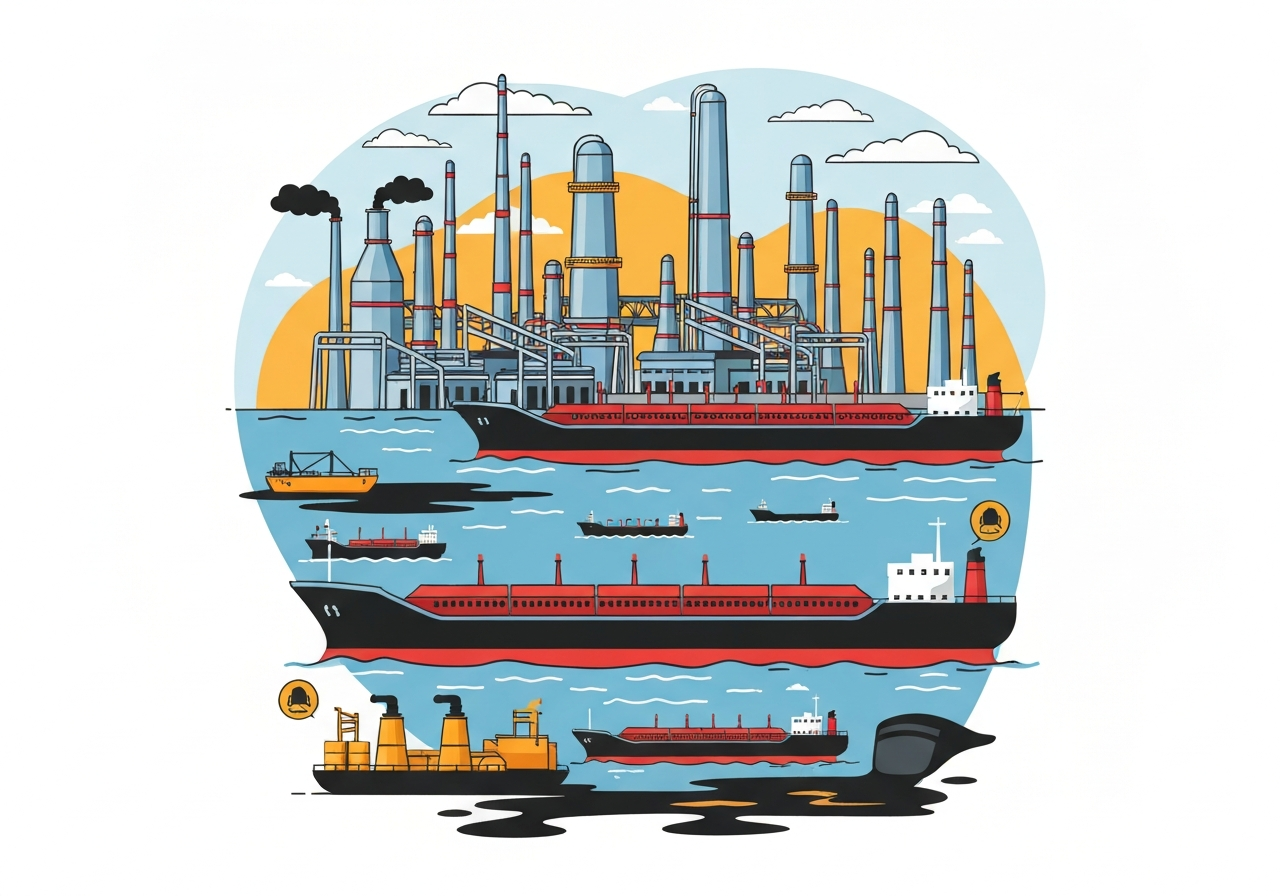
— The International Energy Agency says fighting linked to the Iran war has produced the largest disruption in the oil market on record, affecting roughly 7.5% of global supply and an even higher share of exports. The IEA published the assessment in its monthly oil-market report and its members agreed the previous day to an unprecedented coordinated release of 400 million barrels from emergency stockpiles to temper immediate shortages. The move has already pushed trading desks to reprice risk and prompted fast-moving policy responses among consuming and producing nations.
Key Takeaways
- The IEA estimates the Iran war has disrupted about 7.5% of worldwide oil supply, the largest single disruption in the agency’s records.
- IEA members approved a coordinated emergency release of 400 million barrels to stabilize markets over the near term.
- Export flows are harder hit than production figures alone indicate, with some chokepoints and shipping routes severely curtailed.
- International benchmark prices and regional spreads widened sharply after the IEA report and reserve release announcement.
- Policy responses include emergency releases, contingency logistics planning, and expedited diplomatic talks among major producers and consumers.
Background
Global oil markets rely on both production and export routing; disruptions in a key producer region can therefore magnify impacts beyond the raw share of lost output. For decades, policymakers have maintained strategic petroleum reserves precisely to manage shock events—sudden output losses, supply-chain interruptions, or major geopolitical crises. The IEA, an intergovernmental watchdog composed primarily of consuming countries, monitors global supply and can coordinate collective emergency releases when it judges markets to be under severe strain.
Past supply shocks—caused by wars, revolutions, or embargoes—typically prompted targeted government interventions and market adjustments over weeks to months. What sets the current episode apart, according to the IEA, is the simultaneous closure or rerouting of export channels and the scale of the displacement across both crude and refined-product shipments. Major consuming nations and trading houses therefore face both immediate shortfalls and an uncertain timeline for restoration of normal flows.
Main Event
The IEA’s March monthly report, published on March 12, 2026, quantified the disruption and urged urgent collective action. On March 11, IEA members agreed to release a combined 400 million barrels from emergency stocks, a volume the agency characterized as unprecedented in peacetime coordination. The releases aim to fill immediate physical shortfalls and temper speculative surges in futures markets.
Operationally, the disruption has manifested as reduced tanker dispatches, port congestions, and cancellations of forward cargoes along routes serving Europe and Asia. Traders reported a marked widening of time spreads and premiums for prompt delivery in affected hubs. Refiners dependent on specific crude grades have scrambled to secure alternative feedstocks, accelerating bids for spot barrels from more distant basins.
Market participants described a rapid repricing: benchmark prices rose and volatility spiked in the wake of the IEA statement and the reserve release announcement. Exchanges showed larger-than-normal intraday moves as algorithmic and discretionary desks adjusted positions. At the same time, some consuming countries issued guidance to domestic suppliers and emergency response units to prioritize critical fuel allocations.
Analysis & Implications
The immediate economic impact is a function of lost supply, disrupted exports, and market psychology. A 7.5% hit to global supply is large enough to lift prices materially, but coordinated reserve releases are intended to blunt the worst effects by injecting physical barrels into the market. How long the release can offset the shortfall depends on the duration of disruptions and how quickly alternative shipping and supply chains can be restored.
Politically, the crisis raises pressure on both producing and consuming governments. Producers face choices about whether to increase output elsewhere, which can be constrained by capacity limits and OPEC+ decisions. Consuming nations must balance short-term easing measures with strategic considerations about market signaling and long-term energy security. The episode may accelerate policy debates on diversification of import sources and on the speed of transition away from hydrocarbon reliance.
Financially, prolonged uncertainty would transmit into inflationary pressure via higher fuel and transport costs, with knock-on effects for food and industrial prices. Central banks and fiscal authorities will monitor the pass-through to core inflation and household budgets; any sustained spike could complicate macroeconomic policy setpoints already adjusted for 2026 growth conditions.
Comparison & Data
| Event | Year | IEA-Reported Supply Impact | Notes |
|---|---|---|---|
| Iran war disruption | 2026 | 7.5% of global supply | IEA calls it the largest disruption; coordinated 400 million-barrel release announced |
| Earlier major disruptions (selected) | Historical | Smaller in IEA assessments | Previous shocks affected regional flows and prices but, per IEA, were not as extensive as 2026 |
The table above presents the IEA’s headline assessment alongside a qualitative comparison to prior major shocks. Exact historical percentages vary by dataset and methodology; the IEA’s characterization is notable because it frames the current incident as exceptional in the agency’s monitoring record. Market participants therefore treat both the physical release and diplomatic efforts as key variables for near-term price paths.
Reactions & Quotes
Officials and market observers responded quickly after the IEA report and the emergency release announcement, emphasizing both the scale of the disruption and the need for coordinated action.
“The war in the Middle East is creating the largest supply disruption in the history of the global oil market.”
International Energy Agency (IEA), monthly oil-market report
This succinct IEA formulation framed member deliberations and the decision to deploy emergency barrels. Officials said the release was aimed at stabilizing supplies while diplomatic and logistical channels sought to restore normal export patterns.
“Immediate reserve releases are necessary to avoid a disorderly spike, but they are a bridge, not a cure; much depends on how long the export interruptions persist.”
Senior energy market analyst, international consultancy
The analyst’s comment reflects a widespread view among traders and refiners that emergency barrels can calm short-term tightness but not replace sustained flows if infrastructure or production remains impaired.
Unconfirmed
- Exact share of global exports affected by the Iran war remains to be independently verified beyond the IEA’s general assessment.
- Precise timelines for when disrupted export routes will be restored are uncertain and depend on unfolding military and diplomatic developments.
Bottom Line
The IEA’s assessment that the Iran war has caused a 7.5% disruption to global oil supply, and its members’ coordinated release of 400 million barrels, mark a rare, large-scale policy response to an acute market shock. Emergency releases can damp immediate volatility, but their ability to fully substitute for disrupted export capacity is limited and time-bound.
Investors, policymakers, and end-users should watch indicators of export-route restoration, spare production capacity in other regions, and any secondary sanctions or trade restrictions that could prolong dislocations. The episode underscores the persistent vulnerability of global energy markets to geopolitical shocks and may accelerate strategic planning on both energy security and diversification.
Sources
- Bloomberg — news report summarizing the IEA assessment and the coordinated reserve release (media)
- International Energy Agency (IEA) — official intergovernmental agency monitoring global energy markets (official)