
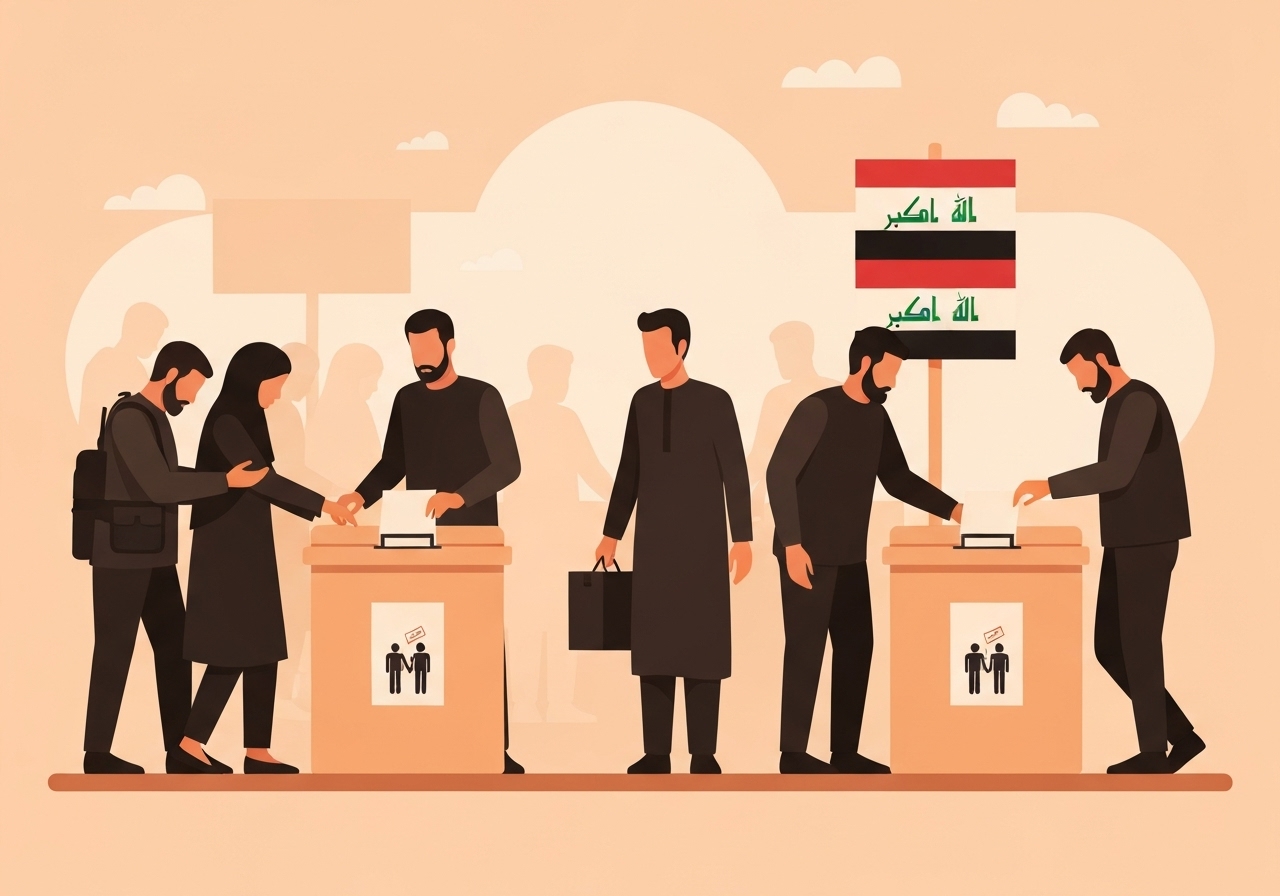
Lead: Iraqis went to the polls on Tuesday in a parliamentary election conducted under heightened security and shadowed by a boycott from the influential Sadrist Movement. Voting took place at 8,703 polling stations nationwide, after early voting Sunday for security personnel and displaced people in camps. Early turnout appeared thin at many polling places visited by journalists, and authorities reported that 21.4 million of 32 million eligible voters had updated their information and obtained voter cards ahead of the vote. The vote faces both political and legal strains that could affect the new parliament’s legitimacy and formation.
Key Takeaways
- 8,703 polling stations were opened across Iraq for Tuesday’s general election, with early voting for security forces and displaced people held on Sunday.
- 21.4 million of an estimated 32 million eligible voters updated their information and received voter cards ahead of the ballot, down from about 24 million who registered in 2021.
- The Sadrist Movement, led by Muqtada al-Sadr, called for a boycott; its 2021 bloc had won the largest share of seats before withdrawing from parliament.
- Sadr City in Baghdad saw an intense security presence—special forces, federal police, armored vehicles and Humvees—while many shops remained closed.
- At one polling center serving 3,300 voters, fewer than 60 people had voted within a few hours of opening, illustrating sharply reduced local participation.
- The head of Iraq’s Supreme Judicial Council issued a statement saying the election date was unconstitutional and noting the vote had originally been scheduled for Nov. 24, opening a path for legal challenges.
- External pressures—including increased U.S. calls to curb Iran-aligned armed factions—frame the vote, while some candidates are aligned with those groups.
Background
The vote comes amid major regional upheaval over the past two years: the wars in Gaza and Lebanon that followed the Oct. 7, 2023 Hamas-led attacks on southern Israel, an Israel–Iran confrontation in June, and the reported fall of Syrian President Bashar al-Assad last December. Those crises have reshaped political alignments and security calculations inside Iraq, where armed groups aligned with Iran remain influential in parts of the political landscape.
Domestically, the Sadrist Movement has been a central actor. Led by Shiite cleric Muqtada al-Sadr, the movement won the largest number of seats in 2021 but later withdrew from parliament after negotiations to form a government collapsed amid deep rivalries with other Shiite blocs. Sadr’s continued rejection of the formal political process has included intermittent calls for boycotts and street mobilizations.
Main Event
On election day security forces were deployed across urban centers, with particularly visible measures around Sadr City on Baghdad’s outskirts. Federal police and special forces manned checkpoints and armored vehicles patrolled main roads, and polling centers in the area were marked by a near-absence of voters. Large banners declaring a boycott and images of al-Sadr were visible in public spaces, while many businesses remained shuttered.
At one polling station that serves roughly 3,300 registered voters, the station director, Ahmed al-Mousawi, reported that fewer than 60 people had cast ballots a few hours after polls opened. Officials and local witnesses described the Sadrist boycott as a major factor depressing turnout at centers in strongholds of the movement.
Separate early voting on Sunday allowed members of the security forces and displaced residents in camps to participate in advance. Across other parts of the country, turnout varied, with some urban precincts recording steadier streams of voters while many neighborhoods aligned with the Sadrist Movement saw near-total abstention.
The head of Iraq’s Supreme Judicial Council issued a statement posted on the council’s site asserting the date set for the election was unconstitutional; the assertion referenced an earlier scheduling for Nov. 24. That statement raises the prospect of legal challenges to certification of results and adds a judicial dimension to the political dispute over legitimacy.
Analysis & Implications
The Sadrist boycott and the lower demonstrated voter engagement create immediate questions about the new parliament’s representative mandate. If a substantial segment of Shiite voters—especially in Sadr-held districts—remains absent from the count, the resulting seat distribution could magnify influence for parties that chose to participate, including Iran-aligned factions.
Washington’s intensified pressure on Baghdad to rein in Iran-backed militias adds geopolitical stakes. Some groups with paramilitary ties have fielded candidates; their success or failure will affect Iraq’s balancing act between Tehran and Washington and could change security dynamics on the ground.
Legal uncertainty about the election date and potential post-election challenges could delay government formation and complicate deliverables for Iraqis facing economic and public-service shortfalls. A protracted dispute over results would also amplify popular frustration and could fuel street protests or political deadlock.
Regionally, the results will be watched by neighbors and international actors as an indicator of Iraq’s internal cohesion and the relative leverage of external patrons. A parliament perceived as lacking broad legitimacy may struggle to pursue coherent foreign-policy or security strategies at a time of heightened volatility across the Levant.
Comparison & Data
| Metric | 2021 | 2025 (pre-election) |
|---|---|---|
| Voter registrations (updated/obtained cards) | ≈24,000,000 | 21,400,000 |
| Estimated eligible voters | — | 32,000,000 |
| Polling stations opened | — | 8,703 |
The table highlights a decline in updated registrations from about 24 million in 2021 to 21.4 million ahead of this vote, against an estimated 32 million eligible voters. The number of polling stations—8,703—reflects the logistical scale, while reported early-day turnout varied significantly by locality, especially where the Sadrist call to stay home was observed.
Reactions & Quotes
The local electoral official at a Sadr City polling center described the contrast with past contests: voter lines that were once long were now absent, underscoring the practical effect of the boycott on participation.
“The Sadrist boycott has had a major impact; today the difference is dramatic compared with previous elections,”
Ahmed al-Mousawi, polling station director
Outside the polling stations, individual voters expressed mixed motivations—some voted in hopes of improved services, others stayed away in deference to political calls. A 54-year-old voter, Sabih Dakhel, said he and his wife cast ballots to try to change local living conditions, but he acknowledged the boycott’s dampening effect on turnout.
“We were able to vote freely today, but the Sadrist boycott has deeply affected participation,”
Sabih Dakhel, voter
At the institutional level, the Supreme Judicial Council’s statement questioning the election date introduced a formal legal challenge that observers say could be invoked to contest results or delay the transfer of power.
“The date set for the election is unconstitutional,”
Head of Iraq’s Supreme Judicial Council (statement)
Unconfirmed
- Final national turnout percentage and full, certified vote totals were not available at the time of reporting.
- The precise number of candidates with direct ties to Iran-aligned armed groups is not yet independently verified.
- The ultimate legal outcome of the Supreme Judicial Council’s objection and any court interventions remains pending and unconfirmed.
Bottom Line
This parliamentary vote tested Iraq’s electoral institutions under the dual strains of an influential boycott and heightened security concerns. Reduced pre-election registration and the visible abstention in Sadrist strongholds risk producing a legislature whose mandate will be questioned by significant constituencies.
Observers should watch three developments closely: final turnout and seat distribution, legal rulings stemming from the judicial council’s statement, and how the new parliament navigates pressure from external actors, particularly regarding the influence of Iran-aligned armed groups. Those factors will determine whether the result stabilizes governance or deepens fragmentation.
Sources
- ABC News (news report summarizing on-the-ground reporting and official statements)
- Iraq Supreme Judicial Council (official statement referenced via ABC News)