
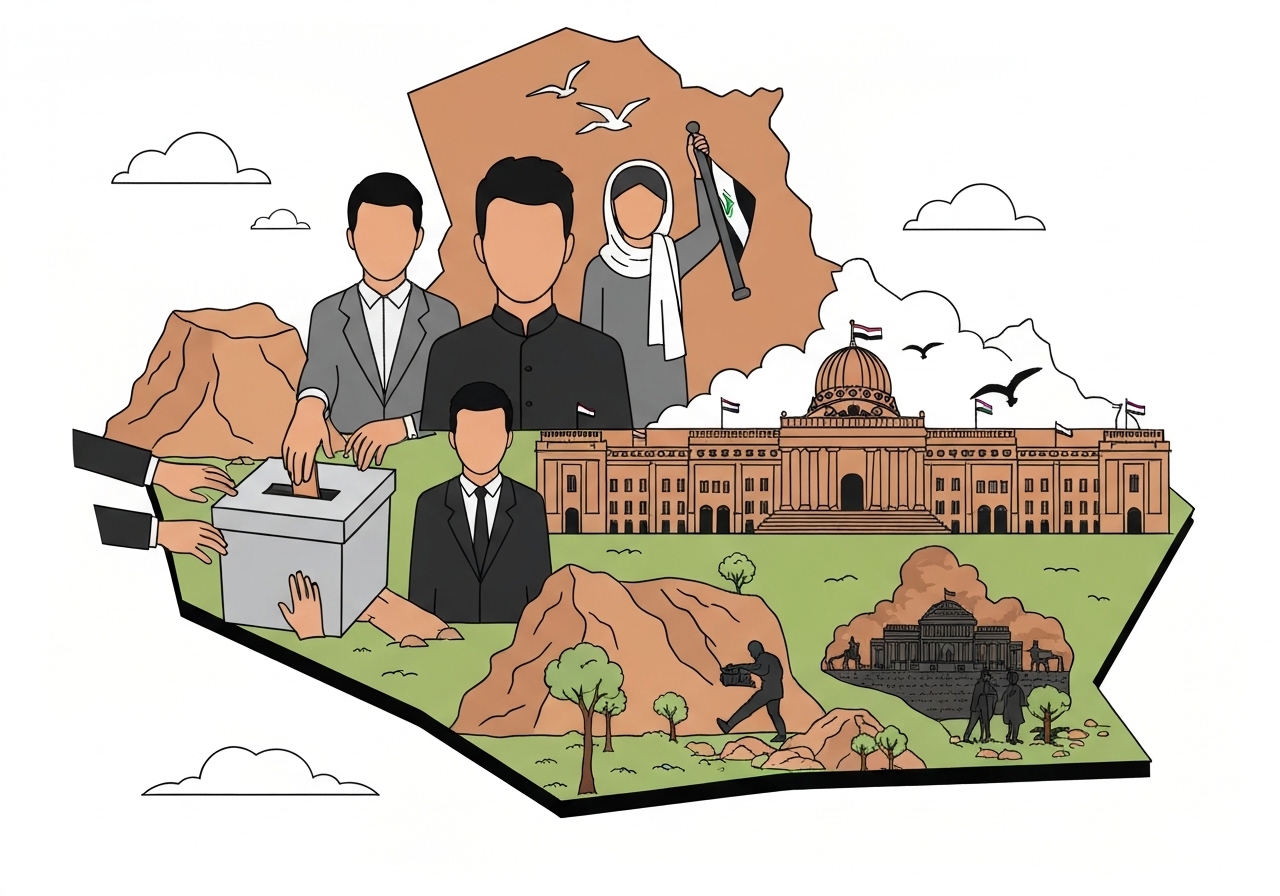
Lead: Iraqis head to the polls this week in a parliamentary election that begins with voting for security forces and displaced people on Sunday and culminates in a nationwide vote on Tuesday. The results will shape whether Prime Minister Mohammed Shia al-Sudani can secure a second term and will affect the balance between Iran-backed militias and Washington-aligned institutions. The vote occurs against heightened regional tensions tied to a potential Israel-Iran conflict and repeated U.S. pressure over armed groups based in Iraq. Observers say turnout and coalition-building after the count will determine the country’s political trajectory.
Key Takeaways
- There are 329 parliamentary seats at stake; 25% are reserved for women and nine seats for religious minorities under current law.
- Only about 21.4 million of 32 million eligible voters have updated their registration and obtained voter cards, down from roughly 24 million in 2021.
- Turnout has been declining: 41% in 2021 and 44% in 2018, raising concerns about electoral legitimacy if participation remains low.
- Some 7,744 candidates are contesting the vote, spanning sectarian blocs, Kurdish parties and independents.
- Several Iran-linked Shiite militias are running through political wings, including Kataib Hezbollah and Asaib Ahl al-Haq-linked lists.
- The Sadrist Movement, led by Muqtada al-Sadr, is boycotting the election after withdrawing from politics following 2021 disputes.
- Election preparations have included the disqualification of 848 candidates; allegations of vote-buying and isolated violence — including an Oct. 15 car-bomb assassination — have been reported.
- The fate of the Popular Mobilization Forces and Iraq’s relationships with Tehran and Washington are central issues shaping voter and elite calculations.
Background
Since the U.S.-led invasion of 2003 and the fall of Saddam Hussein, Iraq has held seven parliamentary elections, all occurring within an often-fractured power-sharing framework. The post-2003 system assigns the prime ministership to a Shiite, the presidency to a Kurd and the parliamentary speakership by convention to a Sunni, aiming to distribute authority across communal lines.
The early postwar years saw a security vacuum that fueled sectarian conflict and the later rise of the Islamic State group. Though large-scale violence has subsided in recent years, many Iraqis now cite unemployment, unreliable public services and persistent electricity shortages as principal grievances amid the country’s oil wealth. Those everyday issues have eclipsed security as the top electoral concern for broad swaths of the population.
Main Event
Voting begins with security forces and internally displaced persons before the general election day, with polling stations operating across the country but none set up abroad for expatriate voters. Campaigning has varied regionally: some districts display active party machines, while in Sadrist strongholds such as Sadr City banners and posters are sparse amid calls for a boycott.
Major Shiite blocs include parties led by former prime minister Nouri al-Maliki and cleric Ammar al-Hakim, alongside lists tied to armed groups. Kurdish representation centers on the Kurdistan Democratic Party and the Patriotic Union of Kurdistan, while Sunni competitors include slates aligned with Mohammed al-Halbousi and incumbent speaker Mahmoud al-Mashhadani.
The election season has been marred by administrative and security controversies: election authorities disqualified 848 candidates for reasons ranging from alleged insults to religious rites to procedural problems, and a candidate — Safaa al-Mashhadani — was killed by a car bomb on Oct. 15, an attack now being prosecuted as terrorism with five arrests reported. Those incidents have heightened concerns about coercion and intimidation around the vote.
Analysis & Implications
The outcome will influence whether Mohammed Shia al-Sudani retains the premiership, but winning the largest bloc does not guarantee the office, given Iraq’s negotiated government-formation process. Al-Sudani entered office in 2022 with backing from pro-Iran factions but has attempted a pragmatic balancing act between Tehran and Washington while emphasizing service delivery at home.
A key unresolved question is the institutional role of the Popular Mobilization Forces. Although placed nominally under the Iraqi military in 2016, parts of the PMF operate with de facto autonomy. If parties aligned with militia networks gain more seats, they could resist efforts to bring armed groups fully under state command, complicating security-sector reform and cooperation with U.S. counterparts.
Low turnout would weaken the new parliament’s domestic legitimacy and could empower well-organized factions with narrow constituencies, including armed-group–linked lists. Externally, any escalation between Israel and Iran, or targeted strikes inside Iraq, could sway public sentiment and harden political positions, increasing the risk of violence and pushing policy debates toward security and sovereignty rather than services and jobs.
Comparison & Data
| Indicator | 2018 | 2021 | 2024 (pre-election) |
|---|---|---|---|
| Voter turnout | 44% | 41% | — (concerns about decline) |
| Registered with voter cards | — | ~24 million | 21.4 million |
| Parliamentary seats | 329 seats; 25% quota for women; 9 minority seats | ||
The table highlights a downward trend in voter engagement: official figures show a fall in registered, card-holding voters from about 24 million in 2021 to 21.4 million ahead of this vote. That reduction, combined with historically low turnout rates, raises questions about representativeness. The reserved quotas for women and minorities remain constant, but their practical influence depends on broader coalition outcomes and post-election bargaining.
Reactions & Quotes
Election authorities and party actors offered terse public statements in the run-up to voting; reactions illustrate competing narratives about readiness and legitimacy.
“Preparations for polling are in place across governorates,”
Iraqi High Electoral Commission (official)
Electoral officials emphasized logistical readiness even as critics pointed to disqualifications and alleged irregularities. The commission framed the process as technically prepared while acknowledging political tensions around candidate eligibility.
“We will not participate in these elections,”
Sadrist Movement (political group)
The Sadrist Movement’s boycott has been widely publicized and helps explain the absence of campaign activity in traditional Sadrist neighborhoods. Analysts say the boycott both signals the movement’s continuing influence and reshapes who will fill seats absent Sadr-aligned candidates.
“Low turnout will amplify the leverage of well-organized factions,”
Independent regional analyst
Policy experts warn that declining participation favors parties with motivated bases, including militia-linked lists, reducing the bargaining space for broad reform agendas focused on services and employment.
Unconfirmed
- Allegations of widespread vote-buying have circulated but the full scale and geographic spread remain unverified by independent monitors.
- Reports of external military action targeting Iran-linked groups inside Iraq are possible given regional tensions but specific planned strikes linked to the election timing are unconfirmed.
- Claims that disqualifications were uniformly politically motivated have been made by parties, but the factual basis for each case varies and is not fully documented publicly.
Bottom Line
This election will test Iraq’s fragile balance between competing internal forces and its external patrons. Whether al-Sudani can navigate coalition bargaining, rein in armed groups’ political power and deliver visible service improvements will hinge on both votes cast and the post-count negotiations that follow.
Key indicators to watch in the days after polling are turnout levels, seat distribution among militia-affiliated lists versus pragmatic blocs, and the speed and transparency of government-formation talks. Given regional volatility, outcomes here will reverberate beyond Baghdad and influence diplomatic and security calculations in Washington and Tehran.