
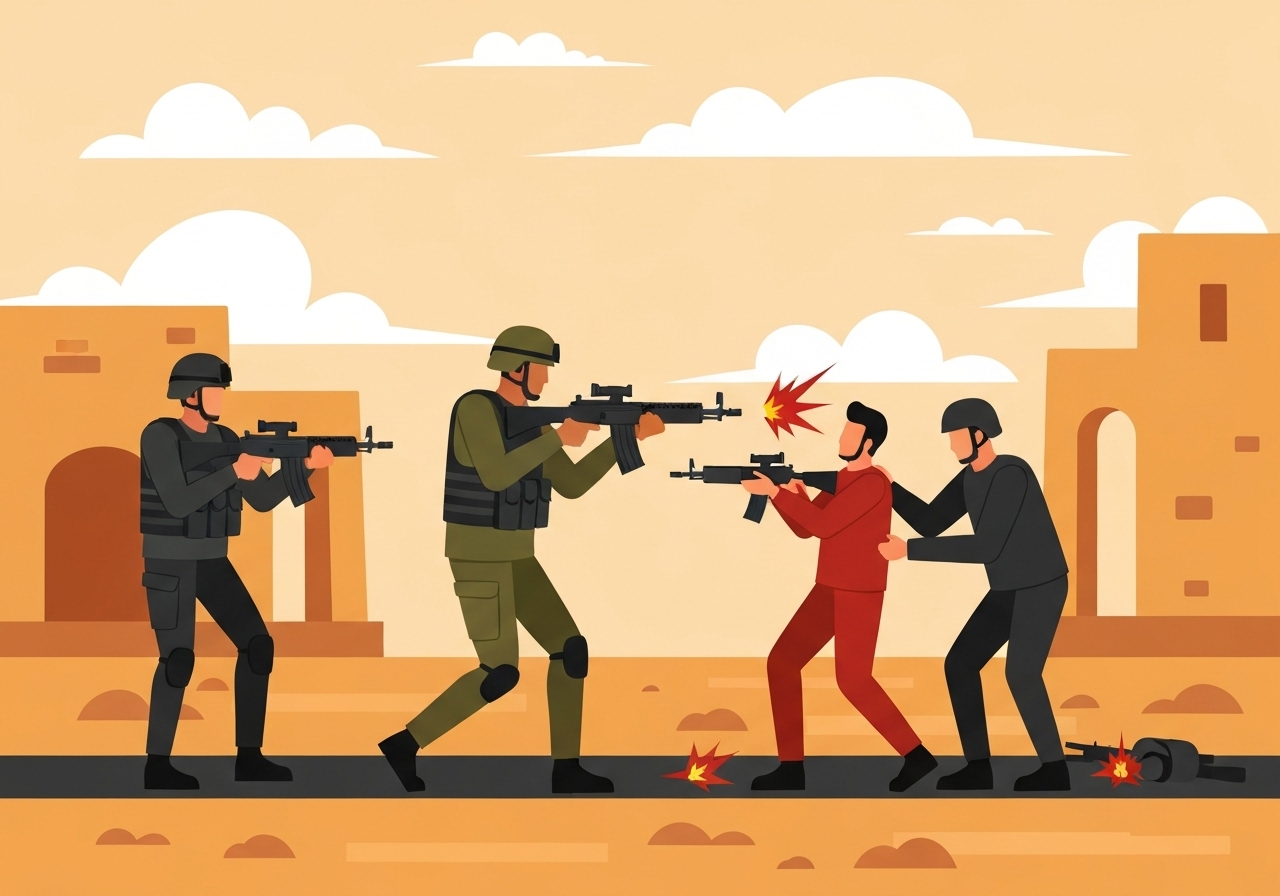
Lead: Three Americans — two U.S. soldiers and a U.S. civilian interpreter — were killed and three other service members wounded in an ambush in Palmyra, central Syria, the U.S. Central Command said. The attacker, described by U.S. officials as a lone Islamic State gunman, was engaged and killed during the incident. President Donald Trump called it “an ISIS attack” and warned of “a very serious retaliation.” The U.S. military withheld the names of the dead for 24 hours while next of kin were notified.
Key Takeaways
- Casualties: Two U.S. soldiers and one U.S. civilian interpreter were killed; three U.S. service members were injured, according to U.S. Central Command.
- Attack location: The ambush occurred in Palmyra, in central Syria, during a “key leader engagement,” the Pentagon said.
- Attacker: U.S. officials described the shooter as a lone Islamic State gunman who was engaged and killed at the scene.
- Responsibility: No group has formally claimed the attack; a Pentagon initial assessment said the attack was “likely” carried out by IS.
- Local reports: The UK-based Syrian Observatory for Human Rights reported the attacker was a member of the Syrian security force; this has not been independently confirmed.
- Other casualties: Syria state media reported two Syrian service personnel were injured in the incident.
- Political response: President Trump vowed serious retaliation; U.S. defense officials issued stern warnings targeting those who attack Americans.
Background
U.S. forces have maintained a presence in eastern and central Syria since operations against the Islamic State began in 2014, aimed at eliminating IS remnants and preventing the return of a territorial caliphate. Over recent years the U.S. mission has shifted toward advisory, training, and partnering roles with local forces while conducting targeted counterterrorism operations.
Syria’s internal control is fragmented: some central regions lack sustained government authority, complicating security for patrols and joint engagements. The Pentagon noted the area where the attack occurred was one in which the Syrian president does not exert full control, underscoring persistent governance gaps.
The broader geopolitical context includes recent outreach between Syria and the U.S.; Syrian President Ahmed al-Sharaa visited the White House last month and Syria has publicly indicated willingness to cooperate with a global coalition against IS. Those developments have not eliminated on-the-ground security risks for foreign personnel and local partners.
Main Event
U.S. Central Command said the ambush occurred while U.S. personnel were conducting what the Pentagon described as a “key leader engagement” in Palmyra. Officials reported a lone gunman opened fire, fatally wounding two soldiers and a civilian interpreter and injuring three other U.S. service members. The attacker was engaged by U.S. forces and killed at the scene.
The Pentagon indicated the initial assessment points to the Islamic State as the likely perpetrator, while noting that no organization had claimed responsibility at the time of the statement. The U.S. military withheld the names of those killed for 24 hours to allow notification of next of kin, a standard practice in such cases.
Syria’s state news agency reported that two Syrian service members were also wounded during the incident. The UK-based Syrian Observatory for Human Rights offered a different detail, alleging the shooter was a member of Syrian security forces; U.S. officials have not corroborated that characterization publicly.
President Trump posted on social media framing the assault as “an ISIS attack” on both U.S. and Syrian personnel and warned of a “very serious retaliation.” Pentagon spokespeople and senior U.S. defense officials reiterated strong responses to attacks on U.S. forces, emphasizing that perpetrators will be sought and held accountable.
Analysis & Implications
The attack highlights the enduring threat posed by IS-affiliated fighters and lone-actor attacks even as territorial control of the group has been greatly reduced. Small-cell and lone-gunman tactics remain a persistent danger in areas where governance and security are fragmented. For U.S. forces conducting advisory or partner engagements, the incident underlines the operational risk of leader engagements outside secure bases.
Politically, the incident may complicate U.S.-Syrian rapprochement efforts. Syrian authorities’ recent moves to join anti-IS initiatives and high-level White House engagement were positioned as steps toward cooperation; an ambush that involves claims of local security involvement, even if unconfirmed, could strain trust and require clearer coordination mechanisms.
Strategically, a U.S. response risks escalation. Officials have signaled strong retaliatory intent, which could involve kinetic strikes, targeted counterterrorism operations, or increased patrol and force protection measures. Each option carries trade-offs: punitive action may degrade IS capabilities but risks further conflict with local actors and unintended civilian harm.
On the operational level, the U.S. military is likely to review force protection protocols for partnered patrols and leader engagements, reassess intelligence and vetting of local counterparts, and potentially increase the visibility of protective measures around U.S. personnel in central Syria.
Comparison & Data
| Metric | Count |
|---|---|
| U.S. fatalities in ambush | 3 |
| U.S. wounded | 3 |
| Attacker neutralized | 1 |
| Syrian personnel wounded (state media) | 2 |
The table reflects the figures released by U.S. Central Command and Syrian state media. These numbers provide a narrow, incident-level snapshot and do not capture subsequent developments such as additional injuries, detentions, or later claims of responsibility.
Reactions & Quotes
U.S. political and military leaders responded swiftly with strong language promising accountability and deterrence. Public statements emphasized pursuit of perpetrators and protection of U.S. personnel.
“It was an ISIS attack against the United States and Syria — there will be a very serious retaliation.”
President Donald Trump (social media post)
This message framed the incident as part of the ongoing fight against IS and signaled intent to respond decisively.
“Let it be known, if you target Americans … the United States will hunt you, find you, and ruthlessly kill you.”
U.S. Defence Secretary Pete Hegseth
Senior defense officials used forceful rhetoric to deter future attacks and reassure domestic audiences of a robust U.S. posture.
“We strongly condemn the cowardly terrorist ambush targeting a joint US–Syrian government patrol in central Syria.”
Tom Barrack, U.S. special envoy for Syria
Diplomatic envoys highlighted continued cooperation rhetoric while also condemning the attack.
Unconfirmed
- The claim by the Syrian Observatory for Human Rights that the attacker was a member of Syrian security forces has not been independently verified by U.S. authorities.
- No group had claimed responsibility at the time of U.S. statements; attribution to IS remains an initial assessment rather than a confirmed forensic conclusion.
Bottom Line
The Palmyra ambush that killed three Americans underscores the persistent, adaptive threat from Islamic State–linked violence in Syria even as militarily significant territory has been reclaimed. The incident illustrates the operational hazards of partnered engagements in areas without firm governmental control.
Expect immediate U.S. steps to tighten force protection, pursue the individuals responsible, and weigh targeted responses that aim to degrade IS capabilities without triggering broader escalation. Observers should watch for follow-up intelligence releases, any formal claim of responsibility, and how U.S.-Syrian coordination evolves in the aftermath.
Sources
- BBC News (media report summarising U.S. Central Command and other official statements)