
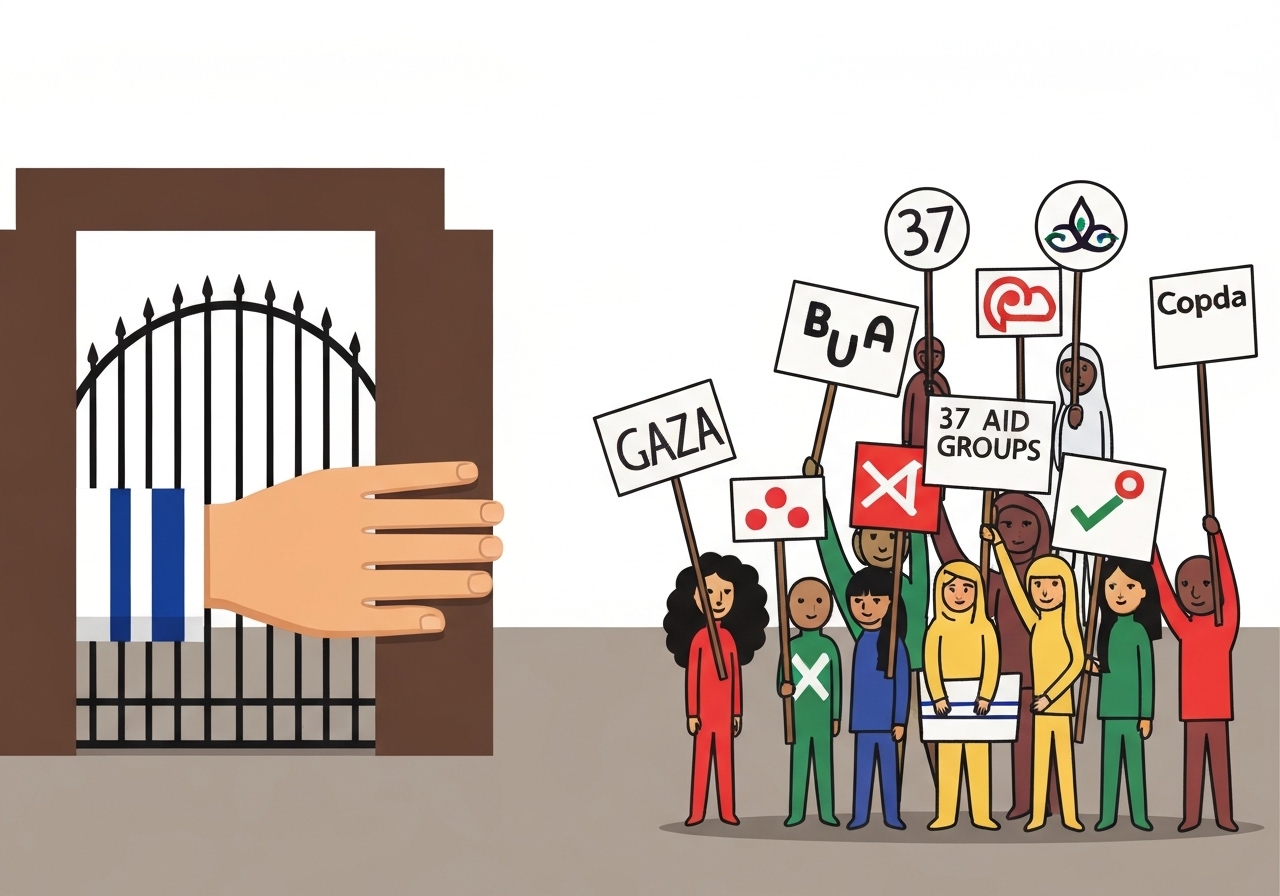
Israel has announced it will revoke the licenses of 37 international and local aid organisations operating in Gaza and the occupied West Bank, saying they failed to comply with newly introduced registration rules. The suspensions are set to begin on 1 January, with the organisations given 60 days to cease operations. Israeli officials cite incomplete staff records and security concerns as central reasons. The decision has prompted strong criticism from a coalition of foreign ministers and humanitarian actors warning of harm to civilian services in Gaza.
Key Takeaways
- Israel will suspend the licences of 37 aid organisations on 1 January; affected groups must end operations within 60 days.
- Israeli authorities say the primary issue is refusal to provide “complete and verifiable” staff information, framed as a security requirement.
- COGAT stated suspended groups contributed roughly 1% of total aid volume during the current ceasefire period.
- Israel’s Ministry of Diaspora Affairs said under 15% of organisations providing Gaza assistance were found in violation of the new framework.
- A joint statement by 10 foreign ministers said the closures would “have a severe impact on access to essential services including healthcare.”
- UN-backed experts reported improvements in nutrition and food supplies after an October ceasefire but noted 100,000 people still faced “catastrophic” conditions the following month.
Background
The move follows a regulatory overhaul requiring humanitarian organisations that work in Gaza and the West Bank to re-register under a new framework administered by Israel’s Ministry of Diaspora Affairs. The rules include provisions on organisational positions toward Israel’s existence, statements about the 7 October 2023 attacks, and obligations to hand over detailed staff information. Israeli officials argue the measures are needed to prevent terrorist infiltration of humanitarian structures and to tighten oversight of foreign-funded organisations.
Humanitarian actors say the criteria are politicised and in some cases clash with international humanitarian principles and privacy laws, creating dilemmas for organisations bound by donor or international legal requirements. The Humanitarian Country Team of the Occupied Palestinian Territory — a UN forum that includes UN agencies and more than 200 local and international organisations — warned that the new system ‘‘fundamentally jeopardises’’ INGO operations and that the registered organisations represent only a fraction of the response capacity required in Gaza.
Main Event
On the date the policy was announced, Israeli officials publicly listed 37 organisations whose licences will be revoked, including internationally known INGOs such as ActionAid, the International Rescue Committee and the Norwegian Refugee Council, alongside groups such as CARE and Medical Aid for Palestinians. The Ministry said the suspensions take effect on 1 January and that groups have 60 days to wind down activities. Officials emphasised that humanitarian flows to Gaza would continue through approved channels, including UN agencies and bilateral partners.
Israeli military authority COGAT, which manages Gaza crossings, told reporters that the named organisations did not bring aid into Gaza ‘‘throughout the current ceasefire’’ and that their combined contribution to deliveries was about 1% of the total. The Diaspora Affairs ministry reiterated that the primary justification for licence revocations was the alleged refusal to provide complete staff details, framing the requirement as vital for preventing exploitation of aid frameworks by hostile actors.
Foreign ministers from ten countries — including the UK, France, Canada and Norway — issued a joint statement calling the new rules restrictive and warning that forced closures would severely hinder access to healthcare and other essential services. Humanitarian groups and diplomats said the criteria, which include provisions on denying Israel’s character or supporting boycotts, impose political tests that many NGOs cannot meet without violating their mandates or donor commitments.
Analysis & Implications
Operationally, removing 37 organisations from the field risks creating gaps in specialised services. According to the Humanitarian Country Team, INGOs run or support most field hospitals, primary healthcare centres, nutrition stabilisation centres and water, sanitation and shelter programmes in Gaza — services that are difficult to replace quickly. Even if core supplies continue to enter via UN and bilateral channels, the loss of implementing partners could delay distribution and reduce technical capacity on the ground.
Politically, the move signals a tighter Israeli control over the humanitarian space and reflects heightened securitisation of aid after the 7 October 2023 attacks. The inclusion of politically framed criteria in the registration tests may deter some organisations from operating under the new rules or from meeting requirements that conflict with legal obligations to protect staff privacy and neutrality. That tension creates a policy dilemma: how to balance legitimate security concerns with international norms that safeguard humanitarian access and impartiality.
Regionally and internationally, the decision may strain Israel’s relations with donor countries and humanitarian partners, many of which voiced immediate criticism. Donors who fund operations in Gaza could face increased administrative burdens and might reconsider funding channels if their implementing partners are excluded. Over time, this could shift more aid through UN agencies and state-to-state mechanisms, altering accountability and distribution dynamics.
Comparison & Data
| Metric | Reported Value |
|---|---|
| Number of organisations to be suspended | 37 |
| Suspension effective date | 1 January (with 60-day wind-down) |
| Share of organisations found in violation | Fewer than 15% |
| COGAT estimate of combined aid share | ~1% of total aid volume |
| People in “catastrophic” conditions post-ceasefire | 100,000 |
The table above summarizes official figures cited by Israeli authorities and UN-backed experts as reported by media. While Israeli agencies highlight a small proportional contribution by the suspended organisations to total crossing deliveries, humanitarian managers warn that proportional share can understate operational importance in specialised services such as medical care and nutrition stabilisation.
Reactions & Quotes
Governments and humanitarian bodies reacted sharply, framing the move as likely to degrade service delivery during an already fragile recovery period.
“The forced closure of INGO operations would have a severe impact on access to essential services including healthcare.”
Joint statement — foreign ministers of 10 countries
“The message is clear: humanitarian assistance is welcome — the exploitation of humanitarian frameworks for terrorism is not.”
Amichai Chikli, Israel Minister of Diaspora Affairs
“The system fundamentally jeopardises INGO operations by relying on vague, politicised criteria and imposing requirements that conflict with international obligations.”
Humanitarian Country Team, Occupied Palestinian Territory
Unconfirmed
- COGAT’s claim that the named organisations did not bring aid into Gaza ‘‘throughout the current ceasefire’’ is an official assertion and has not been independently verified in all cases.
- Statements tying specific security incidents to particular organisations’ staff records have not been publicly substantiated with forensic evidence.
Bottom Line
The Israeli decision to revoke licences from 37 aid organisations raises immediate operational risks for Gaza’s fragile recovery, particularly in specialised health and nutrition services where INGOs play outsized technical roles despite modest shares of crossing deliveries. While Israeli authorities frame the move as a security measure and insist humanitarian flows will continue via vetted channels, humanitarian coordinators warn that implementation gaps and reduced field capacity can still produce dangerous service shortfalls.
In the coming weeks, donors, UN agencies and affected NGOs will need to negotiate operational workarounds and clarify legal obligations around staff data and neutrality. International diplomatic pressure appears likely to continue, but practical solutions will hinge on whether Israel offers an expedited, predictable registration pathway that reconciles security concerns with international humanitarian standards.