
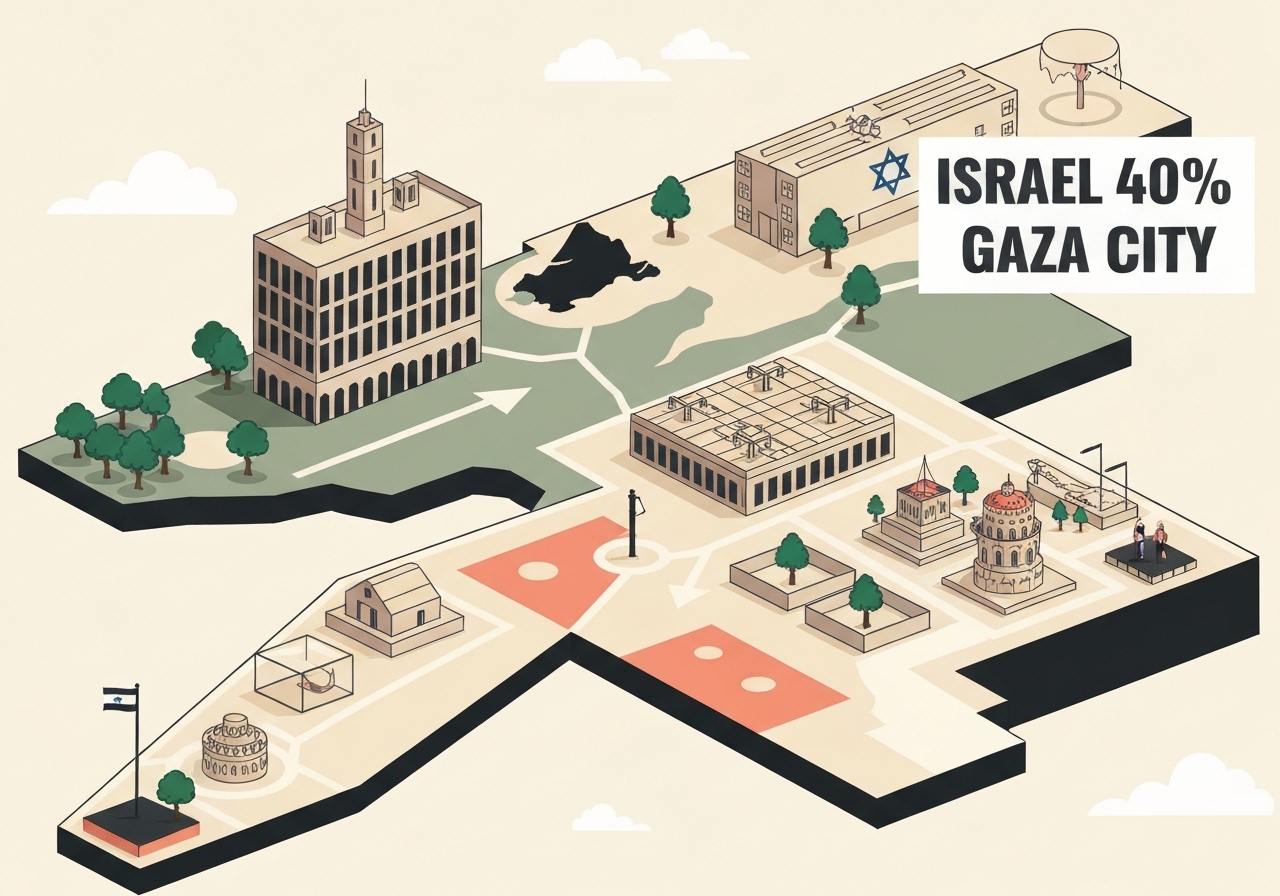
Israeli forces said on Sept. 4–5, 2025 that they held roughly 40% of Gaza City as they prepared a wider ground operation in the territory where hundreds of thousands of civilians are sheltering amid collapsed buildings and makeshift camps.
Key Takeaways
- The Israel Defense Forces (IDF) reported control of about 40% of Gaza City territory, citing operations in several neighborhoods.
- Neighborhoods named by the military include Zeitoun, Sheikh Radwan and Shuja’iyya.
- The IDF said soldiers recovered the bodies of 10 hostages near the city’s eastern outskirts.
- Families of hostages and rights groups warn a large-scale assault could endanger remaining captives and intensify civilian suffering.
- Since Oct. 7, 2023, roughly 1,200 people were killed in the attack on Israel and about 250 were taken hostage; Israeli officials estimate around 20 hostages in Gaza may still be alive.
- Local health authorities report more than 60,000 Palestinians killed in the conflict; international panels have warned of famine and collapsed infrastructure in parts of Gaza.
Verified Facts
The Israel Defense Forces publicly stated its forces control close to 40 percent of Gaza City and identified active operations in the eastern and northern residential districts, including Zeitoun, Sheikh Radwan and Shuja’iyya. The military said soldiers recovered 10 bodies of hostages in the eastern outskirts of the city.
Israeli officials have framed Gaza City as one of the last remaining Hamas strongholds in the Gaza Strip and announced plans to expand ground operations there. The IDF’s description of territorial control reflects battlefield claims by military spokespeople and has not been independently verified by third-party monitors inside the city.
Humanitarian organizations and U.N. agencies report that hundreds of thousands of civilians are sheltering in Gaza City in damaged buildings and tents, with limited access to food, safe water and medical care. Aid groups and a panel of global food experts have warned of famine conditions in parts of the territory.
Contextual figures: the Oct. 7, 2023 attack on Israel resulted in about 1,200 deaths and roughly 250 people taken hostage; since then, local health authorities in Gaza report more than 60,000 deaths in the territory. These counts are provided by the local health ministry, which does not separate civilian and combatant fatalities.
Context & Impact
A full-scale offensive on Gaza City — the territory’s largest urban center — risks displacing or trapping large numbers of civilians who have already moved multiple times since the conflict began 22 months ago. Repeated displacement has exhausted coping mechanisms and worsened shortages of food, water and medical supplies.
Military operations in dense urban areas typically generate high civilian harm, strained logistics for humanitarian relief, and damage to critical infrastructure. Humanitarian groups warn that such a campaign could deepen famine risks and further disrupt the delivery of aid.
Families of Israeli hostages have expressed concern that a major assault could put captives at greater risk. Rights groups and international legal experts stress that footage or statements from people held by armed groups are frequently produced under coercion and should be interpreted with caution.
- Immediate humanitarian effects: increased displacement, hospital overload, aid access restrictions.
- Security implications: potential for intensified urban combat and further civilian casualties.
Official Statements
The IDF described areas of Gaza City where its forces were operating and said they had located bodies of hostages outside the city core.
Brig. Gen. Effie Defrin, IDF spokesperson
Israel’s minister of national security criticized a recently released video of hostages as psychological pressure intended to affect military plans.
Itamar Ben-Gvir (social media post)
Unconfirmed
- The precise locations of all remaining hostages inside Gaza City are not independently verified.
- The breakdown of civilian versus combatant deaths in recent figures remains unclear; local counts do not make that distinction.
- Claims about the conditions and exact dates of video recordings released by Hamas are contested and may reflect coerced statements.
Bottom Line
The IDF’s assertion of control over roughly four in ten parts of Gaza City marks a significant development ahead of a broader operation, but it also raises urgent humanitarian and protection concerns. International agencies and families of hostages warn a major ground push could deepen the humanitarian catastrophe and endanger those still held captive.
Independent verification of battlefield claims and clearer access for neutral observers and aid organizations will be critical in assessing the human cost of any expanded offensive.