
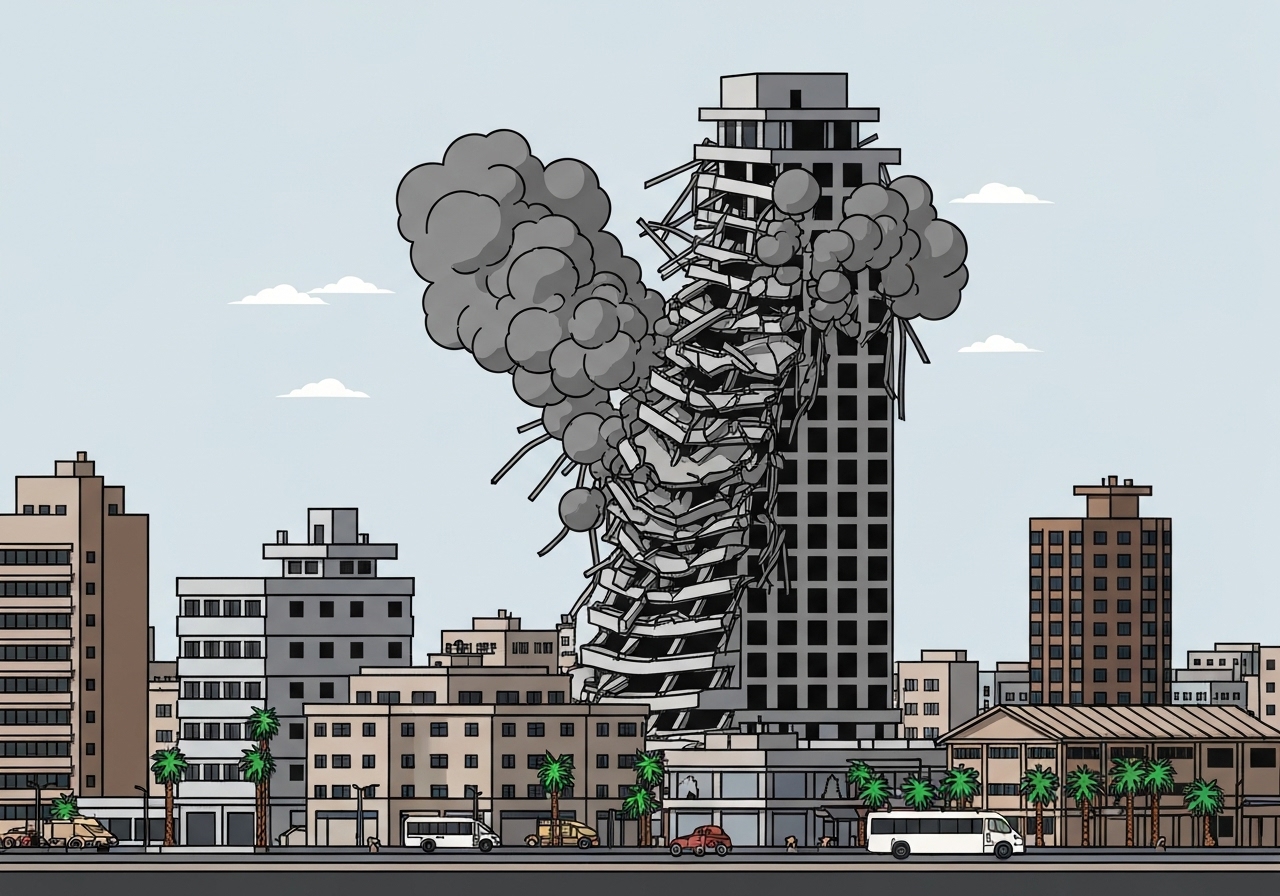
Lead: On 6 September 2025 Israeli forces struck and demolished the Sussi Tower in Gaza City — the second multi-storey tower to be brought down in two days — as operations in the city expand; it was unclear immediately whether the strike caused casualties.
Key Takeaways
- The Sussi Tower in Gaza City was destroyed by Israeli forces on 6 Sept 2025, following Friday’s demolition of the Mushtaha Tower.
- Israel says the building was used by Hamas; the group denies the claim.
- IDF says advance warnings and precise munitions were used; Palestinians and local agencies report displaced families and damage to residential areas.
- Israel urged civilians to move to al-Mawasi; the UN and aid groups call those sites overcrowded and unsafe.
- Witnesses reported five children killed while queuing for water in al-Mawasi; the IDF says the incident is under review.
- The UN has declared famine conditions in Gaza City and warns of a broader humanitarian disaster if operations continue.
Verified Facts
The Israeli military announced the Sussi Tower was struck and released footage showing the building collapsing. Defence Minister Israel Katz posted a short video on X accompanying the message, “We’re continuing,” after the demolition.
This is the second large tower to be destroyed in Gaza City in as many days. On Friday the Mushtaha Tower in the al‑Rimal neighbourhood collapsed following a major explosion at its base; social media footage circulated widely after that strike.
The IDF has said it took “precautionary measures to mitigate harm to civilians, including advance warnings” and has claimed the use of precise munitions. Palestinian officials and local civil defence dispute some of those assertions and say displaced families were sheltering in at least one of the targeted buildings.
Humanitarian agencies report that nearly one million people remain in Gaza City. The UN has declared famine in the area and warned that southern tent sites, including al‑Mawasi, are overcrowded and unable to meet medical and basic needs.
Context & Impact
High-rise residential and commercial towers have been a feature of Gaza City’s post‑Oslo urban growth since the early 1990s, accommodating returnees after 1994. The loss of these multi‑storey blocks erases not only housing but also local businesses and infrastructure.
Satellite imagery analysed by independent observers shows widespread destruction across several Gaza City neighbourhoods in recent weeks, including areas levelled by strikes and controlled demolitions. The removal of tall residential blocks compounds displacement and limits shelter options for thousands.
Clinics and hospitals in the south report they are overwhelmed. The UN and aid groups warn that continued large‑scale operations, coupled with constrained access to food, water and medical care, raise the risk of increased civilian casualties and deeper humanitarian collapse.
“Join the thousands of people who have already gone” to al‑Mawasi, said Avichay Adraee, the IDF Arabic‑language spokesman, urging civilians to relocate to the south.
IDF spokesman Avichay Adraee (social post)
Unconfirmed
- Exact casualty numbers from the Sussi Tower strike have not been independently verified at the time of reporting.
- IDF claims that the Sussi Tower was in operational use by Hamas remain denied by the group and have not been independently corroborated.
- The circumstances of the strike that killed five children in al‑Mawasi are the subject of an IDF review; witness accounts and forensic details are still being examined.
Bottom Line
The demolition of the Sussi Tower marks an escalation in urban operations in Gaza City, with immediate humanitarian consequences for displaced civilians and strained services in the south. Independent verification of military claims and casualty figures remains limited; aid agencies warn that continued large‑scale strikes heighten the risk of a deepening crisis.
Sources
- BBC News coverage
- United Nations / UN OCHA reporting
- Israel Defense Forces (IDF) social posts
- World Health Organization – reporting on health facilities