
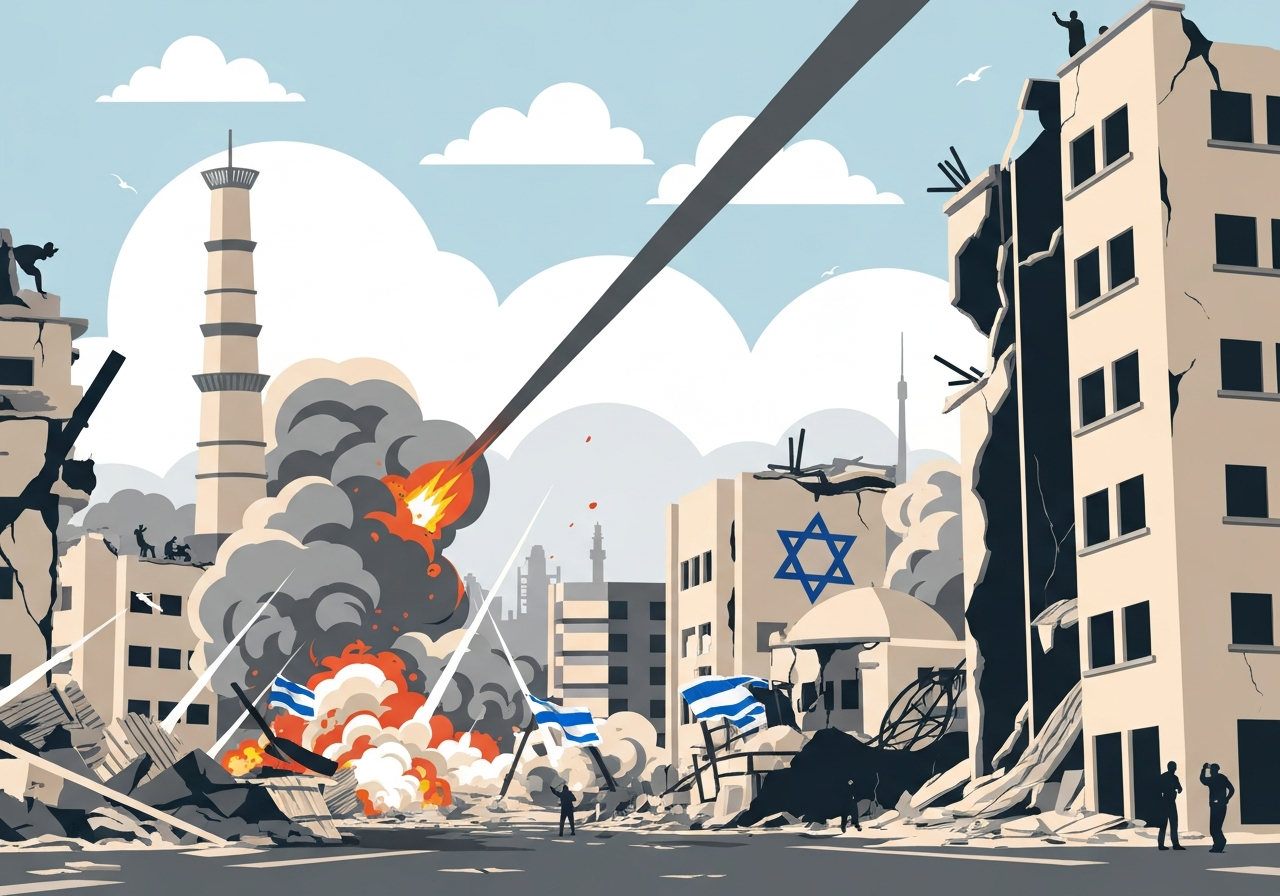
Lead: On March 6, 2026, amid a week of escalating U.S.-Israeli operations, Israeli forces announced fresh air strikes on Tehran and Beirut while Iran continued missile and drone attacks across the Gulf. Governments from the UAE to Kuwait and Qatar reported large numbers of incoming projectiles and extensive interception activity, and the UAE said several civilians were killed and more than 100 injured. President Trump said the campaign’s objective is to “go in and clean out” elements of Iran’s leadership, a remark that underscores the operation’s political as well as military aims. International bodies and regional states warned of mounting humanitarian harm and urged investigations and restraint.
Key takeaways
- Israel announced strikes on both Tehran and Beirut on March 6, 2026, saying dozens of aircraft hit regime and Hezbollah targets in the two capitals.
- The UAE reported tracking 205 ballistic missiles (190 destroyed, 13 falling into the sea, 2 impacting UAE territory) and detecting 1,184 drones (1,110 intercepted, 74 falling on UAE soil); eight cruise missiles were also destroyed, per the UAE Ministry of Defense.
- The UAE said three foreign nationals (Pakistani, Nepali and Bangladeshi) were killed and at least 112 people suffered minor injuries from earlier Iranian strikes in the country.
- Iran claimed it launched a “large volume” of attack drones at U.S. positions in Kuwait and elsewhere; Kuwait reported sirens in its capital following those claims.
- Israeli forces said they struck what they described as an underground command bunker in Tehran associated with the late Supreme Leader Ayatollah Ali Khamenei and that ~50 Israeli fighter jets participated in the mission.
- The Israel Defense Forces and U.S. officials asserted that more than 80% of Iran’s air defenses have been degraded, while Iran continued to launch missiles and drones at regional targets.
- Diplomatic channels showed signs of activity: Iran’s president suggested some countries had begun mediation efforts, but senior Iranian commanders signaled no appetite for a ceasefire.
- The United Nations demanded probes into Israeli strikes in Lebanon and warned that mass displacement orders risk violating international law.
Background
The conflict expanded rapidly after joint U.S.-Israeli strikes began on Feb. 28, 2026, a campaign officials say targeted Iran’s missile and drone production and other military infrastructure. Washington and Tel Aviv have described the operation as focused on degrading Iran’s offensive capabilities and preventing future attacks on U.S. forces and regional partners. Iran has responded with waves of missile and drone launches across the Gulf and directly at Israel, prompting extensive air-defense activity by Gulf states and NATO partners.
Hezbollah in Lebanon and other proxy networks have also been drawn into the fighting, particularly in southern Lebanon and Beirut’s Dahieh district, where Israeli forces reported strikes on command sites and launch facilities. The fighting has produced large-scale displacement inside Lebanon, with U.N. officials warning that evacuation orders affecting more than 100 towns and villages may amount to unlawful forced displacement under international law. Regional capitals, including Kuwait, Qatar, Saudi Arabia and the UAE, have repeatedly reported intercepting incoming projectiles, straining regional air-defense inventories.
Main event
On March 6, Israel’s military announced a new “wave of strikes” against what it called regime infrastructure in Tehran and multiple targets in Beirut, including senior Hezbollah operatives and weapons storage. The Israeli statement described an operation in Tehran involving approximately 50 fighter jets guided by precise intelligence and claimed the destruction of an underground bunker used by Iran’s former Supreme Leader. The IDF released video material it said showed the operation.
Separately, the UAE’s Ministry of Defense issued detailed tallies of incoming threats: 205 ballistic missiles tracked (190 destroyed), 1,184 drones detected (1,110 intercepted), and eight cruise missiles destroyed. The ministry reiterated readiness to defend sovereign territory and said earlier strikes had killed three foreign nationals and injured at least 112 people. Qatar and Saudi Arabia likewise reported intercepting multiple Iranian projectiles, including an attempted strike on Al Udeid Air Base in Doha.
Iranian military statements claimed concentrated drone strikes against U.S. bases in Kuwait and continued launches at Israel. Kuwait reported sirens in Kuwait City after Iran’s announcement. U.S. and Israeli officials said the bulk of incoming munitions were being intercepted, though independent data cited by analysts show the conflict has already resulted in civilian casualties and some weapons getting through Israel’s defenses.
Analysis & implications
The dual campaigns against Iran and Hezbollah signal an effort by the U.S. and Israel to degrade both Tehran’s long-range strike capability and its regional networks simultaneously. If Israel’s claim that more than 80% of Iran’s air defenses have been disabled is accurate, it would significantly reduce Tehran’s ability to blunt future air operations—but that claim remains operationally sensitive and partly unverifiable from open sources.
For Gulf states and U.S. forces in the region the immediate problem is attrition of interceptors and missile-defense stocks. Two regional officials told reporters that Gulf allies are running low on interceptors; if depletion continues, the risk to bases, infrastructure and civilian areas will rise and could force greater reliance on partner nations or NATO assets. NATO has already boosted its ballistic-missile-defense posture after an attempted strike toward Turkey.
The humanitarian consequences are also acute. Mass evacuation orders inside Lebanon affect hundreds of thousands and create urgent needs for shelter, food and medical care. The U.N. demand for investigations into the lawfulness of strikes and forced displacements could create international pressure for ceasefire talks or targeted accountability measures, especially if civilian harm continues to mount.
Comparison & data
| Category | Tracked/Detected | Destroyed/Intercepted | Other outcomes |
|---|---|---|---|
| Ballistic missiles (UAE report) | 205 | 190 destroyed | 13 fell into sea; 2 impacted UAE |
| Drones (UAE report) | 1,184 detected | 1,110 intercepted | 74 fell on UAE soil |
| Cruise missiles (UAE report) | 8 detected | 8 destroyed | — |
The table above summarizes the UAE Ministry of Defense’s public counts. These figures, provided via official statements and social media, indicate high volumes of incoming threats and correspondingly high interception rates, though they also show that dozens of weapons have fallen inside UAE territory. Comparing these counts with reported casualties highlights the continuing risk to civilians and infrastructure even when interception rates are elevated. Analysts caution that official tallies often change as post-strike assessments are completed.
Reactions & quotes
U.N. human-rights officials quickly called for probes into the legality of strikes and evacuations in Lebanon and warned of civilian suffering. Their statement frames the question of compliance with international humanitarian law and the threshold for forced displacement allegations.
“The devastating impact of this renewed conflict is already before our eyes, with civilians paying a painfully heavy price.”
Ravina Shamdasani, U.N. human-rights office spokeswoman
U.S. and Israeli leaders have publicly defended the campaign’s aims while acknowledging it could take time to reach objectives. President Trump’s direct language about removing Iran’s leadership has drawn attention because it blends military goals with explicit political intent.
“We want to go in and clean out everything.”
President Donald Trump, in an interview with NBC News
The Israel Defense Forces described a targeted mission in Tehran and characterized its effect on Iranian command-and-control. The IDF framed the operation as precision-guided and intended to degrade the regime’s ability to coordinate further attacks.
“Targeting the bunker further degrades the regime’s command and control capabilities.”
Israel Defense Forces (official statement)
Unconfirmed
- Claims that Ayatollah Ali Khamenei was killed during the Feb. 28 strikes are reported by Israeli military sources but lack independent verification from neutral observers at this time.
- Iran’s assertion that its drones “hit U.S. positions” in Kuwait is a military claim; Kuwaiti and U.S. authorities have not publicly corroborated damage to specific U.S. facilities beyond prior reporting of earlier incidents.
- Precise percentages for the destruction of Iran’s air defenses (e.g., “more than 80%”) are operational assessments released by Israeli or U.S. officials and are subject to change pending further verification.
Bottom line
The conflict has entered a more dangerous phase in which strikes on capitals, high-volume drone and missile launches, and public declarations about regime removal raise the risk of wider regional escalation. High interception rates have so far blunted many attacks, but attrition of defensive stocks and several reported impacts on territory mean risk to civilians and bases remains real.
Key things to monitor in the coming days: independent verification of major leadership-casualty claims, the state of Gulf allies’ interceptor inventories, progress (if any) in third-party mediation efforts, and U.N. or international responses to mass displacement and strike patterns in Lebanon. Accurate, independent assessments will be crucial for policymakers and the public as the situation evolves.