
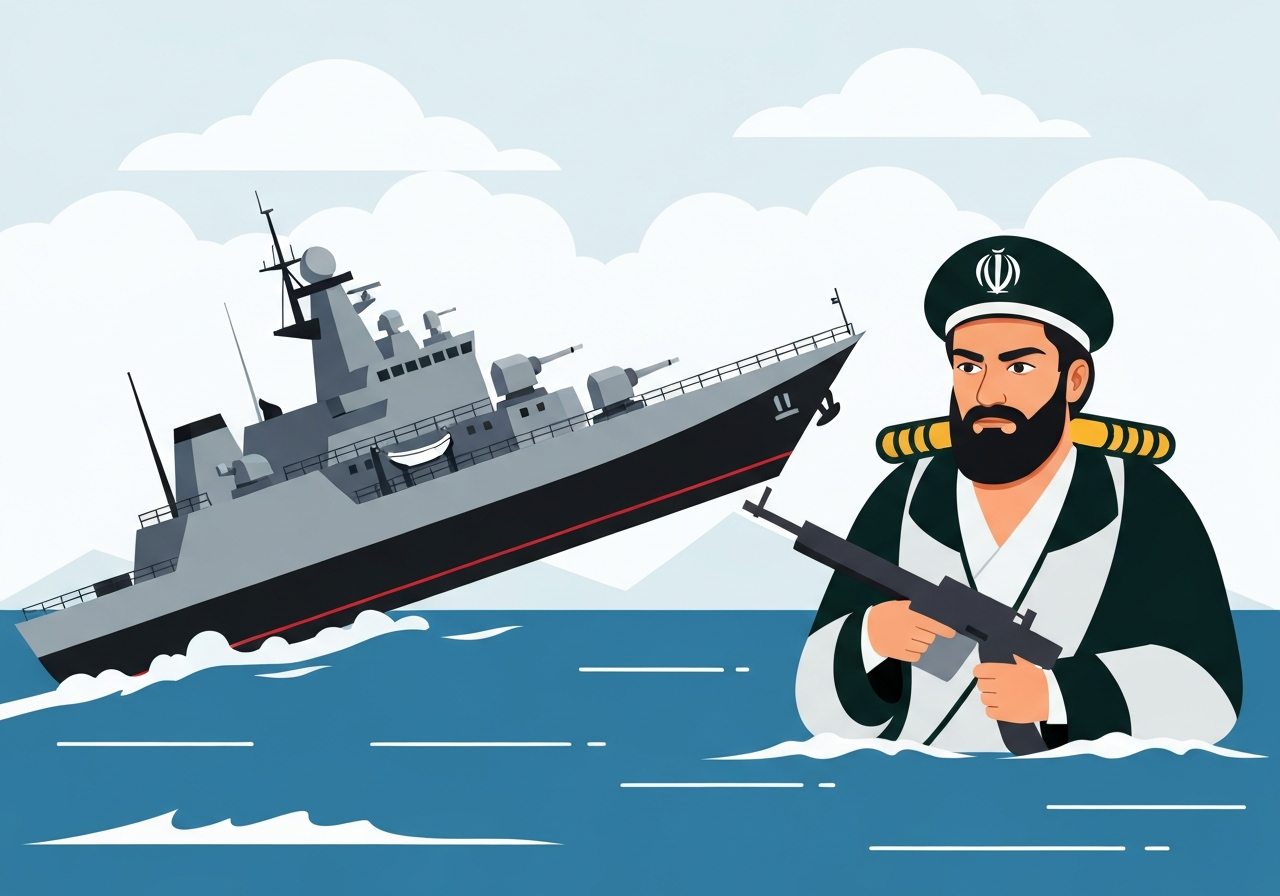
Israel announced on March 26, 2026, that Alireza Tangsiri, commander of Iran’s Islamic Revolutionary Guard Corps (IRGC) Navy, was killed in an operation the Israeli defense minister said targeted the officer responsible for mining and blocking the Strait of Hormuz. The claim comes amid a larger exchange of strikes between Israel and Iran that has spread across the Gulf, killed civilians in Abu Dhabi and driven fresh deployments of US forces to the region. Washington and Islamabad are reported to be working backchannels toward a Pakistan-hosted meeting as diplomats race to find an off‑ramp. Immediate effects include renewed disruption to shipping and another spike in energy and market anxiety.
Key Takeaways
- Alireza Tangsiri: Israel’s defense minister publicly named and said it eliminated the IRGC Navy commander tied to mining and an effective blockade of the Strait of Hormuz.
- Kharg Island: Iranian forces have been repositioning on Kharg, which handles roughly 90% of Iran’s crude exports, amid US concerns about a potential seizure operation.
- US force posture: Approximately 50,000 US troops were already in the Middle East; the Army’s 82nd Airborne has more than 1,000 soldiers preparing to deploy and multiple Marine Expeditionary Units (ARG-MEUs) of roughly 4,500 personnel each have been rerouted.
- Regional casualties: Falling debris from an intercepted ballistic missile in Abu Dhabi killed two people and injured three, authorities said; fighting and strikes have also caused civilian deaths in Israel and Lebanon.
- Energy and markets: Brent crude rose to about $106 a barrel as markets priced heightened supply risk; AAA reported a near-flat US pump price of $3.981 per gallon, down marginally from $3.983.
- Diplomacy: Pakistan confirmed delivering a 15‑point US proposal to Tehran as intermediaries explore an off‑ramp; Islamabad and other regional actors are reported to be engaged in shuttle diplomacy.
Background
The Strait of Hormuz is a strategic choke point through which about 20% of global oil transits; before the recent fighting, Lloyd’s List estimated roughly 100 commercial transits a day. Over recent weeks Iran’s IRGC Navy, under commanders including Alireza Tangsiri, moved to restrict passages and deploy mines and other measures that reduced commercial traffic to a fraction of normal levels. Iran and Israel have been trading strikes since the outbreak of the current war, with the United States providing support to Israel and reinforcing regional forces to protect shipping lanes and allied states.
Kharg Island, off Iran’s southern coast, is central to Tehran’s oil exports and refining system; analysts warn any ground operation there would sharply escalate the conflict. At the same time, several Gulf states and extra‑regional powers have been drawn in politically and militarily, complicating prospects for a negotiated settlement. Diplomats from Pakistan, Turkey and Egypt have reported activity to mediate, even as battlefield events continue to reshape bargaining positions.
Main Event
On March 26, Israel’s defense minister said the Israeli Defense Forces (IDF) had eliminated Alireza Tangsiri, identifying him as the IRGC Navy commander largely responsible for mining operations and the near‑total blockade of the Strait of Hormuz. Two Israeli sources had earlier told reporters that Tangsiri was killed; as of this report Iranian authorities had not publicly confirmed or denied the claim. The IDF framed the operation as both a direct blow against Iran’s maritime interdiction campaign and a signal to US partners about Israel’s role in reopening access to the strait.
The announcement coincided with a wave of strikes and intercepts across the region. Falling debris from an intercepted missile struck Abu Dhabi, killing two and injuring three, while reports say fragments and debris fell in central Israel. Israeli officials reported strikes on infrastructure inside Iran; Iran has acknowledged strikes on its territory and circulated warnings about ground invasions of Kharg Island. Independent verification of specific strike locations and attribution remains limited in several cases.
US military posture has shifted in response. CENTCOM and Pentagon sources say roughly 50,000 US troops were already present in the region and additional formations are being readied: the Army’s 82nd Airborne Division is preparing more than 1,000 soldiers, and two Marine Expeditionary Units tied to the Boxer and Tripoli Amphibious Ready Groups have been rerouted and accelerated. Officials stress these movements are intended to deter further escalation and protect sea lanes, but they also raise the prospect of increased direct US involvement if ground operations are ordered.
Analysis & Implications
The reported assassination of a senior IRGC naval commander represents a tactical shift with strategic consequences. Removing a figure closely associated with the Hormuz blockade could temporarily blunt Iran’s maritime interdiction capabilities, but it also risks prompting retaliatory attacks by Iran or its proxies across multiple theaters. Command decapitation has in past conflicts degraded some operational capabilities while accelerating asymmetric responses, including missile, drone and proxy attacks on partners in the Gulf and Levant.
Energy markets reacted immediately: Brent crude rose toward $106 a barrel as traders priced a higher risk premium for supply disruptions. Because global gasoline and oil prices are set in an integrated market, even limited interruptions in exports from Iran—home to terminals and facilities concentrated on Kharg Island—can amplify price swings and feed inflationary pressures already noted by the OECD. Even small pump‑price changes in the US lag upstream market moves, and spikes would directly affect inflation forecasts and consumer sentiment.
Diplomatically, the timing complicates fragile shuttle talks. Pakistan’s role as intermediary and the delivery of a 15‑point proposal reflect an active search for a negotiated off‑ramp; yet the removal of a senior Iranian commander and concurrent strikes make face‑to‑face diplomacy harder and could stiffen domestic audiences in Tehran against concessions. In the US, congressional unease about an open‑ended war—expressed by some House Republicans questioning future funding—may constrain White House options for expanding ground operations.
Comparison & Data
| Metric | Approx. Pre‑War | Recent/Current |
|---|---|---|
| Commercial transits through Strait of Hormuz | ~100 ships/day | Only a handful/day (Lloyd’s List) |
| US troops in region | Baseline force levels | ~50,000 already present; +1,000 (82nd Airborne) en route |
| Marine Expeditionary Units | Deployed as scheduled | 11th and 31st MEUs accelerated (~4,500 personnel each) |
| Brent crude | Varied; recent levels near $100 | ~$106/bbl (rise after escalation) |
| US pump price (AAA) | $3.983/gal (previous) | $3.981/gal (small fall) |
| Reported fatalities in Lebanon since Mar 2 | — | 1,094 (Lebanon Health Ministry) |
The table clarifies what has shifted: shipping activity has been compressed sharply, US forces have been reinforced, and energy benchmarks moved higher. These changes illustrate both the kinetic impact of the conflict and the economic second‑order effects that ripple into global inflation and growth forecasts.
Reactions & Quotes
The Israeli defense minister framed the action in operational and diplomatic terms:
“The IDF has eliminated the commander of the IRGC Navy — directly responsible for the terrorist operation of mining and blocking the Strait of Hormuz.”
Israeli Defense Ministry
Israel presented the strike as a measure to restore regional freedom of navigation and as a message to partners. Officials emphasized coordination with allies on broader strategy, even as they declined to discuss specific future targets.
US President Donald Trump expressed impatience with Iran’s negotiating posture while signaling that diplomacy remains in play:
“They better get serious soon, before it is too late, because once that happens, there is NO TURNING BACK.”
US President (public post)
The White House has said indirect talks continue and that US officials are arranging meetings in Pakistan; yet presidential rhetoric underscores the political pressure to secure a quick resolution while keeping military options visible. Tehran has so far been skeptical about US proposals and has highlighted intermediated exchanges rather than direct bilateral talks.
An Iranian army commander warned of the costs of any ground invasion of Kharg:
“A ground war will be more dangerous and costly for the enemy.”
Brig. Gen. Ali Jahanshahi (IR Army)
Iranian statements emphasize readiness to resist a seaborne or airborne assault on Kharg and foreshadow asymmetric responses if core energy infrastructure is targeted.
Unconfirmed
- Iran has not publicly confirmed Tangsiri’s death; independent verification of the targeted strike remains pending.
- Reports that Israeli forces had removed coordinates for Iran’s foreign minister and parliamentary speaker from target lists after Pakistani warnings are based on Reuters sourcing and have not been independently verified.
- Accounts that US forces will imminently attempt to seize Kharg Island are reported in intelligence‑sourced briefings but lack formal public confirmation; operational plans could change quickly.
Bottom Line
The reported killing of Alireza Tangsiri, if confirmed, removes a prominent IRGC naval figure and may temporarily degrade Iran’s ability to interdict shipping in the Strait of Hormuz. Yet such an action also raises the probability of reciprocal strikes and broader escalation, including attacks by Iran’s regional proxies and further strikes on energy infrastructure.
Near term, expect continued volatility in energy markets, sustained US and allied naval presence in the Gulf, and intensified diplomatic shuttle activity centered on Pakistan and other intermediaries. Key watch points are Iranian official confirmation or retaliation, the stability of shipping through Hormuz, and whether Congress in Washington alters funding posture in response to expanding troop commitments.
Sources
- CNN (news) — live reporting and on‑the‑ground updates
- Reuters (news) — reporting on Pakistan mediation and target list claims
- US Central Command (official) — force posture and incident statements
- Organisation for Economic Co‑operation and Development (intergovernmental) — inflation and growth forecasts
- Lloyd’s List (maritime intelligence) — shipping transit estimates
- ISNA / Mehr (Iranian media, semi‑official) — statements from Iranian commanders