
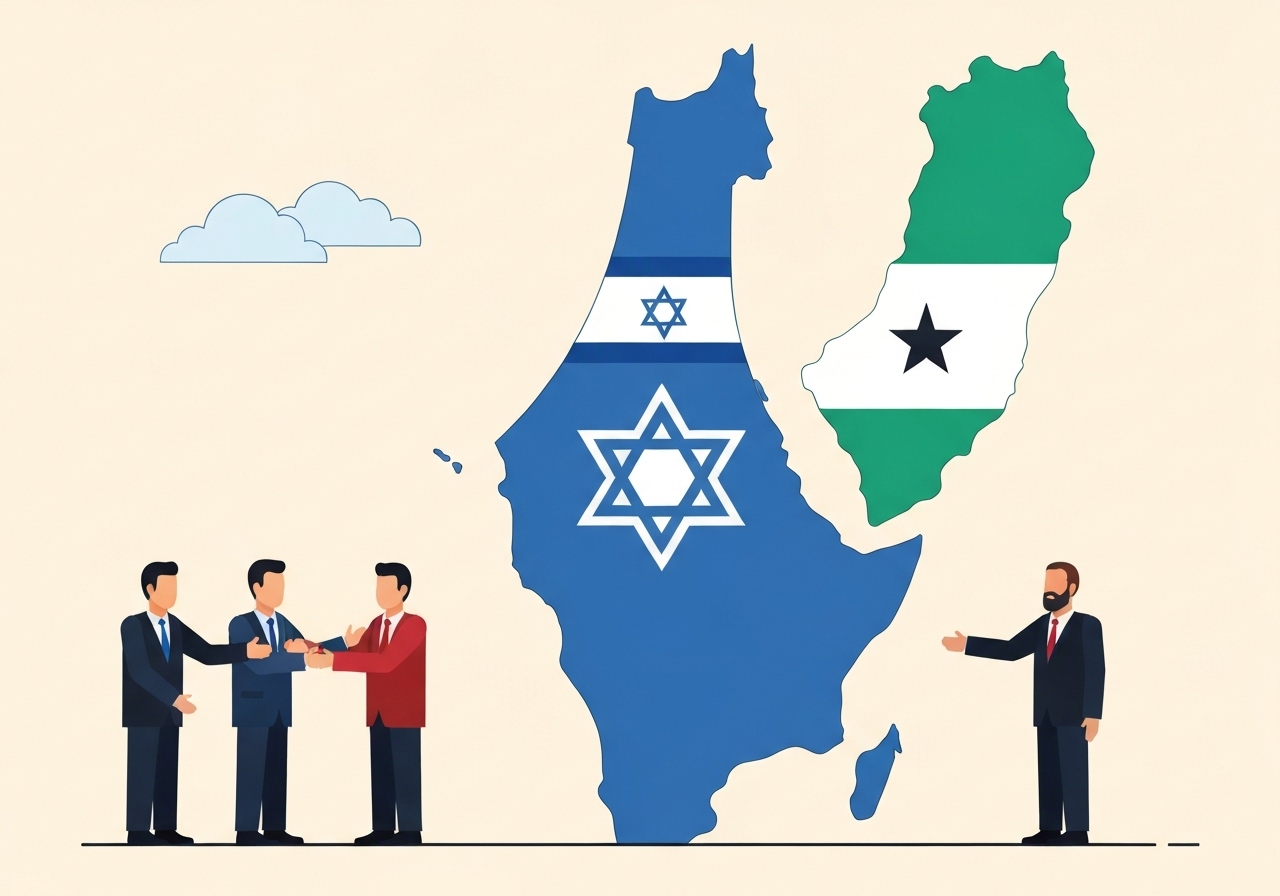
Lead: On 26 December 2025 Israel formally recognised Somaliland as an independent state and signed an agreement to establish full diplomatic relations, including the exchange of ambassadors and plans to open embassies. The declaration, announced by Israeli foreign minister Gideon Sa’ar, follows decades of Somaliland’s unilateral independence claim after 1991 and represents the first bilateral recognition by a UN member state. Somaliland’s president Abdirahman Mohamed Abdullahi welcomed the move by video call with prime minister Benjamin Netanyahu. The decision has already prompted sharp regional pushback and raised strategic questions about security in the Red Sea and Horn of Africa.
Key Takeaways
- Israel announced recognition on 26 December 2025 and signed a pact to establish full diplomatic ties, including ambassadors and embassies.
- Somaliland declared independence from Somalia in 1991 and until now had received no recognition from UN member states; its population is about 6.2 million.
- Israel framed the declaration as aligned with the spirit of the Abraham Accords, and Netanyahu invited Somaliland’s president to visit Jerusalem.
- Egypt and Turkey publicly condemned the move as interference in Somalia’s internal affairs and tied it to broader regional politics.
- Analysts and an Institute for National Security Studies (INSS) report have argued Somaliland’s location near Yemen could offer operational value for monitoring or logistics related to the Houthi conflict.
- The United Arab Emirates already operates a military facility at Berbera in Somaliland; the base includes a port and airstrip used in regional operations.
- Washington appears divided over recognition: officials worry about impacts on security cooperation in Somalia, where the US supports operations against al-Shabaab.
- Political currents in the US — including Project 2025 and congressional pushes — have urged recognition as a counter to growing Chinese influence in Djibouti.
Background
Somaliland separated from Somalia in 1991 after the collapse of Somalia’s central government and has since functioned as a de facto state with its own institutions, currency and security forces. It controls the north-western tip of the Somali peninsula, borders Djibouti to the north-west and Ethiopia to the west and south, and sits across the Bab el-Mandeb strait from Yemen. Despite holding multiparty elections and peaceful transfers of power, Somaliland has not secured recognition from any UN member states until Israel’s December 2025 decision.
Efforts to gain recognition have been shaped by both local governance outcomes and great-power competition in the Horn of Africa. The region is strategically vital for international maritime routes and has drawn sustained interest from Gulf states, China and Western powers. External security partnerships—such as the UAE presence in Berbera—have both boosted Somaliland’s capacity and complicated its diplomatic standing with Mogadishu and neighbouring states.
Main Event
On 26 December 2025 Gideon Sa’ar announced that Israel and Somaliland had signed an agreement to formalise diplomatic relations. Israeli officials said the arrangement foresees opening embassies and appointing ambassadors; Sa’ar instructed the foreign ministry to begin immediate institutional work to implement the pact. The Israeli prime minister’s office posted a video of Benjamin Netanyahu speaking by video call with Somaliland president Abdirahman Mohamed Abdullahi; Netanyahu invited Abdullahi to visit Israel and described the new ties as historic.
Abdullahi responded positively, telling Israeli media he would be “glad to be in Jerusalem as soon as possible,” and framed recognition as a long-sought vindication of Somaliland’s statehood claim. The announcement follows roughly a year of confidential talks, Israeli officials said, and comes amid broader diplomatic momentum stemming from the Abraham Accords normalization process that began in 2020. Sa’ar and other Israeli figures portrayed the move as strengthening bilateral cooperation and regional stability from their perspective.
The declaration prompted immediate diplomatic backlash: Egypt and Turkey issued a joint condemnation, accusing Israel of meddling in Somalia’s domestic affairs and linking the move to wider regional tensions over Palestinian statehood and territorial influence. Analysts also highlighted potential security motivations behind Israel’s decision, pointing to Somaliland’s location opposite Yemen and its existing military facilities used by external partners.
Analysis & Implications
Geostrategically, Israel’s recognition of Somaliland recalibrates influence in a corridor that controls approaches to the Red Sea and Suez Canal. For Israel, access to ports and air facilities on the Horn of Africa could enhance intelligence collection and logistical reach related to operations and monitoring in Yemen and the broader Gulf of Aden. Israeli analysts and a November report from the Institute for National Security Studies argued Somaliland’s territory could serve as a forward operating location for surveillance and support against Houthi activity, though operational details remain sensitive.
For Somaliland, formal recognition by a UN member state is a diplomatic milestone that may strengthen its push for wider acceptance, attract investment and deepen security ties with partners. But recognition also increases exposure to regional contestation: Egypt and Turkey’s condemnation signals risks of diplomatic isolation from key neighbours and potential economic or security pushback. Mogadishu, which views Somaliland as an integral part of Somalia, is likely to denounce the move and could seek countermeasures through regional bodies.
The decision complicates Washington’s calculus. US forces operate in the region supporting Somali counterterrorism efforts; some US officials reportedly fear recognition could harm military cooperation with Somalia and destabilise fragile partnerships. At the same time, congressional and policy strands in the US—cited by advocates for recognition—frame Somaliland as a strategic partner against growing Chinese influence in Djibouti and the Horn. The net effect will depend on whether other states follow Israel’s lead and how Washington chooses to balance security interests with diplomatic norms.
Comparison & Data
| Item | Somaliland | Recognised Somalia (Federal) |
|---|---|---|
| Declared independence | 1991 | 1960 (independence, UN member) |
| UN recognition | None until 26 Dec 2025 (Israel) | UN member state |
| Population (approx.) | 6.2 million | Over 17 million (Somalia overall) |
| Foreign military presence | UAE base at Berbera | Foreign troops operate in Somalia regionally/internationally |
The table above contrasts Somaliland’s de facto status with the internationally recognised Somali state and highlights why political recognition matters: legal status affects access to treaties, development aid, and international courts. Somaliland’s institutional stability on some domestic measures has been stronger than parts of Somalia, yet its lack of formal recognition has limited international finance, trade agreements and multilateral participation.
Reactions & Quotes
The following reflect official and expert responses and the contexts in which they were made.
“This is a historic friendship — I look forward to hosting Somaliland’s president in Jerusalem,”
Benjamin Netanyahu, Israeli prime minister (office statement)
Netanyahu framed the recognition as a diplomatic breakthrough linked to Israel’s broader normalization push. The prime minister’s office released a video of the exchange and emphasised shared strategic interests.
“We welcome recognition and are ready to deepen relations with all partners,”
Abdirahman Mohamed Abdullahi, president of Somaliland (video call)
Abdullahi described recognition as the culmination of Somaliland’s long campaign for statehood and signalled readiness to expand diplomatic, economic and security ties.
“This initiative constitutes interference in Somalia’s domestic affairs and aligns with expansionist policies,”
Joint statement from Egypt and Turkey (diplomatic communique)
Egypt and Turkey presented a coordinated diplomatic response condemning the recognition and warning of negative consequences for regional stability and Palestinian statehood diplomacy.
Unconfirmed
- Whether Israel will permit permanent military basing or extensive operational deployments in Somaliland remains unspecified and is not confirmed by independent sources.
- Reports that the INSS assessment directly determined an Israeli operational plan are interpretive; public reports describe possibilities rather than confirmed military commitments.
- The scale and timing of possible follow-on recognitions by other states — including the United States — are not confirmed and depend on ongoing diplomatic deliberations.
- Allegations that Project 2025 directly dictated US policy on Somaliland are contested; links between the project’s recommendations and later administration actions are subject to further verification.
Bottom Line
Israel’s recognition of Somaliland on 26 December 2025 is the first of its kind and marks a significant diplomatic milestone for a territory that has sought statehood since 1991. The formalisation of ties opens political and economic opportunities for Somaliland but also escalates regional diplomatic tensions, particularly with Egypt, Turkey and Somalia. Practically, the move adds a new vector to competing interests in the Horn of Africa, where strategic access to the Red Sea and proximity to Yemen drive security calculations.
How this decision reshapes regional alignments depends on three variables: whether other states follow Israel’s lead, how Mogadishu and regional organisations respond, and how external powers—especially the United States and Gulf actors—adjust security and aid relationships. For readers, the key watchpoints are immediate diplomatic reactions, any changes in military posture around Berbera, and signals from Washington about its policy toward Somaliland and Somalia.
Sources
- The Guardian (international press report)
- Institute for National Security Studies (INSS) (Israeli think tank)
- Freedom House (international NGO; governance and rights assessments)
- Prime Minister’s Office, Israel (official government site)